

The first time my doctor asked me to check my blood pressure at home, I did what I always do when I do not know something. I wrote it on an index card, put the card in my purse, and thought about it the whole drive back to Lawton. My readings in her office had been running high, and she wanted me to check twice a day for a few weeks and bring the numbers in. Not a diagnosis. Not a change to anything. Just a record. That was the whole assignment, and I still managed to make it complicated for about a month.
Here is what I got wrong first. I bought a little wrist cuff because it fit in a drawer, and I never trusted it. The numbers bounced around so much that I stopped writing them down, which defeated the entire purpose. Then a friend at church, who has been checking hers for years, told me to get an upper arm monitor and stop guessing. That is how the A&D Medical UA-767F ended up in our kitchen. It is an upper arm monitor with a wide range cuff, and the box holds the monitor, the cuff, the manual, and the battery.
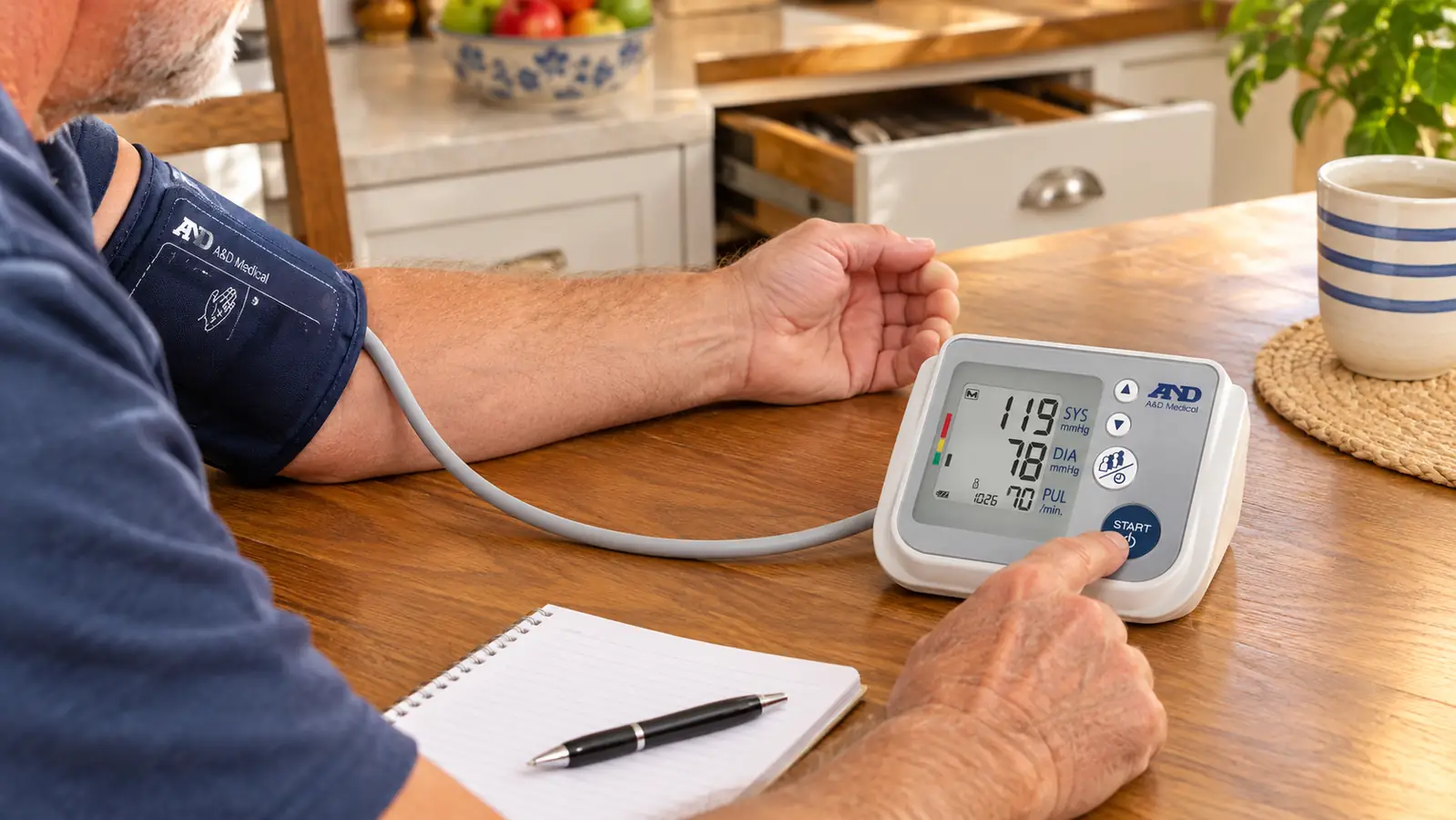
What I did not want was a machine with a lot of buttons. I spent thirty years counting other people's money at a bank window, so I am comfortable with a keyboard. I am not comfortable with a medical device that wants me to set a dozen preferences before it will tell me a number. The UA-767F from A&D Medical is one button. You put the cuff on, you press it, you wait. That is the entire operation, and I mean that as a compliment.
Gene is seventy and checks his too, so the monitor had to work for two people without a fight over whose turn it is and whose numbers are whose. This one is built for up to four users, which is more than the two of us need, and the readings stay separated by user. He checks in the evening, I check in the morning, and neither of us has to write a note on the box to keep it straight. The cuff fits both of us. It is listed at eight point six to sixteen point five inches, and my arm and his arm both land inside that range without a wrestling match.
The first morning I used it, I sat at the kitchen table with my feet flat on the floor and my arm resting on the table the way the manual shows. The cuff went on above the elbow and tightened, and then the screen filled with numbers big enough that I did not have to hunt for my glasses. That sounds like a small thing. It is not a small thing when you are sixty-seven and checking in a hurry before your coffee.
I am not a nurse. I am a woman with a kitchen table, an index card, and a machine that gives me one number and then stays out of my way.
The Monitor That Made Two Weeks of Logging Feel Like Nothing
One button, one cuff, oversized numbers on the screen. The A&D Medical UA-767F is the upper arm monitor that finally got me writing my readings down instead of avoiding them.
Amazon Check Today's Price on Amazon →Two weeks turned into two months, and then it turned into a habit. The monitor lives in the drawer beside the silverware. I check before coffee and again in the evening, and I write the numbers on a pad of paper with the date and the time. Nobody asked me to make it a routine. It just became one, the way the crossword became one. When I go to my appointment, I tear off the pages and hand them over. My doctor reads them and we talk about what she sees. That part is hers to do, not mine.

One thing I did not expect was how little I would think about the power. It runs on a battery, so there is no cord to plug in and no outlet to fight over, which matters in a kitchen with exactly one free socket behind the toaster. I have not had to fuss with it since the day I put the battery in. The warranty is five years limited in the USA, which I noticed only after I bought it, and it made me feel better about spending money on something I did not fully understand yet.
The cuff in the box is the wide range one, and A&D Medical also sells small, medium, and large cuffs separately if that range does not suit your arm. This is worth knowing before you order, because a cuff that does not fit is the reason a lot of people end up with numbers they cannot use and then quit. I measured my arm with a cloth tape before I ordered, wrote the number on that same index card, and checked it against the range on the box.
I will say the plain thing here. This monitor tells you a number. It does not tell you what the number means, and it does not stand in for the person in the white coat who went to school for it. If a reading worries you, write it down and call. Do not sit at the table at six in the morning deciding things on your own. I have done that, and it never once helped.
The other thing I would say is that consistency matters more than the machine. Same time, same chair, same arm on the table, feet flat. My readings still move around a little, because I am a person and not a spreadsheet. But they move around in a way my doctor can actually read, and that is the whole point of doing this at home instead of guessing in a waiting room.
What I'd Tell You If We Were Sitting at My Kitchen Table
I would tell you to measure your arm before you buy anything, because the cuff is the part that has to fit and the part most people skip. I would tell you to check twice a day and write it down even when the number is not what you hoped, especially then. I would tell you that one button is worth more than ten features you will never use, and that a monitor in a drawer you actually open beats a fancier one in a closet. And I would tell you to bring the paper to your doctor and let her do her job. That is what I do now. It has made the whole business a good deal less frightening than that index card in my purse.
One Button, One Number, and a Pad of Paper for Your Doctor
If your doctor has asked you to check at home, start with a cuff that fits and a routine you will keep. The A&D Medical UA-767F has been sitting in our kitchen drawer for months, and it has not given me a reason to move it.
Amazon See the A&D Medical UA-767F on Amazon →