

Six months ago Gene and I came home from my doctor's office with a note scribbled on the back of an envelope: check your blood pressure at home, twice a day, for three weeks, and bring me the numbers. That envelope sat on the kitchen counter for two days. I am 67 years old and I spent 31 years behind a teller window counting other people's money, so I am not helpless, but a blood pressure cuff felt like something a nurse should be doing. Not me. Not at my own table.
The Omron Bronze is the monitor we ended up with. It lives in the kitchen drawer now, next to the pens and the takeout menus, and it has been there through months of morning and evening readings. What follows is not a clinical report. It is what I noticed after using it twice a day, and what I would tell a friend if she sat down at my table and asked me straight whether it was worth the trouble.
The Quick Verdict
A plain upper-arm monitor with a cuff wide enough for bigger arms. Runs on four AA batteries, no app to manage, and the numbers are yours to write down.
Amazon Check Today's Price →The monitor that ended up in our kitchen drawer
Upper arm cuff fits 9 to 17 inches, so two people can share one unit. Runs on four AA batteries. Hypertension and irregular heartbeat indicators show up right beside your reading.
Amazon Check Today's Price on Amazon →How I've Used It
My routine has not changed since the first week. Morning, before coffee, I sit at the kitchen table with my feet flat on the floor. I roll up my left sleeve, slide the cuff onto my bare arm so the bottom edge sits about an inch above the bend of my elbow, and rest that arm on the table. Then I press the button and the cuff fills. It goes quiet, and the numbers come up on the screen.
It takes about a minute from sitting down to having the numbers in front of me. The cuff opens to 17 inches, so Gene can use it right after me without either of us fighting with the strap. He is 70 and his arms are a good deal bigger than mine. Mine sit near the small end of the range and it still closes down snug. For two people sharing one machine, that range is the whole ballgame.
We measured before we bought, using a cloth tape out of my sewing basket, and I wrote both numbers on the same envelope the doctor's note was on. Mine came out just under 10 inches around. Gene's came out at 16. That is a six-inch spread between two people sharing one machine, and it is the reason I stopped shopping around. A monitor that fits one of us and pinches the other is a monitor we would have quit using by the second week.
I write my numbers in a small spiral notebook. Date, time, both figures. My doctor asked for a written log and I did not argue with her. The monitor keeps recent readings, so if I forget the notebook I can flip back through them and copy them down later, but paper is what actually gets carried into the exam room and set on her desk.
The first week was a mess and I want to say that plainly, because I nearly gave up on it. I took readings over a thin sleeve. I took one right after carrying groceries in. I took three in a row trying to get a nicer number. All of that is wasted effort. The machine was doing its job. I was the unreliable part.
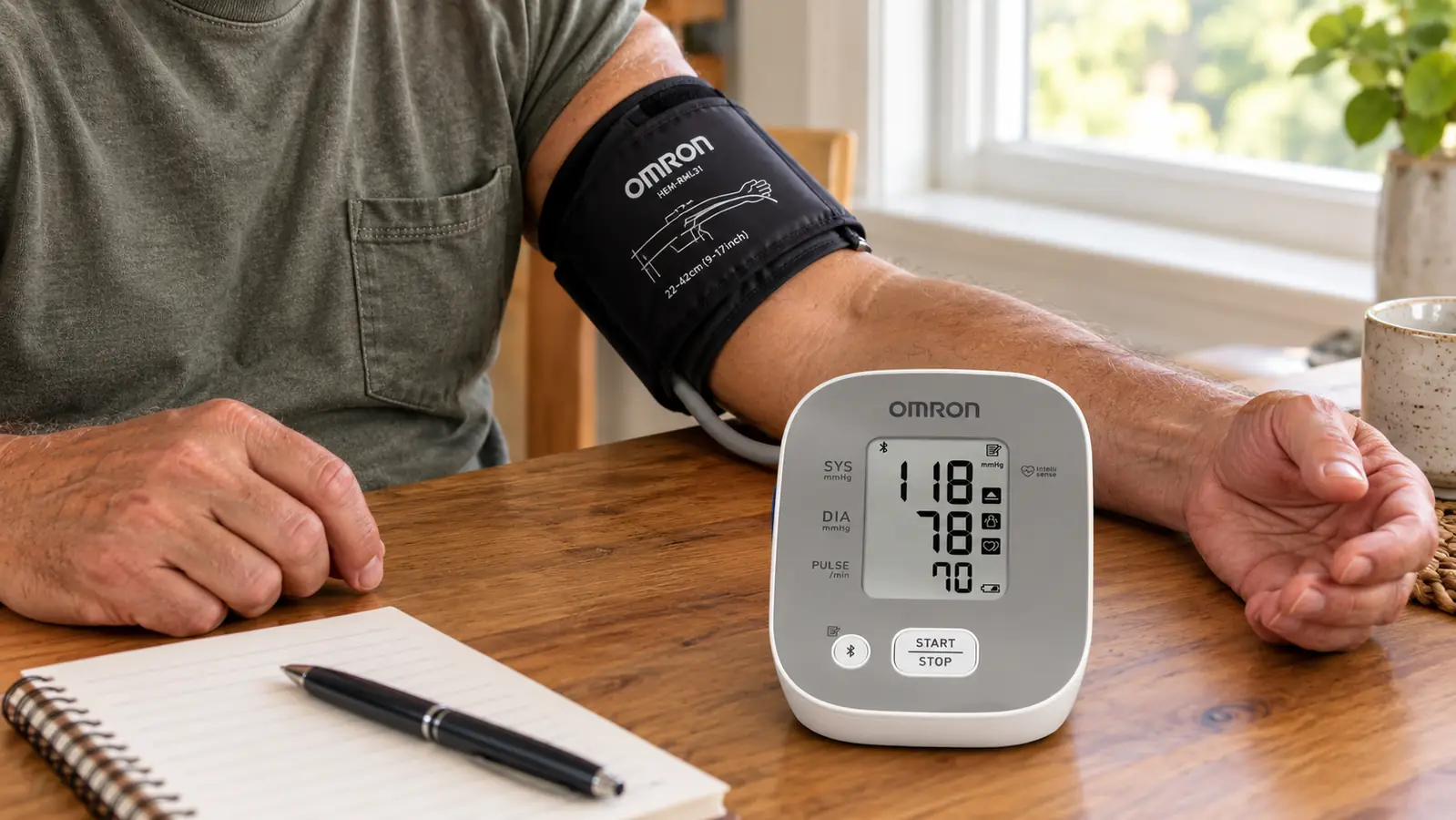
The Cuff Range Is the Whole Reason We Bought It
If you take one thing from this, take this: look at the cuff range before you look at anything else. A cuff that is too tight on a big arm and a cuff that is too loose on a small arm can both throw a reading off, and no amount of careful sitting will fix a fit problem.
The Omron Bronze ships with a 9 to 17 inch cuff and no other sizes to sort through. That was the deciding factor for us. Gene's arm measures right around 16 inches, and most of the units I looked at online stopped at 14 or 15. We would have been buying a monitor we could not use on the person who needed it most, and I would not have known that until the box was already open.
The other thing I got wrong at first is that the cuff goes on bare skin. I tried it over a shirt sleeve for the first several days because I did not want to be rolling up in front of Gene at breakfast. The readings were all over the place. Bare arm, arm at heart height, feet flat, no talking. That is the routine that gave numbers consistent enough to hand to a doctor.
There was a Tuesday in the first week when I took a reading over my cardigan, then one on bare skin two minutes later out of plain curiosity, and the two numbers were far enough apart that I sat there staring at the screen. I do not know which one was right. I only know that one of them was not worth writing down, and I stopped doing it the easy way.
If your arm falls outside 9 to 17 inches, this is not the monitor for you, and I would rather tell you that now than have you find out the way I almost did. Fit first. Everything else is second.
What the Hypertension and Irregular Heartbeat Indicators Actually Do
Two things show up on the screen besides the numbers. The first is a hypertension indicator that alerts you when a reading lands in the elevated range. It does not tell you what to do about it. It is a marker, like a small flag saying that this one was higher than the ones before it.
The second is an irregular heartbeat indicator. It notes when your heartbeat is not steady during the measurement. The first time it appeared on mine I did the wrong thing, which was to sit there and take six more readings in a row trying to make it go away. That is not how it works, and I knew better by the second time. I wrote down the date and time, mentioned it at my next visit, and let my doctor decide what it meant.
I want to be plain about this because I had to be plain with myself. This machine does not diagnose anything. It measures, and it flags. Everything past that belongs to your doctor. What the monitor does is give her something to look at that came out of my own kitchen over weeks, instead of one tense morning in an exam room where my numbers always run high.
That is the part I did not expect to matter so much. Gene and I compare our notebooks on Sunday evenings, not to compete, just to see whether the week looked like the week before. Two retired people at a kitchen table with two spiral notebooks is not much of a health program, but it is ours, and it started with a note on an envelope.
Four AA Batteries, No App, No Charging Cable
The Omron Bronze runs on four AA batteries. That is the entire power story. No charging cable to lose, no app to set up, no pairing, no phone. It measures 5.5 by 3.3 by 4.3 inches and weighs about 1.2 pounds, which means it fits in a kitchen drawer and would fit in a carry bag if we went to visit our grandchildren for a week. The screen is a plain LCD with dark figures on a light background, large enough that I can read it without hunting for my glasses.
Batteries were a worry of mine. I have owned enough small devices that quietly died to be suspicious of anything that runs on AAs. We are months in on the original set and the screen has not faded, and it has not asked for new ones. When it does, it is four batteries out of the junk drawer, not a proprietary cable ordered from somewhere and waited on for a week.
The one thing I check now and then is the battery marker on the screen. So far it has not moved enough to notice. When the day comes that the figures look faint, I will swap all four at once rather than mixing old and new, which is what the little paper sheet in the box suggests and what my father always did with the flashlight in the truck.
The trade-off is that nothing is automatic. There is no app recording your readings for you and no reminder telling you it is time to sit down. If you want a log, you write a log. I happen to think that is fine, because writing the numbers down is the part that made me pay attention to them, but if you know you will not keep a notebook, be honest with yourself about that before you buy.

What Months of Twice-Daily Readings Taught Me
The first week of numbers was noise. My mornings and my evenings did not look like they came from the same person, and I fussed about it. Then I noticed the pattern was not in the numbers, it was in the routine. On mornings I took a reading after coffee and after a long phone call with my sister, the numbers were higher. On mornings I sat down first thing, calm, feet flat, they were steadier.
There was one Wednesday in February that I still think about. I had slept badly, skipped my walk because of ice on the sidewalk, and taken a call from the insurance company about a claim. My evening reading that night was the highest I had written down in weeks. Nothing was wrong with me and nothing was wrong with the machine. It was just a hard day, written down honestly, which is exactly what the notebook is for.
The second thing I learned is that a single reading tells you almost nothing. Two readings a day for three weeks is 42 readings. That is a record a doctor can actually look at, and it is 42 more than I had before. I brought the notebook in, she flipped through the pages, and we had a different conversation than we had ever had with one number taken in a hurry at the start of a visit.
The third thing is smaller but real. Once the machine was in the drawer and the routine was set, I stopped dreading it. It takes a minute. There is no production to it. That matters more than any feature on the box, because a monitor you avoid is a monitor that does nothing for you, no matter how good it is.
What I Liked
- Cuff fits 9 to 17 inches, so a bigger arm and a smaller arm can share one monitor
- Runs on four AA batteries, with no cable to lose and no app to manage
- Hypertension and irregular heartbeat indicators show up right beside the reading
- Plain LCD screen with figures large enough to read without glasses
- Compact and light enough to keep in a kitchen drawer or pack for a trip
Where It Falls Short
- You keep your own log. Nothing here writes the numbers down for you.
- One cuff size in the box, 9 to 17 inches, with no alternative if you fall outside it
- Cuff goes on bare skin, and the first week of readings will be messy while you learn the routine
- Nothing on the screen tells you the cuff was wrapped badly, so a sloppy placement looks the same as a good one
- No reminders of any kind, so the habit is entirely yours to build
Two readings a day for three weeks is 42 readings. That is 42 pieces of paper my doctor could actually look at, and 42 more than I had before.
Who This Is For
This is for the person who got the same note on the back of an envelope that I did. Your doctor wants home readings, and you need a machine that does the job without becoming a project you have to maintain. It suits a couple sharing one monitor, especially if one of you has a bigger arm, because that 9 to 17 inch cuff covers both of you with room to spare.
It also suits anyone who does not want another app on their phone. If you are comfortable with a notebook and a pen, and the idea of pairing a device and syncing it sounds like more trouble than it is worth, this is the least fussy monitor I have used. Set it on the table, press the button, write the number down, put it away. The routine does not change from one day to the next, which sounds like a small thing until you have tried to remember a five-step sequence at six in the morning before your coffee.
Who Should Skip It
If your arm measures outside 9 to 17 inches, skip it. Not because the machine is bad, but because the cuff is the part that has to fit, and there is no second size in the box. Measure your upper arm with a cloth tape before you order anything, mine came out of my sewing basket.
If you know yourself well enough to know you will not write the numbers down, and you want something that records and organizes readings for you, look at a different model. This one measures and it stores recent readings, but the log is your job. And if you want a monitor that will nudge you, remind you, or tell you what your numbers mean, this is not that. It measures. Your doctor interprets. That is the deal, and I would not want it any other way, but you should know it going in.
A minute in the morning, a minute at night, and a log to bring in
Omron Bronze upper arm monitor with a 9 to 17 inch cuff. Four AA batteries, hypertension and irregular heartbeat indicators, and a screen you can read without your glasses. Bring your readings to your doctor.
Amazon Check Today's Price on Amazon →