
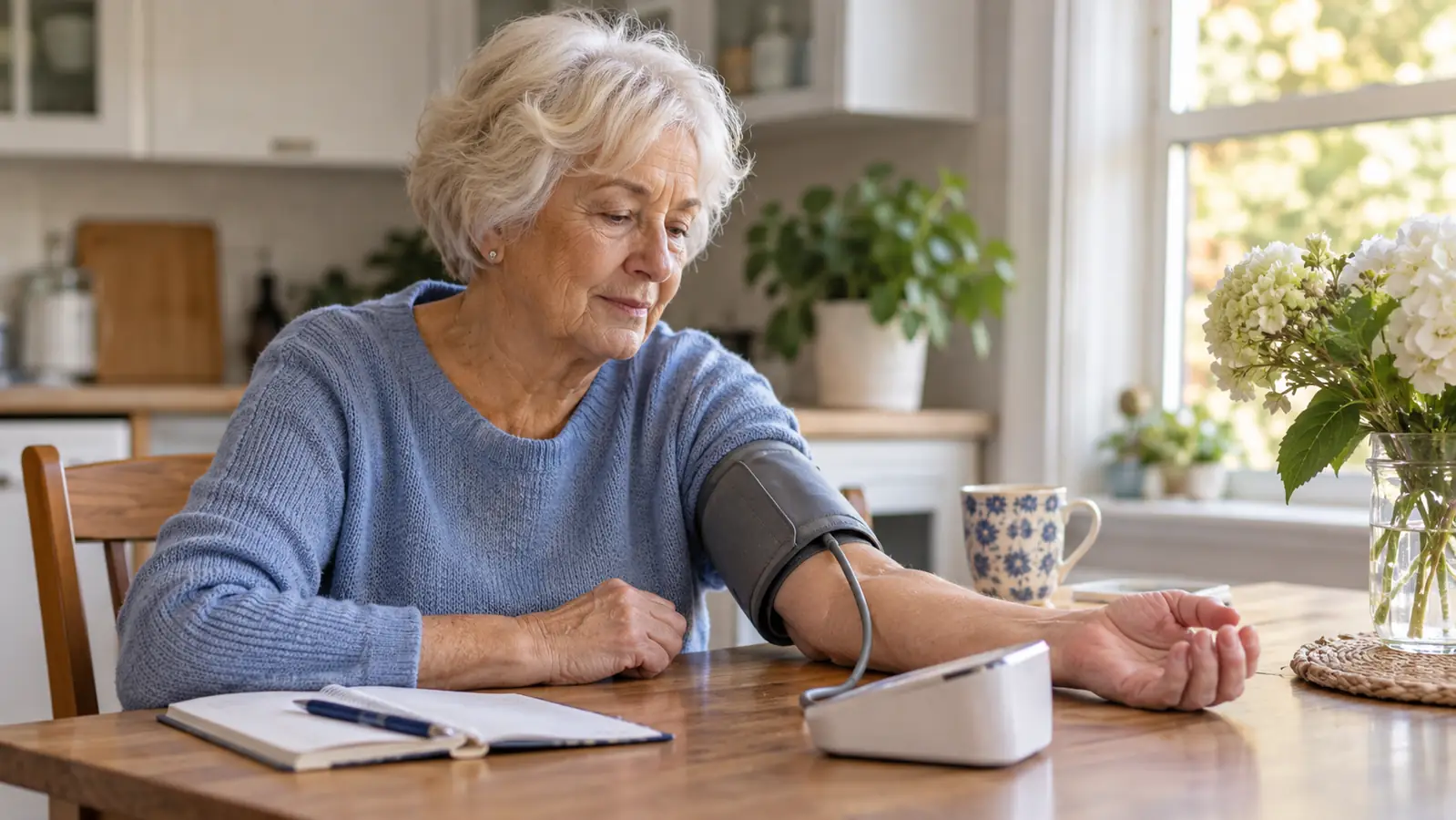
My doctor's office is where this started, and I want to be straight about that. Every time I sat in that chair my numbers came back higher than they do anywhere else, and after the third visit my doctor said one reading in an office is one reading. She asked me to check at home twice a day for a few weeks and bring the log in. That is the entire reason I own a blood pressure monitor. Not because I wanted another gadget in the house.
I bought the A&D Medical UA-767F after giving up on a different monitor that squeezed my arm so hard I flinched every time the cuff went tight. I have used this one twice a day, most days, ever since. What follows is the version of the review I wish somebody had handed me in the store aisle: what the cuff really fits, what the one button does and does not do, and the handful of things about it that still get on my nerves.
The Quick Verdict
A plain upper arm monitor that does one job without asking you to learn anything. Wide cuff, big numbers on the screen, five year warranty. No app and no way to send a reading anywhere, so the log is a paper notebook and a pen. That suited me. It will not suit everybody.
Amazon Check Today's Price →If your doctor asked for home readings, this is the plain version that gets it done
One button, a cuff sized 8.6 to 16.5 inches, and oversized numbers on the screen. No app to set up and no account to create. Measure your arm before you order.
Amazon Check Today's Price on Amazon →How I've Used It, and What My Mornings Look Like Now
The routine is the same every day. I sit at the kitchen table before my coffee, both feet flat on the floor, and I rest my left forearm on the table so the cuff sits near heart height. I wrap the cuff around my upper arm, press the one button, and sit still while it does its work. Then I write the number in a small notebook with the date and whether it was morning or evening. Gene and I do the same thing again before supper. That is it. The monitor lives in the kitchen drawer between uses and it has been there long enough that I no longer think about it.
Gene is seventy and his arm is a good deal bigger around than mine. That was my first real worry when the box arrived, because a cuff that does not fit is a cuff that gives you a wrong number and no warning. The band on this one is sized 8.6 to 16.5 inches, which is a wider range than the first monitor I bought, and both of us are comfortably inside it. He sits toward the upper end and I sit toward the lower end and neither of us has had to fight to get it closed around the arm.
One thing I will say plainly, because nobody told me: the cuff does not care how you feel about it. If I sit down worked up about something and take a reading, the reading reflects that. If I let my arm hang down at my side instead of resting it on the table, the number comes out different. The machine is consistent. My technique was not, at first. It took me about two weeks of writing down what I had done wrong before my own numbers started to look steady.
What Nobody Tells You About Cuff Size
Almost every review of every home monitor talks about accuracy first, and almost none of them start with the cuff. That is backwards. The cuff is the part touching your body and it is the part that can be the wrong size in your own home without anybody noticing. Before you buy anything, take a soft tape measure and go all the way around your upper arm at the middle, halfway between the shoulder and the elbow, with the arm relaxed. Write that number down. That number decides which monitor you can use.
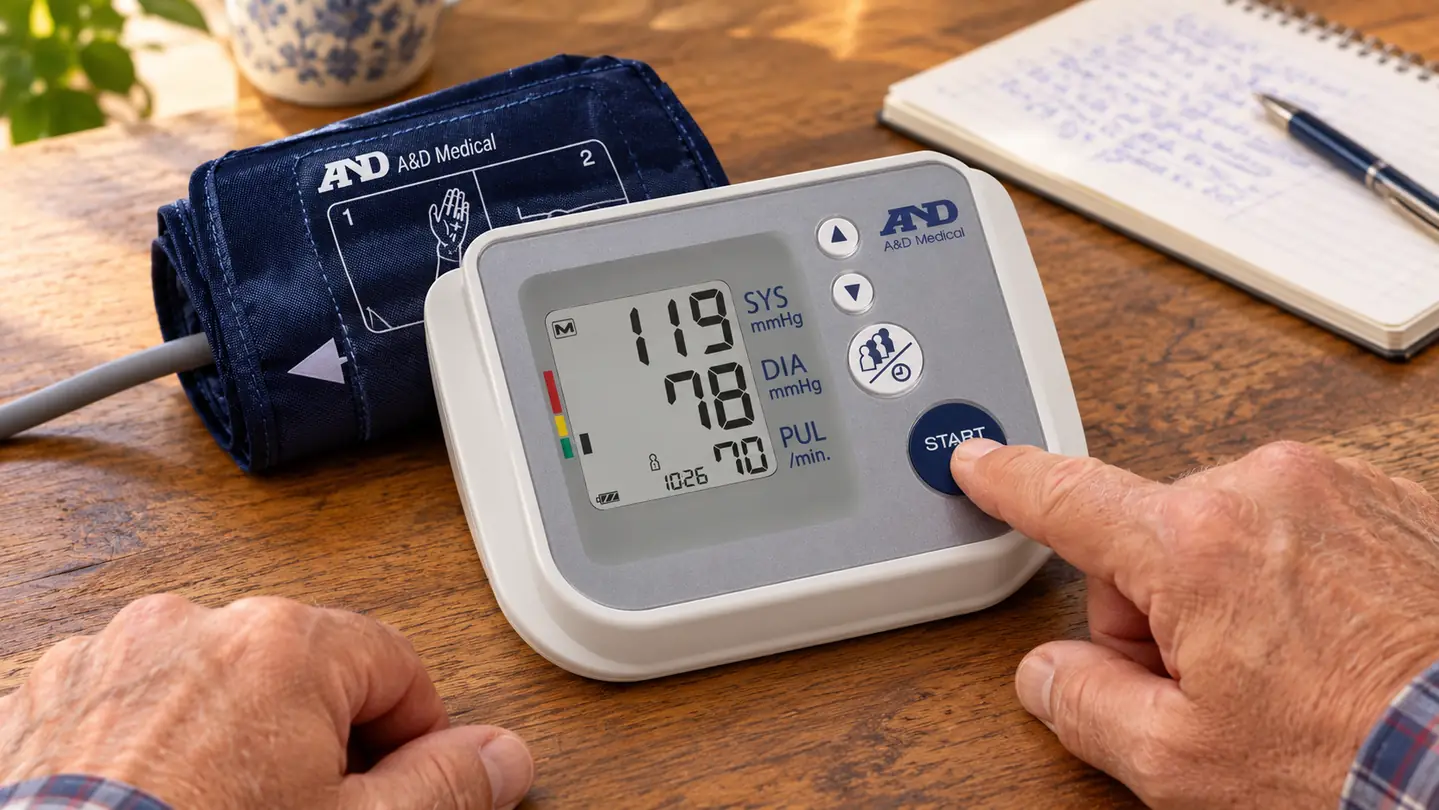
The 8.6 to 16.5 inch band on the A&D Medical UA-767F covers most adults. If your arm measures over 16.5 inches, this cuff is not the one, and no amount of careful sitting will fix it. A&D Medical sells separate cuffs for the same monitor, including the UA-289A small cuff from 6.3 to 9.4 inches and the UA-290A medium cuff from 9.0 to 14.6 inches, which tells you they expect people to match the cuff to the arm rather than the other way around. I would much rather know that in the store than after three weeks of numbers I could not trust.
There is a second thing I had to learn, and it is not on any listing. It is an upper arm cuff, so you are seated at a table with a sleeve rolled up, not standing in a doorway or perched on the edge of a couch with your arm in the air. That is not a flaw. It just means that if you are looking for something you can slap on in thirty seconds on your way out the door, this is not that. It is a sit down, put your feet flat, do it properly kind of device.
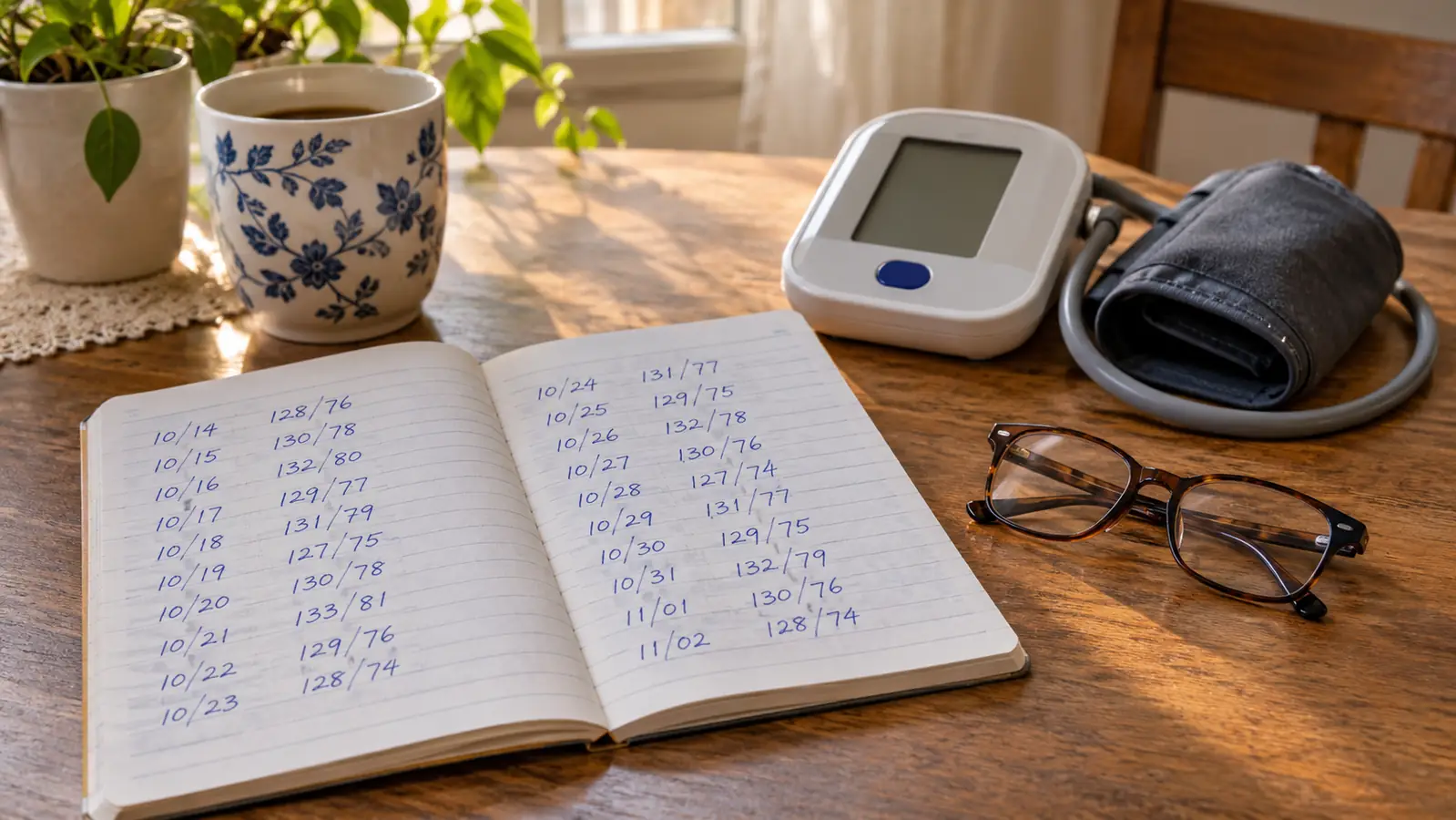
Two readings a day, dated, in a notebook, for three weeks. That paper log is what my doctor actually read. The monitor only supplied the numbers.
The One Button Is the Whole Point
The operation is a single button. You press it, the cuff fills, the machine does its work, and the number shows up on a large screen with oversized digits. That is the entire interface. There is no menu to page through and no mode to select at six in the morning before I have had my coffee. For a person who did not grow up with this equipment, that is worth more than any feature list printed on a box.
The screen is the part Gene likes. He takes his glasses off to read it, which he cannot do with his phone, and the numbers are big enough that he does not have to squint or hold the thing at arm's length. Small thing. It comes up every single day, twice a day, and it stops being small after the first week.
It also handles more than one person. The listing says four users, and that matters in a house where two people both check. I keep my own notebook anyway, because the notebook is what goes to the doctor, but a household where two people share one machine will not have to buy two machines.
There is a small learning curve even so, but it is about the reading, not the button. The first week I got numbers that jumped around and I said unkind things about the machine. It was not the machine. I was talking while it ran, or I had my legs crossed, or I took a reading ninety seconds after carrying a laundry basket down the hall. Once I started sitting quietly for five minutes first, the readings settled into a pattern I could hand to my doctor without apologizing for it.
What I Do Not Like
There is no app, no wireless connection, and no way to send a reading anywhere. I want to be clear that this is not a hidden flaw, it is the design. The number appears on the screen and that is the end of the conversation. If you want a chart of your last ninety days on your phone, this monitor will not give it to you. You will be writing numbers in a notebook like I do, or typing them into a spreadsheet yourself on a Sunday afternoon.
It runs on batteries. That is fine until it is not, and mine went quiet one morning partway through a reading without any warning I noticed. Now there is a spare set in the kitchen drawer right next to the monitor, and I do not wait to be told twice. If you are the kind of person who forgets, put a reminder in your phone the day you unbox it.
The cuff tops out at 16.5 inches. I have already covered it once in this review and it belongs on the dislike list too, because a person with a large arm will buy this, get it home, and find out in the worst possible way, which is by trusting a number that was never going to be right. Measure first. It takes one minute and one soft tape.
And the last one is not the machine's fault at all. There is nothing here that tells you what the number means. It gives you a reading, not an opinion, and it should never be asked for one. I have had mornings where the number was not what I wanted and I had to put the pen down and walk away instead of taking it four more times until I got a better one. That temptation is on me, not on A&D Medical. A monitor that flatters you is worse than no monitor at all.
What I Liked
- One button, start to finish. Nothing to learn before your first reading.
- Cuff band sized 8.6 to 16.5 inches, wide enough that my husband and I use the same machine.
- Large screen with oversized numbers, readable without glasses.
- Handles up to four users in one household.
- Five year limited warranty in the USA.
- Battery powered, so there is no cord running across the kitchen table.
- Nine ounces and small enough to live in a kitchen drawer between readings.
Where It Falls Short
- No app, no wireless, no export. Paper log or nothing.
- Runs on batteries with no charging cord to fall back on.
- Cuff stops at 16.5 inches. Larger arms need a different cuff.
- It will not tell you what your numbers mean, and it should not.
- Upper arm cuff means sitting at a table with a sleeve rolled up, not a quick reading on the way out the door.
What Is in the Box, and What Is Not
The box holds the monitor unit, the wide range cuff, an instruction manual, and a battery. That is the list. There is no carrying case, no second cuff, no log book, and nothing that plugs into a wall. I say that plainly because the pictures online make it look like more than it is, and a person who opens the box expecting a case will be disappointed over something that has nothing to do with how well the thing measures.
What you do get is the manual, and I would read it once with a pen in your hand. The part worth folding the corner on is the page about wrapping the cuff, because that is where most home readings go wrong and it is the one page nobody reads. The rest is the usual. I marked my page, put the manual in the drawer with the monitor, and that five minutes of reading saved me three weeks of numbers I would have had to throw out.
How It Has Held Up
It has lived in a kitchen drawer, been knocked onto the floor once, and been used twice a day by two people. Nothing has cracked and nothing has stopped working. It is nine ounces and it does not feel like laboratory equipment, and I do not think it needs to feel that way. The warranty is five years limited in the USA, which is longer than I expected for something this size, and it was one of the reasons I picked this one instead of the cheapest thing on the shelf.
The only maintenance item is the batteries. There is no charging dock and no cord, so when they go, you are making a trip to the store or waiting on a delivery. I keep a spare set in the drawer with the notebook and I swap them on the first of the month whether or not the machine asks me to. That small habit has saved me two mornings where I would otherwise have sat down, wrapped the cuff, and gotten nothing for my trouble.
What I Actually Bring to My Doctor
The first time I brought in my log, my doctor flipped through three weeks of dated readings, asked me two questions about when I took them, and then talked to me about my actual pattern instead of one nervous number in a chair. That is the entire payoff. The monitor did not make a decision about my health and neither did I. It gave us something to look at together, which is a different thing from a diagnosis and a much more useful thing than a guess.
What made the log usable was boring consistency. Same chair, same arm, morning before coffee, evening before supper, date written in the margin. Two or three readings a week that are all taken the same way tell a doctor more than a dozen taken however you happened to be sitting. If you take nothing else from this honest review, take that part.
Who This Is For
This is for the person whose doctor asked for home readings and who wants to be done thinking about equipment. It is for a household where two people check and one monitor has to serve both of them. It is for anyone who would rather write a number in a notebook than learn an app, and for anyone who has stood in a kitchen at six in the morning and did not want to make one more decision before breakfast. It is also, frankly, for people our age who want the numbers big enough to read the first time without hunting for glasses.
It is a good fit if your arm measures inside that 8.6 to 16.5 inch range and you are willing to sit properly for a couple of minutes twice a day. The sitting properly part is the actual work. The machine is the easy half, and I say that as somebody who fought with the easy half for two weeks before it stopped fighting back.
Who Should Skip It
Skip it if you want your readings on your phone with a chart and a trend line. Skip it if you travel a great deal and want something that folds into a carry on, because an upper arm cuff plus a monitor plus a paper log is not that. Skip it if your upper arm measures over 16.5 inches and you do not want to order a separate cuff to go with it. And skip it if you already know in your heart that you will not write the numbers down, because the log is the only reason any of this matters in the first place.
One more honest note for the person who is on the fence. The monitor is not going to change your health. What it does is give you and your doctor a record of what your blood pressure does on an ordinary Tuesday in your own kitchen, which is something an office visit cannot give you no matter how good the office is. If you take the readings and bring them in, you have done the useful part. The machine just did the arithmetic.
Measure your arm first, then go look at the cuff range
If you land between 8.6 and 16.5 inches, this is a plain, dependable upper arm monitor with one button and a five year warranty. Take the readings to your doctor.
Amazon Check Today's Price on Amazon →