

My readings at the doctor's office always came in high. Not because something was wrong that day, but because I was sitting in a cold room in a paper gown waiting to hear something I did not want to hear. My doctor asked me to check at home twice a day for a few weeks and bring the log in. That is how a 67 year old retired bank teller in Lawton, Oklahoma ended up learning more about blood pressure cuffs than she ever wanted to know.
Gene, my husband, is 70 and checks his blood pressure too, so we share one machine and compare notes at the kitchen table. We did this the hard way first. I read reviews until my eyes crossed, bought something that did not fit my arm, and drove it back to the store. Then we settled on the Omron Bronze upper arm monitor. Months in, here are ten plain reasons it has earned its spot in the kitchen drawer.
The monitor that survived month six in my kitchen drawer
Upper arm cuff, four AA batteries, no phone involved. It does one job at my table twice a day and I write the numbers in a notebook.
Amazon Check Today's Price on Amazon →The cuff covers 9 to 17 inches, which is the number I got wrong first
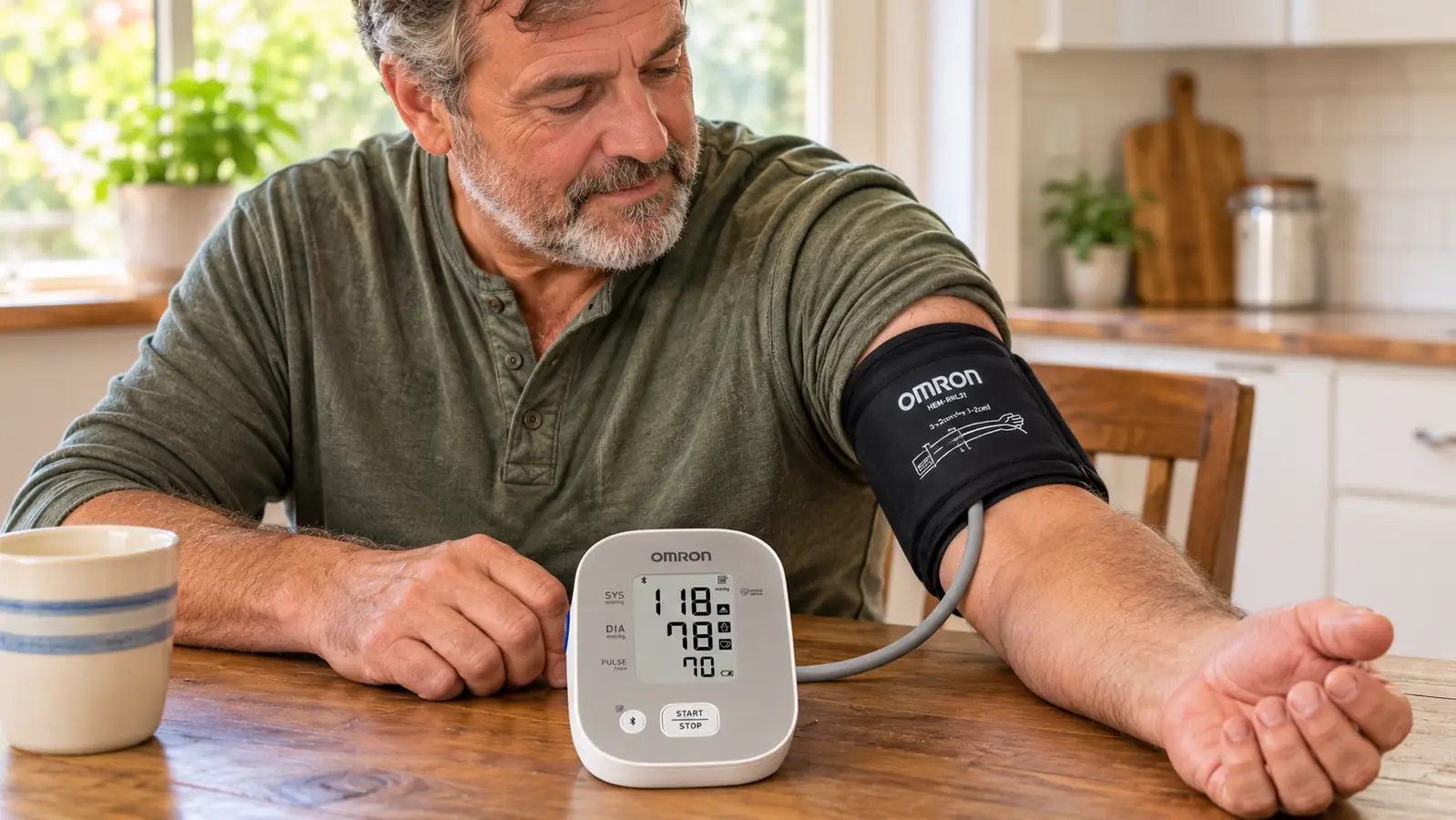
I bought a monitor once without measuring my arm, and I paid for that lesson. The Omron Bronze lists a 9 to 17 inch band, and that figure matters more than anything else on the box. The nurse measured my upper arm at the office and wrote it down for me. Gene's arm is bigger than mine and still falls inside the same range, which is why one machine works for two people in this house. If your arm measures outside that band, this is not your monitor, no matter how good the rest of it is.
Four AA batteries means no cord and no outlet behind the toaster
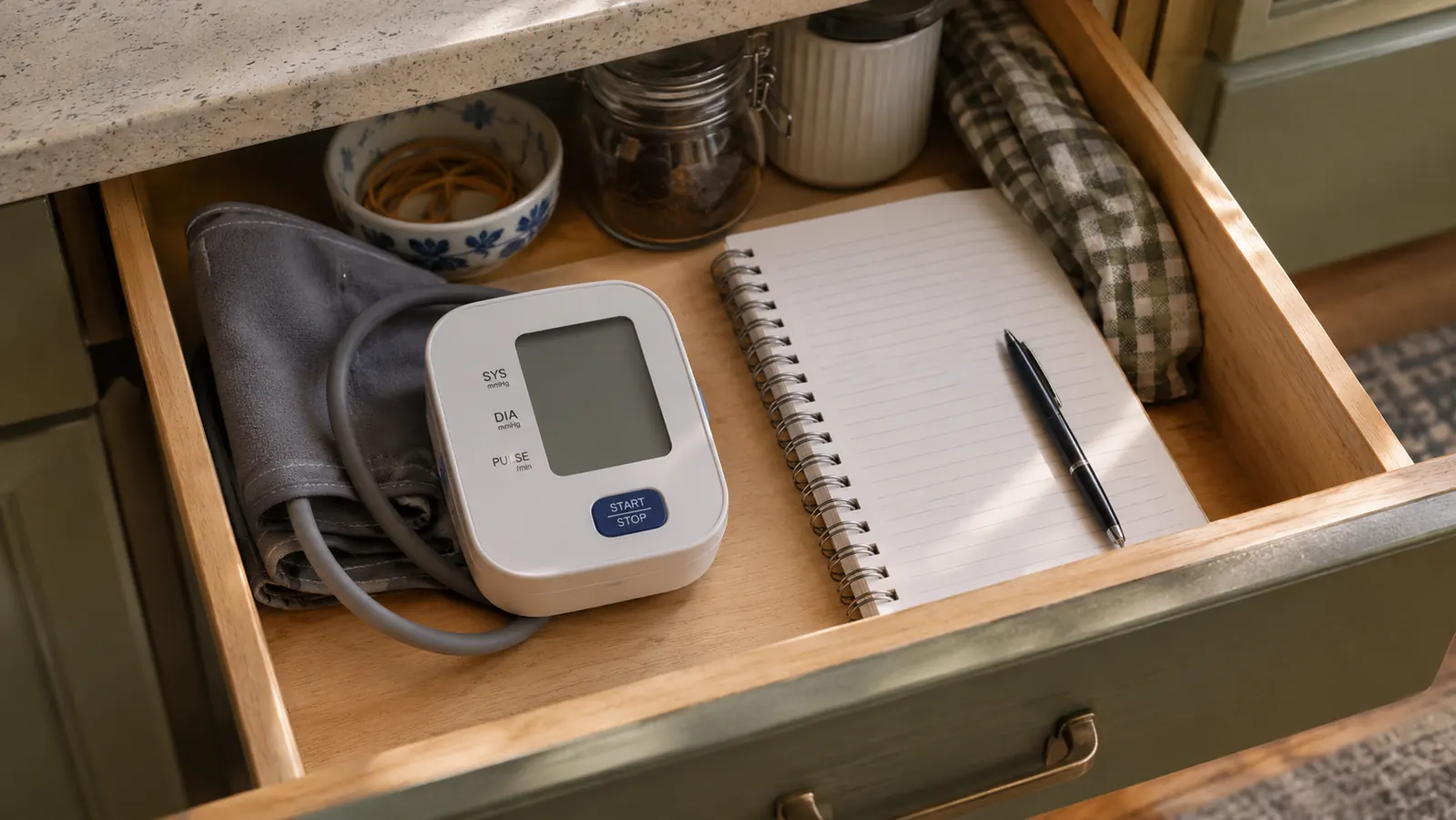
Four AA batteries run the whole thing. The monitor lives in the kitchen drawer and comes out twice a day, and I am not fishing for an outlet or hunting a charging cable that wandered off. When the batteries wear down I put in four fresh ones and I am back in business. We keep a spare pack in the drawer right next to it, because a dead monitor at seven in the morning is a nuisance you can plan around in about ten seconds.
The reading shows up on an LCD screen, not on a phone
The number comes up on an LCD screen on the unit itself. I do not open anything, pair anything, or wait for something to catch up. I sit down, wrap the cuff, and read the result right there at the table. I am 67 years old and I do not want to squint at a telephone in a dim kitchen before my coffee. The whole interaction takes less thought than setting a timer on the stove, and that is exactly the amount of thought I want to give it.
The irregular heartbeat indicator notices what I would have missed
This is the feature I did not expect to care about. The Omron Bronze flags an irregular heartbeat during a routine reading, right when it is already taking the measurement. I am not a nurse and I am not going to interpret it. What I do is write it in the log next to the number with a little note, and I take the log to my doctor. It notices something, I write it down, she tells me what it means. That is the arrangement and it works for me.
The hypertension indicator says elevated plainly, so I stop arguing with myself
The hypertension indicator tells you when a reading is elevated instead of leaving you to remember where the line sits from one month to the next. I still write the numbers down. I still take them in to my doctor. But on a morning when the reading is up, the machine says so in plain terms, and I do not spend the rest of the day telling myself it was probably the coffee or the weather or the drive. Plain is better than my own guessing.
The machine notices. I write it down. My doctor tells me what it means. That is the whole arrangement, and it has held for months.
It is an upper arm cuff, which is what my doctor actually asked for
My doctor was specific about the arm. She asked me to check at home and she did not want a wrist reading, so a wrist cuff was never on my list. The Omron Bronze is built for the upper arm, and I did what I was told. Feet flat, back against the chair, arm resting on the kitchen table with the cuff above the elbow. Same position every time, because a reading is only useful if you can compare it to the last one.
About 5.5 by 3.3 by 4.3 inches and a little over a pound, so it goes in a drawer
That reads like a spec sheet, so let me tell you what it means in a real kitchen. It fits in the drawer with the scissors and the takeout menus. It goes in a tote bag when we pack the car to visit family for a weekend. It does not take over the whole nightstand or sit out on the counter collecting dust and reminding me I forgot. A monitor you can put away is a monitor you will actually pull out twice a day.
One machine covers both of us without mixing up whose numbers are whose
Gene is 70 and checks his blood pressure too, so we share the machine and we do not share the log. Two columns in one spiral notebook, his on the left and mine on the right, because a shared monitor with a shared log turns into a mess by Thursday. His arm and mine both fall inside the 9 to 17 inch cuff range. One machine, two columns, one routine, and no confusion at the end of the month about who wrote what.
Four minutes, twice a day, sitting down at the same table
Morning before coffee, evening before the news. I set the monitor next to the notebook the night before so there is nothing to remember at six in the morning except to sit down. The reason the Omron Bronze suits everyday readings is not that it is interesting. It is that it is boring enough that I have not quit doing it. Any habit I have ever kept was boring. The ones I dropped were the ones that wanted a ceremony.
You hand your doctor a month of numbers instead of one bad guess
Here is the payoff, and it is not about the machine at all. I used to sit in the exam room trying to remember what my readings had been for the last three weeks, and I got it wrong every single time. Now I hand over a notebook with dates next to numbers, the high ones included, especially the ones I did not like. My doctor can look at a month of mornings instead of one reading taken in a cold room. Nothing in that requires me to interpret anything on my own.
What I'd Skip
If you are shopping this week, skip buying a monitor before you measure your arm. A cuff that does not fit gives you a number you cannot trust, and fit matters more than every feature you are comparing on a screen. Skip the wrist models if your doctor asked for an arm reading the way mine did. And skip paying for extras you will not touch. I looked at units with more on the screen and I honestly could not tell you what half of it would do for me at six in the morning.
The one thing I would not skip is the notebook. A monitor without a log is a number you forget by lunch. Buy a cheap spiral one, write the date and the time and the reading, and note anything odd in the margin. And do not buy two machines for a two person house unless your arms fall on opposite sides of the cuff range. Ours do not, so one lives in the drawer and the second one stays at the store where it belongs.
Ten small reasons, one boring routine, and a log your doctor can read
The upper arm cuff, the LCD reading, the indicators, the four AA batteries. None of it is exciting. All of it gets used twice a day at my kitchen table.
Amazon Check Today's Price on Amazon →