
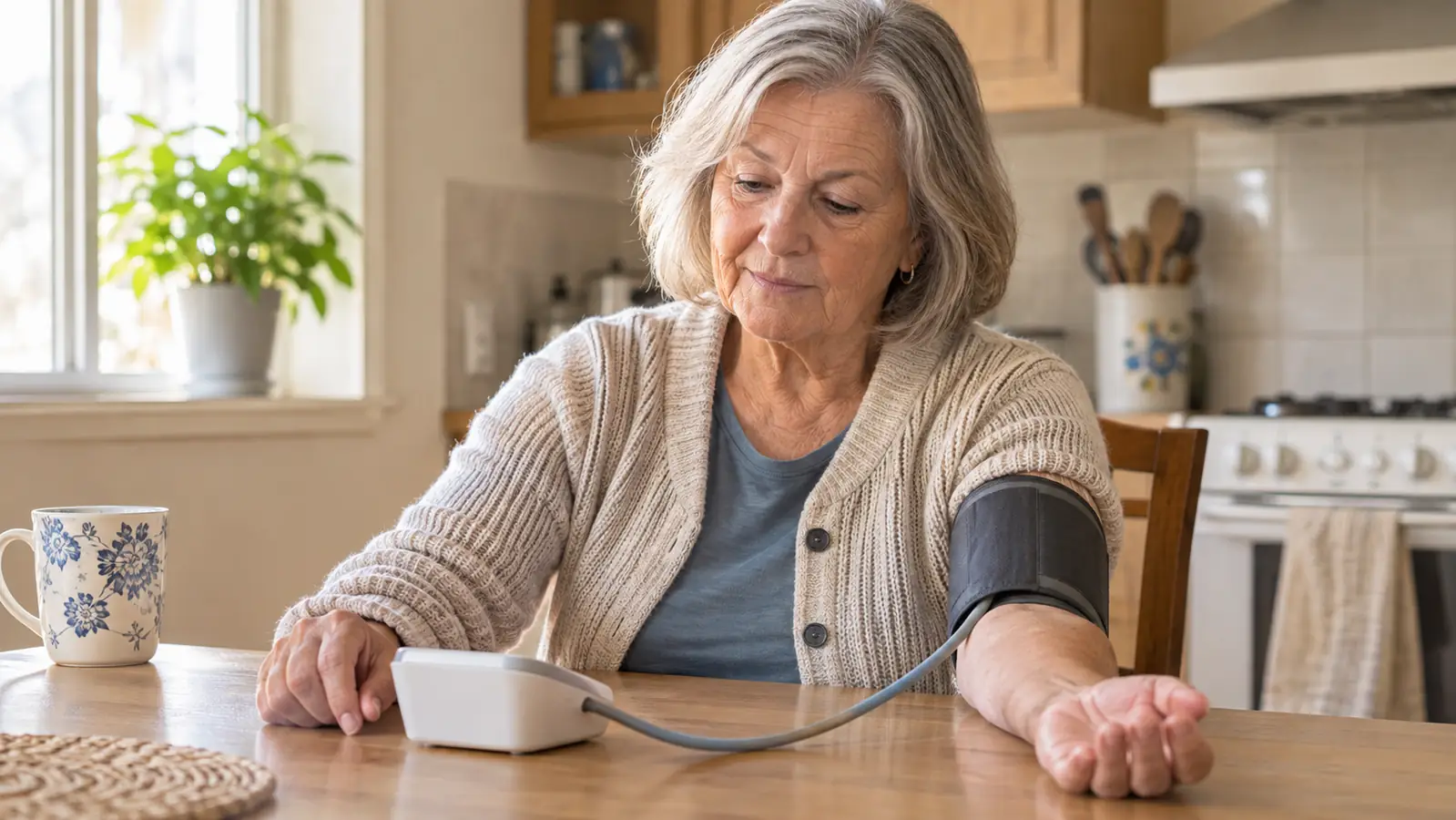
My doctor's office has a way of making my numbers look worse than they are. I would sit in that waiting room, get called back, have the cuff squeezed on the second I sat down, and the reading would come out high enough that she would raise an eyebrow at me. So she asked me to do it at home for a few weeks instead. Twice a day, morning and evening, write it down, bring the log back in. That was the whole assignment.
Gene is seventy and retired, same as me, and he decided he wanted in on it. So we needed one machine two people could share, that stored readings for both of us, that a person could work without reading a manual twice. We landed on the Greater Goods upper arm blood pressure monitor for home use, and it has lived in the kitchen drawer ever since. This is what several months of twice-daily readings actually looked like in our house.
The Quick Verdict
A genuinely simple two-person cuff that stores what it promises and does not fight you. The cuff size range covers both my arm and Gene's, the one-button start is real, and the memory is the reason we kept it. My complaints are small ones about the case and the batteries.
Amazon Check Today's Price →The monitor that made our twice-a-day log something we actually kept up
Two user profiles, sixty stored readings each, one button to start. If your doctor asked you to check at home and bring the numbers in, this is the machine that made the routine stick at our kitchen table.
Amazon Check Today's Price on Amazon →How I've Used It
I want to be plain about the setup, because the setup is most of the battle. Every morning before coffee, I sit at the kitchen table, both feet flat on the floor, and rest my left forearm on the table so the cuff sits roughly level with my heart. I wrap the cuff on my bare upper arm, press the one button, and wait. Then I do the same thing again in the evening after supper. Gene does his own at different times, and the machine keeps us apart, which matters more than I expected.
The first week, I did it wrong and did not know it. I was resting my forearm on the arm of the kitchen chair instead of flat on the table, so my arm sat lower than my heart, and my morning readings came out lower than my evening ones in a way that made no sense to me. I mentioned it to the nurse when I called about something else, and she told me to put my arm on the table and keep it level. I did that, and the gap between my mornings and my evenings closed up within four days. That is not a machine problem. That is a chair problem, and it took me a week to notice it.
The cuff that comes with it measures 8.75 to 16.5 inches around, or 22 to 42 centimeters. That range is the reason we could share one machine at all. My arm is not large and Gene's is bigger through the bicep than mine, and one cuff handled both of us without either of us feeling like our arm was being wrung out. If your arm runs past that upper number, this cuff will be too small and you should find that out before you buy, not after.
The operation is genuinely one button. You pick User 1 or User 2, you press Start, the cuff inflates, it deflates, and the number appears on the LCD. There is a color-coded scale on the side of the reading so you are not left decoding what a number means on your own, and it also flags an irregular heartbeat if it detects one. I do not treat that flag as a diagnosis and neither should you. I treat it as a note in the margin to show my doctor.
The memory stores up to sixty readings per user, a hundred and twenty total. That is the feature that changed this from a chore into something useful. I open the memory, page back through the last several weeks, and I can see the shape of my mornings versus my evenings instead of trying to remember what I got last Tuesday. When I brought my log to my appointment, I was not reciting from memory. I was reading off the machine.
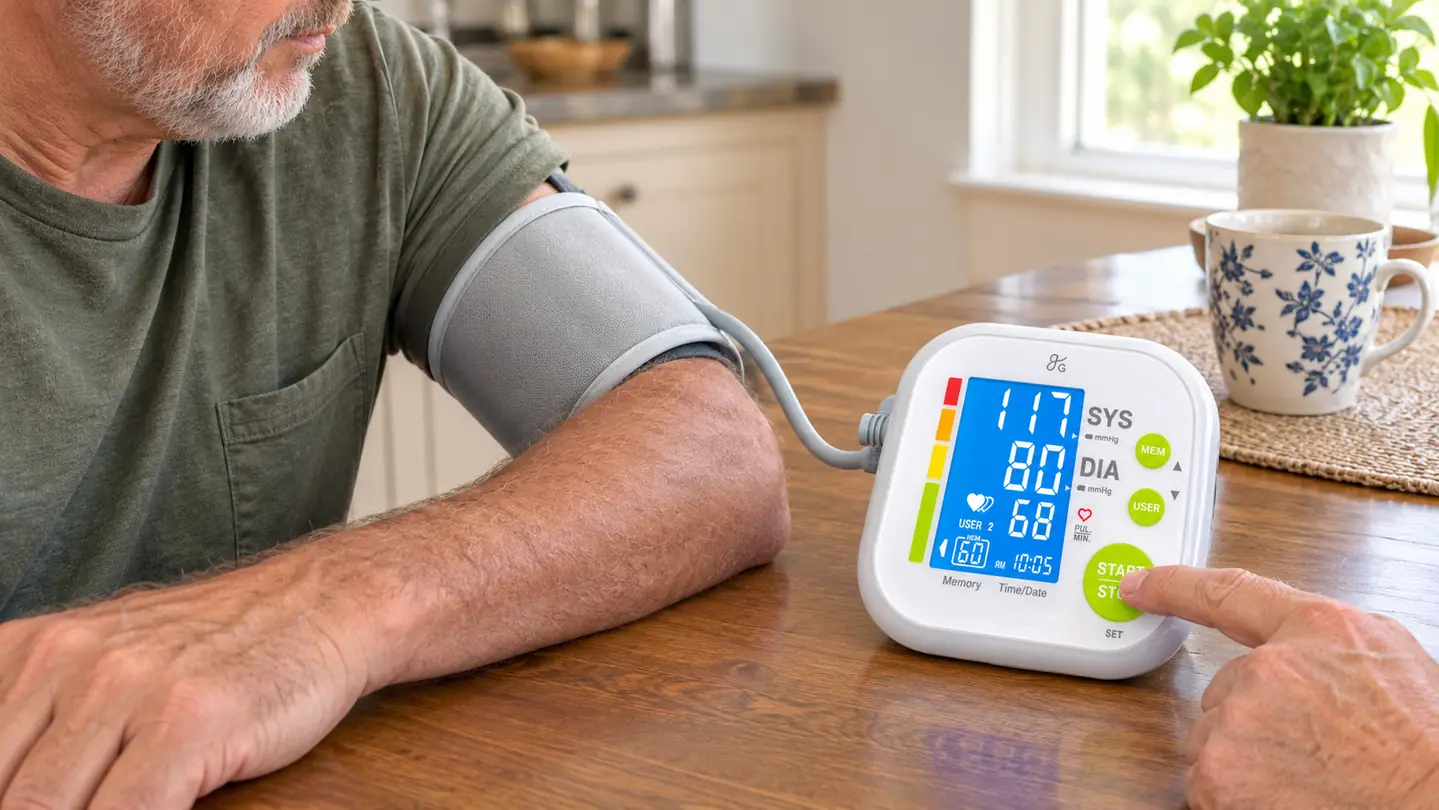
The Two-User Memory Is the Whole Reason We Kept It
Plenty of monitors will give you a number. What made us keep this one on the counter instead of in a closet was that Gene and I never once mixed up whose reading was whose. You select the profile before you start, and it stays with that profile. I did not have to keep two notebooks, and I did not have to squint at Gene's handwriting to figure out whether the Tuesday number was his or mine.
I will say the honest thing here: sixty readings per person sounds like a lot until it is not. At twice a day, that is a month of coverage. We were asked to log for a few weeks and bring it in, so it fit the assignment with room to spare. In June, when my log filled up before my appointment did, I paged back through the oldest entries, wrote the ones I wanted onto a sheet of lined paper, and started fresh on the next morning. It took me maybe eight minutes at the kitchen table with a cup of coffee going cold beside me. If you are the kind of person who wants a full year of history on the device itself, you will be copying numbers out or looking at a machine that does more than this one does. For our purposes, a rolling month was exactly what we needed.
The other thing that made it stick is that it does not feel fussy. There is no sequence of menus to remember, no moment where I have to recall which button does what. I am sixty-seven. I have spent my life working a teller window and counting other people's money, and I have no patience left for a device that makes me feel stupid first thing in the morning. This one asks me one question and then does its job. When Gene's brother visited in July and wanted to check his own reading before he drove home, we handed him the cuff, walked him through picking a profile and pressing the button, and he had a number inside two minutes with no help from either of us.
What Several Months of Daily Use Actually Showed
The readings themselves are for my doctor to interpret, and I mean that. What I can tell you is what the routine showed us about the machine. The Greater Goods monitor was consistent. When nothing had changed in my morning, the numbers sat in a narrow band rather than jumping around, which is the only thing a home monitor can really be trusted to do well. If the machine had been erratic, my log would have been noise, and I would have known it by the second week.
It was also forgiving of the way real people live. There were mornings I sat down too fast, mornings I had a second cup of coffee before I remembered, mornings I wrapped the cuff a little sloppily because I was half awake. The machine still ran. It did not throw errors at me or give me a blank stare. The one time it gave me something odd, I had the cuff on over a sleeve, and taking the sleeve out of the way fixed it, which is the kind of lesson you learn once. There was also a Thursday in August when I put the cuff on upside down, tubing pointing the wrong way up my arm, and the machine simply reported an error instead of pretending it had a reading. I fixed it and started over. I would rather have an error than a made-up number.
On power, it runs on four AAA batteries, and they come in the box along with the monitor, the cuff, and a case. That is worth mentioning because the batteries lasted us a long stretch, but they are batteries, and batteries die at inconvenient moments. Ours went down on a Sunday evening mid-reading, right in the middle of the inflation, and the screen just faded out on me. I have since kept a spare four pack in the drawer next to the monitor, which is the cheapest insurance in the house. It is powered by battery only, so there is no cord to plug in and no wall outlet required, which is the tradeoff: total freedom from an outlet, in exchange for watching the battery level now and then.

The Case, the Size, and the Small Annoyances
The monitor measures 7.25 by 5.25 by 3.25 inches and weighs 6.4 ounces, so it is small enough to sit in a kitchen drawer with the spatulas and not announce itself. The included case is the part I have the most to say about, and most of what I have to say is mild. It does the job of keeping the cuff and the tubing together, but it is not a padded travel case. If you are carrying this in a bag to a doctor's appointment, wrap the cuff around itself and tuck the tubing in properly, or you will pull out a small nest of tubing when you open it. I learned that the morning of my first appointment, standing in the driveway with the car running, working the tubing back into a loop with both hands.
The tubing itself is a little stiff for the first few weeks. It loosens up with use. The cuff is comfortable enough that I stopped noticing it, which is more than I can say for the cuff at my doctor's office. It inflates firmly, and if you are new to home monitors and expect a gentle squeeze, know that any upper arm cuff is going to squeeze you. That is what it is doing to get the reading. My sister in Enid bought a different brand last year and called me to ask whether the squeeze was supposed to feel like that. It is. Give it a few seconds and it lets go.
My other note is about the display. The LCD is clear and the numbers are large enough to read without my glasses, which I appreciate more every year. The color-coded scale on the side is a nice touch for anyone who is not used to looking at numbers all day, though I would caution you not to let a color on a screen tell you how to feel about your health. Take the reading, write it down, show it to your doctor. That is the whole chain, and no machine on a kitchen table gets to shorten it.
I did not have to keep two notebooks, and I did not have to squint at Gene's handwriting to figure out whether the Tuesday number was his or mine.
Who This Is For
This is for the household where one person got told to check at home and the other person decided they might as well too. The two profiles and the shared cuff range make that work without buying two machines. It is for someone who wants to press one button, get a number, and get on with their morning. It is for the person who will actually write the readings down or page back through the memory at the appointment, because the machine only helps if the routine holds.
It is also for someone whose arm sits inside that 8.75 to 16.5 inch range and whose budget is a consideration. I have looked at the more expensive monitors, and this Greater Goods machine does the core job the same way: cuff on, button, number, memory. What you pay extra for elsewhere is usually connectivity and history depth, not a better reading. If you want to see how it stacks against one of the better known names, I put the two side by side in my Greater Goods vs Omron comparison, and if you are still deciding whether a home cuff is worth the trouble at all, the ten reasons a simple monitor suits a house like ours covers that ground.
What I Liked
- One button to start, plus a simple User 1 or User 2 selection, so two people can share it without confusion
- Cuff fits 8.75 to 16.5 inches, which covered both my arm and Gene's
- Stores sixty readings per user, enough to bring a month of twice-daily readings to an appointment
- Large, clear LCD with a color-coded scale and irregular heartbeat detection
- Runs on four included AAA batteries, no cord and no outlet needed
- Small and light enough to live in a kitchen drawer without taking over
Where It Falls Short
- Battery only, so a dead set of AAAs will interrupt you at the worst moment unless you keep spares
- Sixty readings per user is about a month at twice a day, not a long history
- The included case is a carry pouch, not a padded travel case
- No app, no phone pairing, no automatic sharing with anyone. You write it down or you page through the memory yourself
Who Should Skip It
Skip it if your upper arm measures past 16.5 inches. That is the top of the cuff range and no amount of good intentions will fix a cuff that does not fit. Find a monitor with a larger cuff instead. Skip it if you want your readings to land in an app on your phone so you can email a chart to your doctor without touching a pen. This machine does not do that, and I would rather tell you plainly than have you find out on the day of your appointment.
Skip it if you want a year of history stored on the device, or if you are buying this for someone who will not keep up a routine. A monitor in a drawer that nobody uses is a twenty minute experiment, not a habit. The machine is simple, but it cannot sit down at the table for you. And skip it if you are looking for something that will tell you what your numbers mean. It will not, and it should not. That conversation belongs with your doctor.
If your doctor asked for a home log, this is the machine that kept ours going
Press one button, get a reading, page back through a month of mornings and evenings at your next appointment. Bring the numbers to your doctor and let them tell you what they mean. Ours has earned its place in the kitchen drawer.
Amazon Check Today's Price on Amazon →