
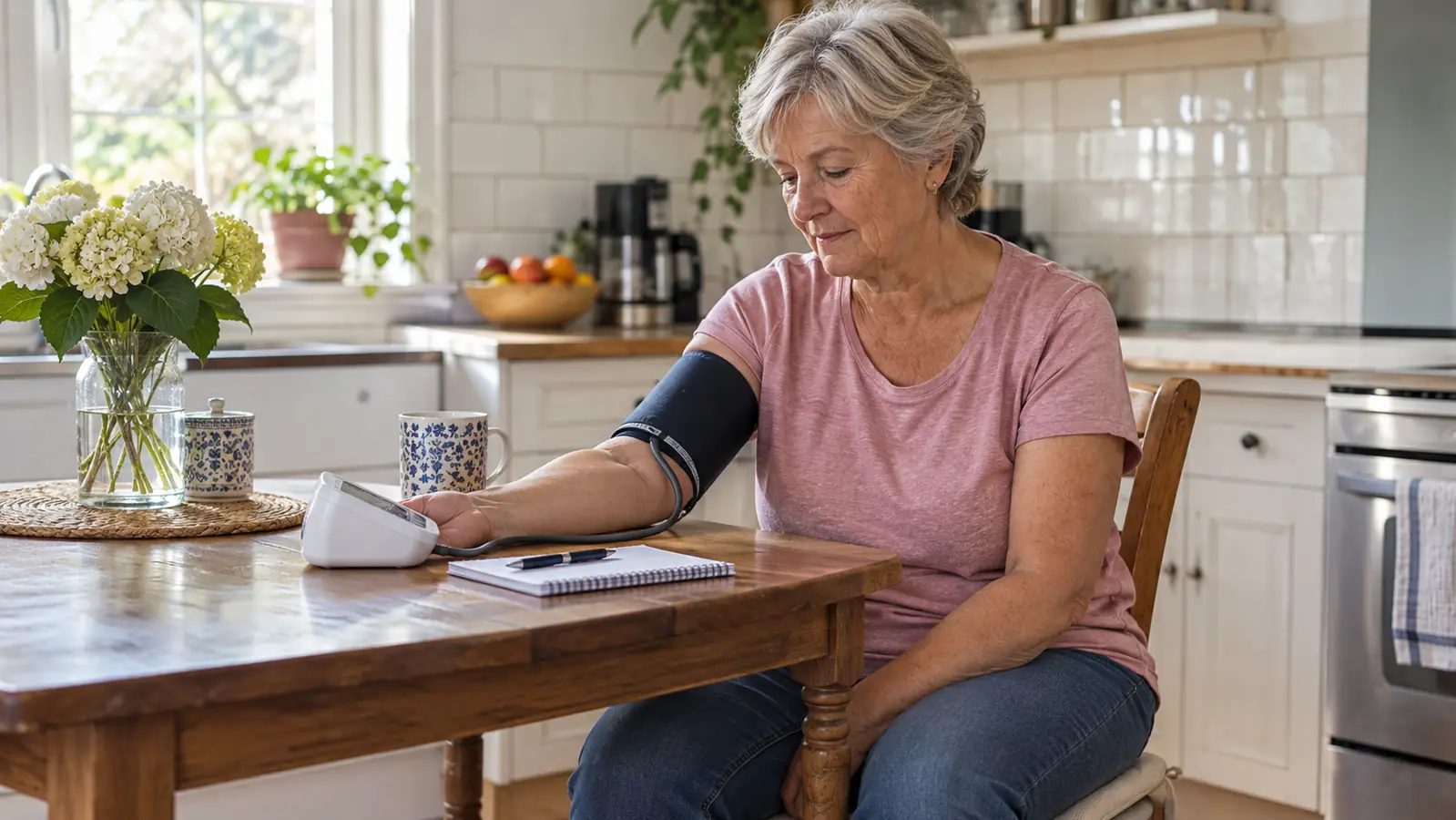
When I first set up a home monitor, I thought a blood pressure cuff was a blood pressure cuff. Then my husband Gene and I started checking twice a day at the kitchen table, and I learned that the little differences matter more than the big label on the box. The Omron Bronze is the one in our kitchen drawer. The Omron Silver is the one I borrowed for a month to see what the extra steps bought us. Same upper-arm cuff idea, same morning-before-coffee routine, two different experiences.
Here is the short answer. If you want to sit down, wrap the cuff, take a reading, and write the numbers in a notebook, the Omron Bronze is the easier fit. If you want the readings to collect themselves and you are comfortable pairing a phone, the Omron Silver earns its place. Neither one is a doctor. Both are tools for getting a record you can take to your doctor. The rest of this is how I got to that answer.
What Both Monitors Get Right
Both the Bronze and the Silver are upper-arm monitors, which is the kind my doctor asked me to use. The cuff wraps above the elbow, the tube runs to the unit on the table, and the reading shows on an LCD screen. The Bronze comes with the cuff, the pump, and the tube in the box. It runs on four AA batteries, so there is no cord to trip over and no outlet needed at the kitchen table. It measures 5.5 by 3.3 by 4.3 inches and weighs about 1.2 pounds, which means it fits in the drawer with the napkins and comes out without a production.
Both units carry the features I actually look at. The Omron Bronze has Advanced Accuracy Technology, an irregular heartbeat indicator, and a hypertension indicator. In plain words, the monitor is built to take a consistent upper-arm reading, it will show a symbol if it notices an irregular heartbeat during the reading, and it will flag a reading that is in the elevated range. I do not treat those flags as a diagnosis. I treat them as a reason to keep the log and bring it to my doctor. The Silver has the same core job. The difference is what happens after the numbers appear.
| Omron Bronze | Omron Silver | |
|---|---|---|
| Core job | Upper-arm reading with Advanced Accuracy, an irregular heartbeat indicator, and a hypertension indicator. | Upper-arm reading with the same core indicators and app record keeping. |
| Cuff fit | 9 to 17 inch cuff included. | 9 to 17 inch cuff included. |
| Everyday setup | Batteries in, cuff on, take a reading. No phone needed. | Batteries in, one-time pairing with the app, then cuff on and take a reading. |
| Record keeping | Readings stay on the device. A paper notebook does the long-term log. | Readings sync to the app and build a digital log. |
| Shared use | One monitor, one notebook, take turns. | One monitor, a digital log that is easier to organize. |
| Phone in the routine | None. | Needed for the app side, not for a single reading. |
| Screen | LCD display. | LCD display. |
| Size and travel | 5.5 by 3.3 by 4.3 inches, about 1.2 pounds. | Similar tabletop footprint. |
| Best for | A simple twice-a-day routine you write down. | A routine you want tracked and shared at appointments. |
| Learning curve | Low. The routine is the same every time. | Moderate. The app adds a setup step. |
The Drawer Test
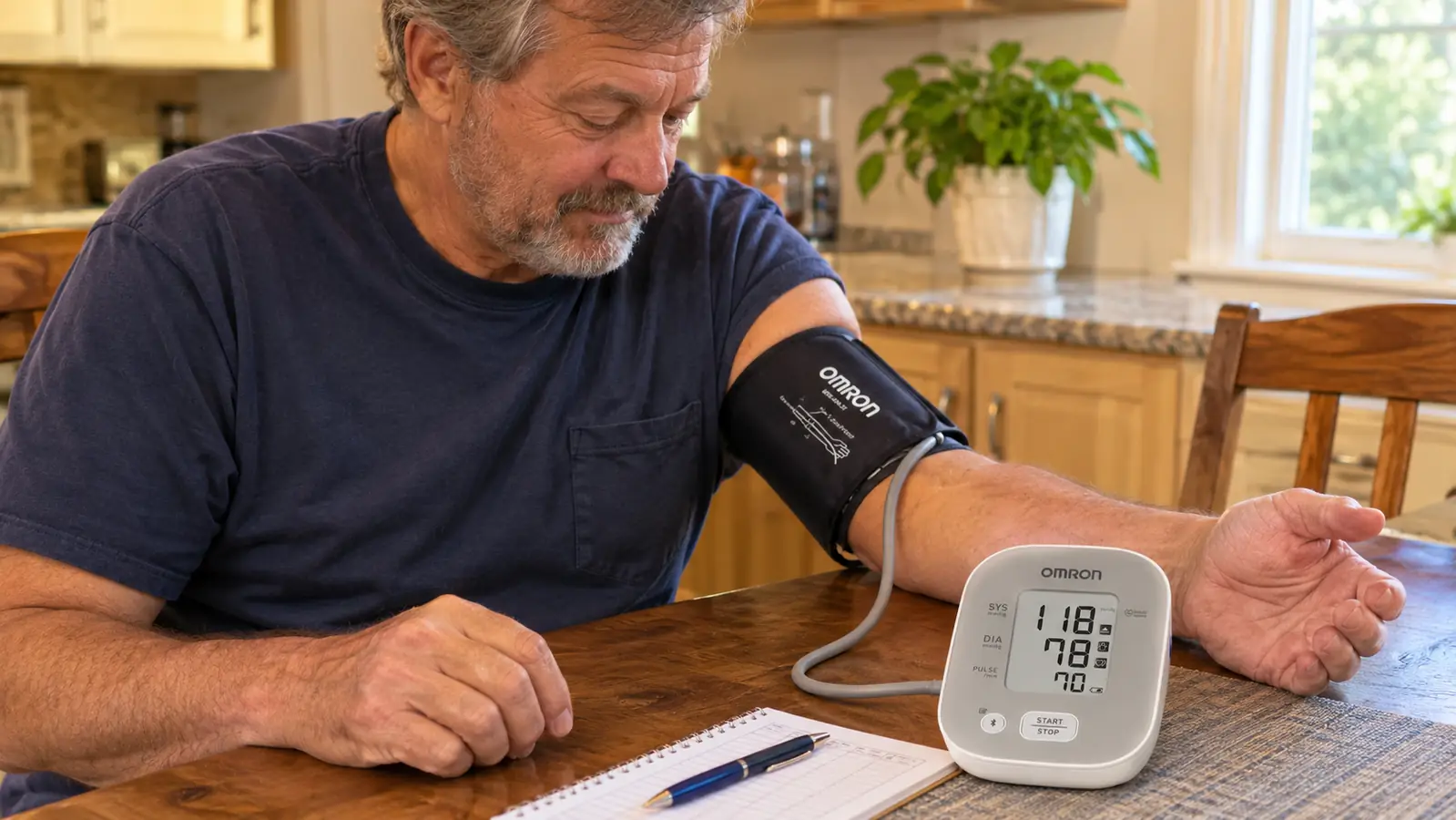
A monitor can look good in a listing and still lose the drawer test. The drawer test is simple. After the new wears off, does it stay within reach, or does it end up under the good scissors? The Bronze passes because it has one home and one routine. The cuff, the pump, and the tube go back in the same place. The four AA batteries last long enough that I am not hunting for a charger. I can hand it to Gene without a tutorial.
The Silver passes too, but for a different reason. It passes if the phone is already part of your day. If you check the app the way you check the weather, the Silver will earn its spot. If the app is one more thing to remember, it will end up in the drawer with the cuff, and the extra steps will not do you any good. That is not a knock on the Silver. It is just how routines work.
Where Omron Bronze Wins
The Bronze wins on the thing that matters most in my house. It is ready when I am. I do not have to find my phone, unlock it, wait for an app, or remember a password before coffee. I sit down, wrap the cuff, take the reading, and write it in the notebook. Gene can do the same without asking me how the pairing works. If one of us is having a morning where the technology feels like too much, the Bronze still does its one job.
It also wins on the small things. There is no account to recover, no app update to install, and no phone that can die at the wrong moment. The cuff is a 9 to 17 inch size, so it fits both Gene and me, and the whole unit lives in the kitchen drawer of our small one-story house. When we travel to see family, I put in fresh batteries and pack it. The Bronze is not fancy. That is the point. When a visitor wants a reading, I do not have to add anyone to an account. I hand over the cuff and write the number on a scrap of paper.
Where Omron Silver Wins
The Silver wins on the record. My handwriting is not what it was, and a paper log can get coffee rings and skipped days. The Silver sends the readings to the Omron Connect app, so the log builds itself. Over a few weeks, I can see the pattern instead of squinting at a page. When my doctor asks how the mornings have been, I can bring a list rather than a story. That is a real difference, and I am not going to pretend otherwise.
It also wins if two people share one monitor and you want the numbers kept apart. With the Bronze, Gene and I share a notebook and a pen. With the Silver, the digital record is easier to organize when you are comparing two people's routines or looking back over a month. If you are comfortable with a phone and you will actually use the app, the Silver earns its place in the lineup. If you will not open the app, you are carrying a feature that sits idle.
The Bronze is the one that stayed in my drawer
The Omron Bronze is the simple upper-arm monitor in my kitchen drawer. It runs on four AA batteries, comes with the 9 to 17 inch cuff, and gives you the core features without an app. See the listing for yourself.
Amazon See the Omron Bronze on Amazon →The Cuff, the Chair, and the Two Minutes
A monitor is only as good as the way you sit. My doctor told me to sit with my feet flat, my back against the chair, and my arm resting on the table at about heart height. I do that at the kitchen table, morning before coffee and again in the evening. I put the cuff on my upper arm, above the elbow, and I stay still while it takes the reading. I do not talk, I do not check the news, and I do not try to do two things at once. Two minutes, twice a day, is the whole routine.
The cuff size is the part people skip. The Bronze ships with a 9 to 17 inch cuff. If your arm is outside that range, neither the Bronze nor the Silver will be right until you get the correct cuff, and that is a conversation for the company or your doctor's office. I am not a nurse. I am a retired bank teller who learned this from scratch. What I can tell you is that the same cuff and the same chair give you a better record than a different setup every day.

The Two-Person Household
Gene and I share one monitor because it is easier to keep one routine than two. The Bronze makes that simple. We keep the notebook on the table, and each of us writes the date, the time, and the numbers. We can tell whose page is whose by the handwriting. That is not high technology, but it works. If one of us forgets, the other one notices.
The Silver is better if you want that shared record without two notebooks. The app can hold the readings in one place, and when you look back, you can see the two routines side by side. That is helpful when you are the one who keeps the family organized. It is not helpful if you are the one who avoids the phone. The right answer depends on which person you are.
What I Do With the Numbers
I do not diagnose anything. I write the date, the time, and the numbers in the notebook, and I note anything unusual about the reading, such as a symbol on the screen. If the monitor shows the irregular heartbeat indicator, I write that down too. I do not panic and I do not try to guess what it means. I bring the log to my doctor and ask. That is the deal we made when I started this routine.
The same goes for the hypertension indicator. It is a flag, not a verdict. A single reading at the kitchen table is one point in a day. The log is what gives it context. If you use the Silver, the app can hold that context for you. If you use the Bronze, the notebook does the same job. Either way, the point is to bring a record to the person who can interpret it.
Who Should Buy Which
Buy the Omron Bronze if you want a standalone monitor and you do not want a phone in the routine. Buy it if you write your readings in a notebook, if you share the monitor with a husband or wife, or if you want the simplest thing that will still give you the core features: upper-arm reading, irregular heartbeat indicator, and hypertension indicator. Buy it if you have watched enough app updates go sideways that you would rather not depend on one.
Buy the Omron Silver if the record is the part you will use. If you want the readings to land in the Omron Connect app, if you like seeing a month at a glance, or if you are the person who brings a printout to every appointment, the Silver is the more natural fit. Buy it if you are comfortable with a one-time pairing and you will keep the phone nearby. Do not buy it for the app if you know you will not open the app. The best monitor is the one you will use twice a day.
What I'd Tell a Friend
I would say this. Do not let the label on the box make the decision for you. The Bronze and the Silver both take an upper-arm reading. The Bronze keeps the routine simple. The Silver keeps the record. Pick the one that matches the way you actually live, not the way you think you should. In our house, the Bronze is the one in the drawer, and the notebook is beside it. That is the routine that stuck.
Whatever you pick, bring the readings to your doctor. I write down the date, the time, and the numbers, and I take the log with me. I do not try to interpret the numbers on my own, and I do not change anything without asking. A home monitor is a tool for a conversation, not a replacement for one. That is the plain truth from my kitchen table in Lawton. This is not medical advice.
Pick the routine you will keep past the first week
The Omron Bronze gives you the upper-arm reading, the cuff, and a clean start. Write the numbers down, bring them to your doctor, and let the routine do its job.
Amazon See the Omron Bronze on Amazon →