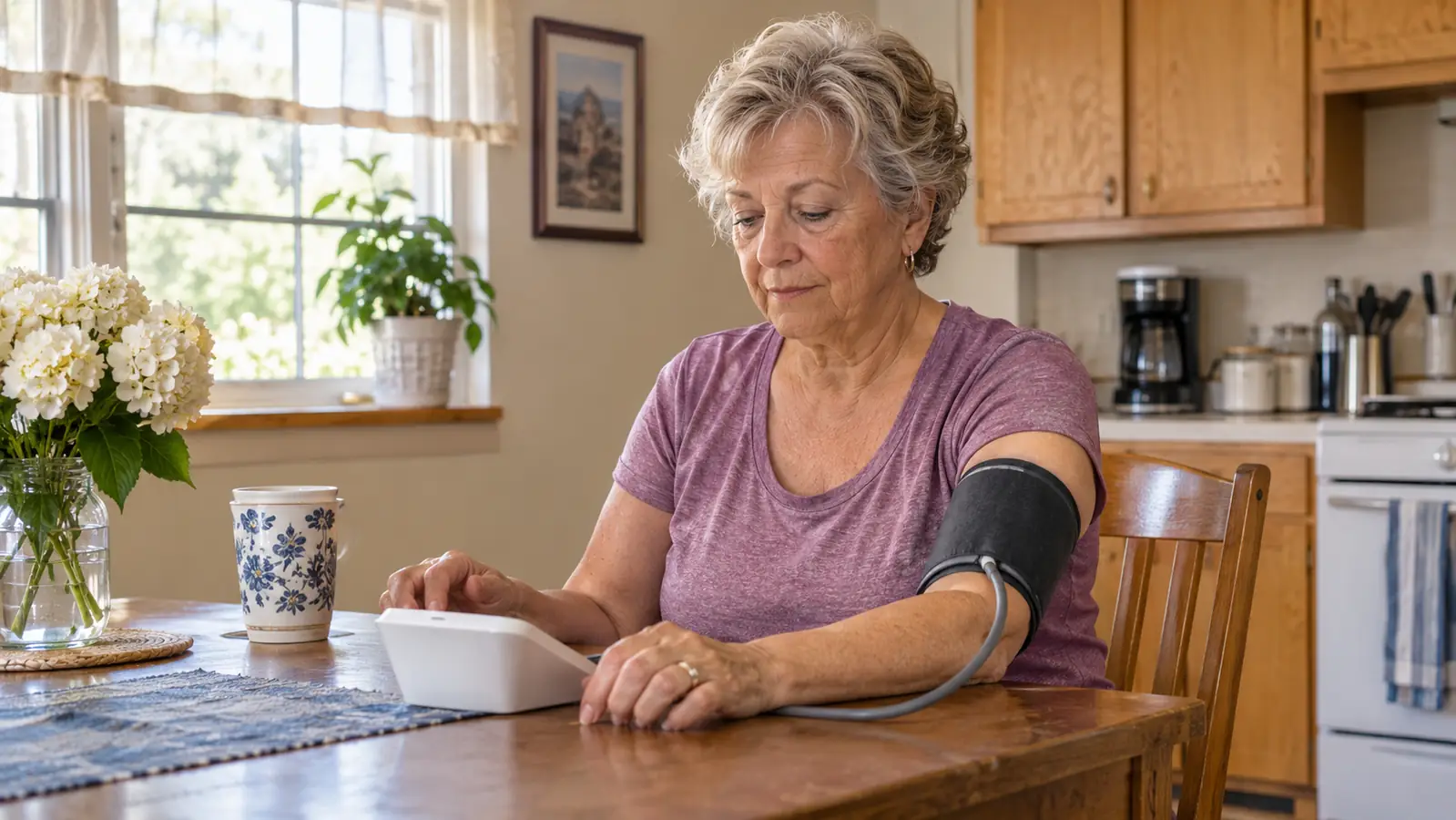
My doctor's office is where this started. I would sit in that chair, the nurse would wrap the cuff around my arm, and the number would come back higher than it should be. Every single visit. My doctor was not alarmed, exactly, but she was not satisfied either. She asked me to check at home twice a day for a few weeks and bring her the log. That is the whole reason there is a blood pressure cuff in my kitchen drawer today.
I am 67, retired after thirty-one years as a bank teller in Lawton, Oklahoma, and I had never used a home monitor in my life. My first try was a wrist cuff that gave me three different numbers in five minutes. My second was a cheap arm cuff that squeezed so hard my arm ached for an hour afterward. Then I bought the Withings BPM Connect, mostly because the pharmacy assistant said it was the one people bring back the least. Gene and I have used it twice a day since, and I have opinions.
The Quick Verdict
Reads reliably, shows the numbers clearly, and builds the log on its own. Not the cheapest arm cuff on the shelf, and the app is where everything lives.
Amazon Check Today's Price →The cuff that turned my morning readings into a two-minute habit
Two presses, a wait, and the number is on the screen and in the app. That is what made me keep doing it after the first week, which is more than I can say for the wrist cuff.
Amazon Check Today's Price on Amazon →How I've Used It
Twice a day, one reading before my coffee and one after supper. I sit at the kitchen table with my feet flat on the floor and my left arm resting on the tabletop, which is what the instructions say and what the nurse told me. Gene takes his right after mine, so the cuff never really gets put away. It lives in the second drawer down, next to the potholders, and it comes out at roughly the same two times every day. That routine matters more than any feature on the box.
Here is what a Tuesday actually looks like. I get up a little after six and put the kettle on, and while it heats I take the cuff out of the second drawer. Band on the left arm, arm flat on the table, feet on the floor, press the button, sit still, wait. Gene shuffles in somewhere around the middle of it with his hand already out, and by the time the kettle clicks we have two readings between us and neither of us has touched the spiral notebook that used to live on the counter. The first week I was slow at it, four minutes from drawer to drawer, because I read the instructions twice and second-guessed the band. Now the whole thing is under two minutes and I do not think about it at all.
The thing that changed my routine was not the readings themselves. It was that I stopped writing them down. With the wrist cuff I kept a little spiral notebook, and I would forget it for three days and then try to remember what the numbers had been, which is a silly thing to do at my age. With this one the reading goes to the app whether I remember or not. When the nurse asked for two weeks of morning and evening numbers, I opened the app and handed her my phone.
One reading takes about as long as waiting for the kettle. You wrap the band, press it, sit still, and wait. It is not fast, and I do not think it is supposed to be. If it were faster I would probably trust it less. Gene times his against the microwave clock out of habit, and he says it runs close to the same length every time, which is the kind of consistency that makes a person keep using a thing.
What the Display Shows You Without Reaching for a Phone
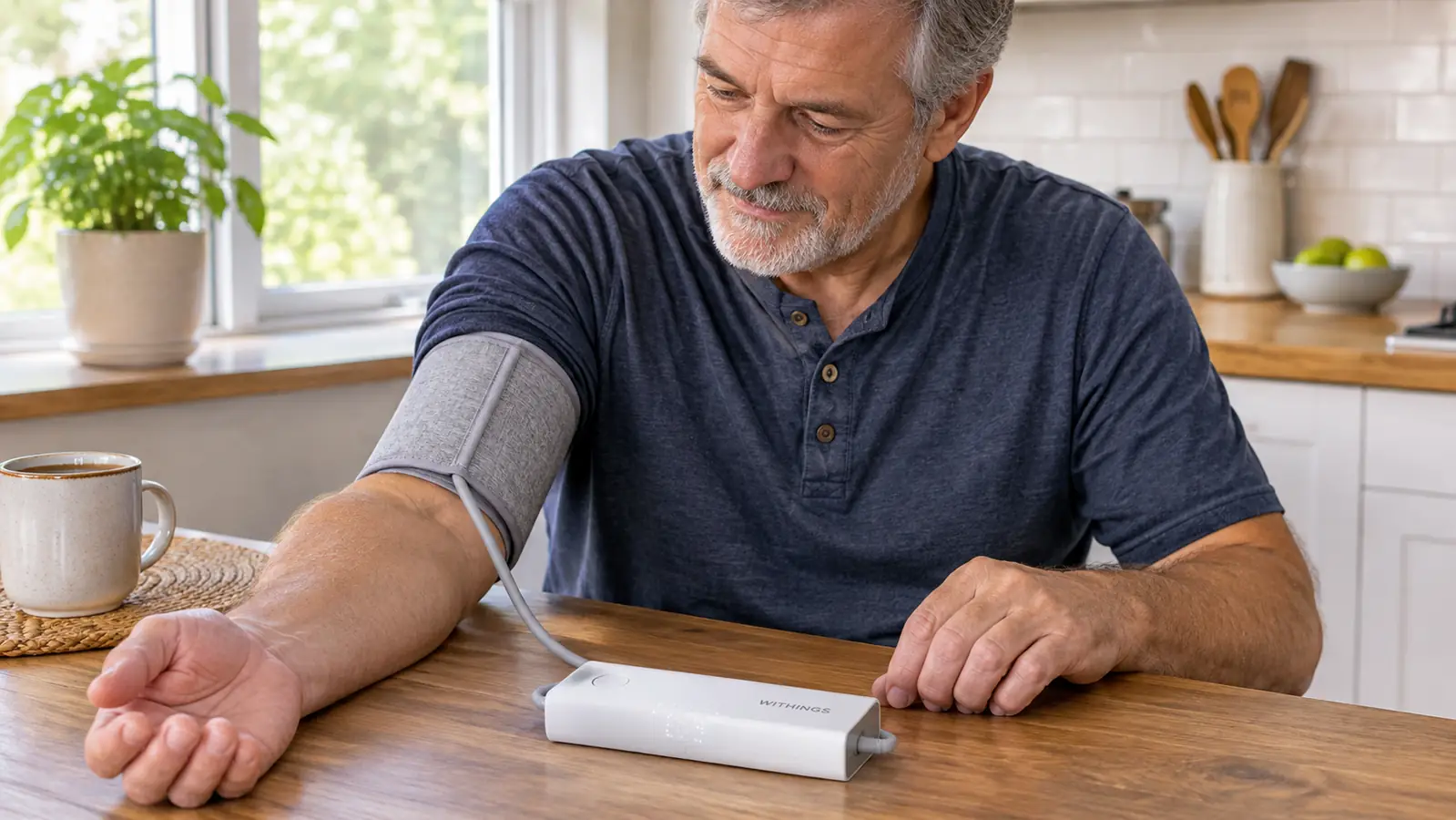
The part I did not expect to care about is the display on the unit itself. It reads out systolic, diastolic and pulse right there, in numbers big enough that I can see them without hunting for my glasses. At 67 that is not a small thing. Along with the numbers you get color-coded feedback on the display, so you are not left doing arithmetic in your head at six in the morning trying to remember where the line is.
That matters more than it sounds like it would. My mother had a monitor where the only way to know what you got was to write it down and look at it later with a magnifying glass. This one tells you while you are still sitting there. The color-coded feedback tells you where the reading sits without you needing to know the exact thresholds by heart, and after a few weeks you learn what your own ordinary looks like on that little screen. I still keep a paper notebook as a backup, because I am the kind of person who keeps a paper trail, but the paper is now the backup instead of the only record.
The Band, the Arm, and Sharing It With Gene
The band that comes with the Withings unit is rated for arms from 22 to 42 centimeters, and that range is the reason Gene and I can share one unit instead of buying two. Gene is 70 and his arm is thicker than mine. The band closes around his arm with room to spare, and on my arm it closes snug without pinching. Neither of us has to fight with it. The whole unit weighs about 12.8 ounces according to the box, so it is not a heavy thing to have sitting on the table while you wait.
I measured my own arm with a cloth tape before I ordered, which felt foolish at the time and was not. If you are buying one cuff for two people, that range on the box is the first thing to check and the last thing anybody thinks to check. I also marked the band with a pencil so I could find my fit again without hunting for it, and Gene did the same on his side. Small thing. It saves a minute of fumbling every single morning, and a minute of fumbling is exactly what makes a person quit doing this by week three.
It goes on the upper arm, which my doctor was firm about. She does not care for wrist cuffs, and after my first month with one I understand why. The wrist cuff wanted my arm at exactly heart height, and if I was a half inch off the number moved. The upper arm band does not care where my hand is as long as my arm is resting on the table. For two people in their late sixties doing this without supervision, that forgiveness is worth more than any extra feature.
What the App Does With the Readings
It syncs over Wi-Fi and Bluetooth to the Withings Health Mate app, and the syncing is the quiet workhorse of the whole thing. I take a reading at the table, put the cuff back in the drawer, and go start my coffee. By the time I sit down with the cup, the number is in the app with the date and the time on it. I never once had to pair it, poke at it, or hold my phone next to it while it worked. It just does it.
The other thing the log gave me was the times. My old notebook only ever had numbers in it, because when you are writing by hand at a kitchen table you write the number and nothing else. With this one I can look back and see that a reading came four minutes after I carried two bags of groceries in from the car, or that it came at twenty past nine at night instead of my usual seven. Those little details are what my doctor asked about. She did not want a pile of numbers so much as she wanted to know the circumstances around them, and I would never have written the circumstances down on my own.
Some mornings the sync is slower than others, and once or twice I have opened the app and had to pull down on the screen to refresh before the new reading appeared. That is the extent of the trouble I have had with it. What I care about is that a month of morning and evening readings sits in one place, in order, with the times on them. My doctor could see at a glance that most of my readings were taken at home in a quiet kitchen rather than in a chair in her office, and that changed the conversation entirely.
The first time I handed my doctor a month of morning and evening readings instead of a guess, the whole conversation changed.

Where It Gave Me Trouble
Setting it up the first time took me the better part of an evening. You need a phone and an account before you take your first reading, and I am of the age where creating an account means hunting for a password I will forget. Gene did his own on his phone, separately, which confused us both until we worked out that we each had our own record. If you are not comfortable with apps, plan on doing that part with someone patient sitting next to you.
The printed instructions are small enough that I read them with my reading glasses on top of my regular glasses, and I still had to go back over the setup page twice. Gene gave up on the paper altogether and worked it out on the screen, which is faster if your eyes are better than mine. And there is no way around the account. If you want the log, you make the account, and that is the trade. Once it was done it was done, and I have not had to touch that part again in months of use.
It runs on a battery, and there is a charger in the box, and I have forgotten to charge it twice. Both times I found out by sitting down at the table, cuff on, ready to go, and getting nothing. That is on me, not on the machine, but I would be lying if I said it was not annoying. I have since gotten into the habit of plugging it in on Sunday evenings, and that has solved it.
What I Compared Before Buying
I looked hard at the Omron models because that is the name the pharmacy carries and the name my sister in Tulsa uses. There is a full side-by-side in my comparison of the Withings BPM Connect against the Omron Gold, and the short version is that both of them do the basic job. What pushed me toward the Withings was the syncing and the display, and what pushed me toward the Omron was that it costs less and the buttons are bigger. Neither one is wrong. It depends on whether you want the log built for you.
I also thought about the plain manual cuff and stethoscope, which is what the nurse uses. I am not a nurse. I could not hear the tick reliably at 67 with the television on, and I would have been guessing at numbers and writing the guesses in a notebook. For me that would have been worse than no monitor at all, because a wrong number you wrote down yourself feels more trustworthy than it should.
What I Liked
- Reads systolic, diastolic and pulse on the unit itself, so you are not tied to your phone for the number
- Color-coded feedback on the display means you are not doing arithmetic before coffee
- Wi-Fi and Bluetooth sync to the Health Mate app builds the log without you writing anything
- Band fits arms from 22 to 42 centimeters, so Gene and I share one unit
- FDA cleared upper arm monitor, and the numbers are large enough to read without glasses
- Two year manufacturer warranty
Where It Falls Short
- Costs more than a basic arm cuff that does the same measurement
- Setup needs a phone and an account before your first reading, which took me an evening
- Runs on a battery and I have forgotten to charge it twice
- The app carries far more detail than I will ever use
Who This Is For
This is for the person whose doctor said check it at home and bring me the numbers. That was me, and I suspect it is most of you reading this. It suits a couple sharing one device, because the band covers a wide range of arms and the readings land in separate records. It suits anyone who has tried keeping a paper log and quietly stopped keeping it around day nine. And it suits someone like me who wants the number on a screen big enough to read while the cuff is still on her arm.
Who Should Skip It
If nobody asked you to track anything and you just want a number now and then, a plain cuff at half the fuss will do you fine. If you do not want a phone involved in your health at all, skip it, because the setup wants one and the log lives there. And if your arm is outside the 22 to 42 centimeter band, check that before you buy anything, because a cuff that does not fit will not give you a reading worth taking to your doctor. I am not a medical professional and I am not telling anyone what their numbers should be. I am telling you what I do at my kitchen table twice a day, and that whatever you get, you take the readings to your doctor and let her read them.
Two minutes at the kitchen table beats a guess in a notebook
This is the cuff Gene and I have used twice a day for months. If your doctor asked for a home log and you have been putting it off, this is the version that keeps the log for you.
Amazon Check Today's Price on Amazon →