

My doctor's office is where this started. Two readings in a row came back higher than he liked, so he asked me to check at home twice a day for a few weeks and bring the log in. That is how I ended up doing what a lot of people in their sixties end up doing, which is standing in an aisle reading boxes. I bought the Omron Gold wireless wrist blood pressure monitor, and it has lived in my kitchen drawer in Lawton ever since, used every morning before coffee and every evening after supper.
I am not a nurse and I am not going to tell you what your numbers mean. That is your doctor's job and I mean that sincerely. What I can tell you is which parts of this machine made a twice-a-day habit easy enough to keep, because a monitor you stop using is worse than no monitor at all. Ten reasons, in the order they mattered to me.
The cuff goes on your wrist. The whole thing lives in a kitchen drawer.
Two users with 200 readings each, two AAA batteries in the box, a carry case so nothing goes missing. That is the machine, and it takes a minute.
Amazon Check Today's Price on Amazon →The 8.5 inch band wraps your wrist, so nothing has to go up over your elbow
I sit down, push my sleeve up a little, rest my forearm flat on the table, and wrap the band around my wrist. No rolling a sleeve up past the elbow, no threading my arm through a loop, no arguing with a table height. Gene does the same thing in the same chair ten minutes after me. The whole business takes under a minute, and that is the only reason I have kept it up for months instead of a week.
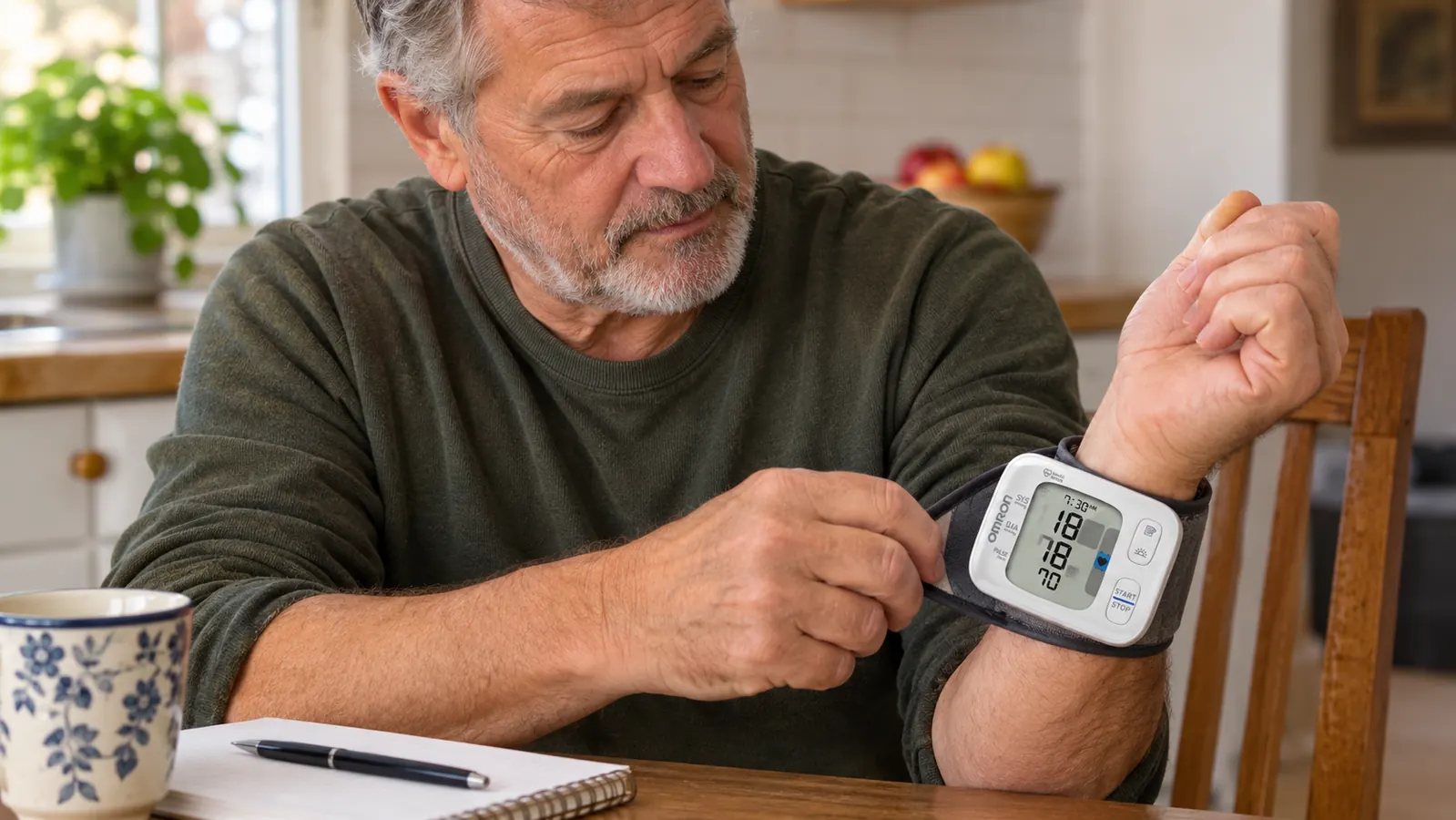
Two people can keep separate records on one machine, up to 200 readings each
This matters in a house with two people checking. Gene's mornings are not my mornings, and I do not want to scroll past his numbers to find mine. The Omron holds two sets, 200 readings each, and you switch between them. When I sit down I am on my own record. When he sits down he is on his. One machine in one drawer, nobody guessing whose morning was whose.
The irregular heartbeat indicator gives you something to write down and hand over
If it notices something irregular while it is taking the reading, a symbol shows up next to the numbers. I am not going to tell you what that means, because I do not know and neither does the machine. What I do know is that I wrote the date down the two times it happened and handed the whole thing to my doctor, instead of lying awake trying to remember whether it was Tuesday or Thursday.
The high morning average indicator is built for the before-coffee crowd
My doctor is the one who told me morning readings are worth watching, and the Omron has a high morning average indicator for exactly that. It looks at your morning readings as a group rather than one at a time, which is a fairer picture than any single number. I check before coffee, same as always. After a couple of weeks I have something to show that is more useful than one reading that could have been anything.
Two AAA batteries, included, and no cord across the kitchen table
It runs on two AAA batteries and they come in the box, so it works the day it arrives. No cord, no dock, no outlet needed at a table that already has a toaster and a radio on it. I keep a spare pair in the drawer next to it, because a dead monitor on a morning you meant to check is its own small annoyance and entirely avoidable.
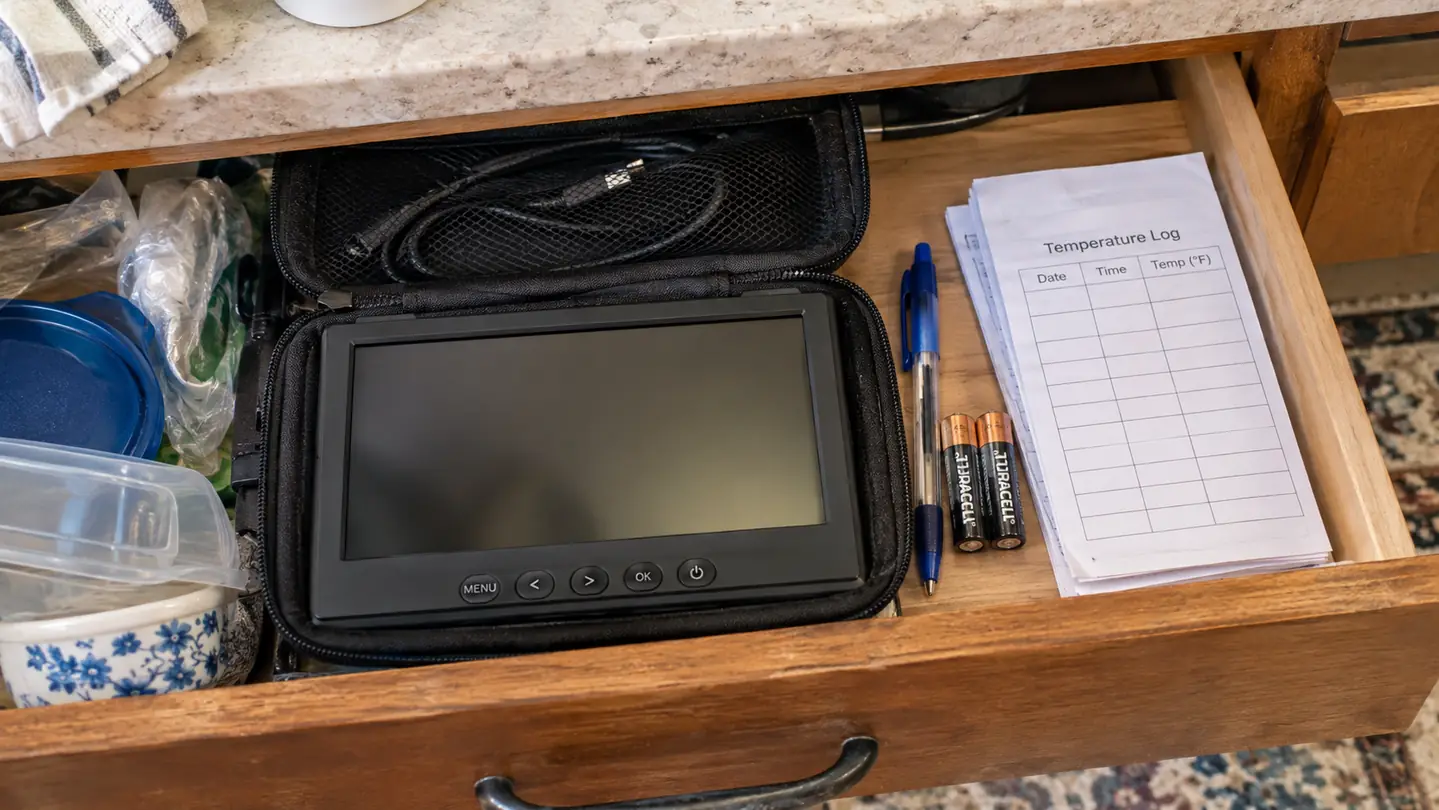
It measures about 3.6 by 2.5 inches and weighs 3.2 ounces, so it travels
Small enough to live in the kitchen drawer with the pens and the takeout menus and still be there when I want it. Small enough, also, to go in my purse when we drive to my sister's for a week, so I do not come home with a hole in the log. A monitor that stays home is a monitor I stop using, and I have proven that with other things.
A digital readout with no dial to read at an angle
The readings come up on a digital display. No dial to sight across, no needle to squint at, nothing to interpret. I wear glasses for reading and I have never had to go hunt them down to see what the machine said. For me that is the difference between checking twice a day and checking when I happen to remember.
The included case keeps the whole thing together in the drawer
This sounds like a small thing until you have lost a cuff behind the silverware divider. The case holds the monitor and the band as one lump, so nothing goes missing and nothing gets tangled with the spatulas. When we travel it goes in the suitcase in one piece instead of three loose ones. Small things. Small things are what keep a routine going for months.
It makes the same position easy to repeat, and repeatable is the point
A wrist reading depends on where your wrist is. I learned that the hard way in week one, when I took a reading with my arm hanging down and got a number that made no sense. Now I do it the same way every time. Feet flat. Back against the chair. Forearm on the table. Wrist at about the height of my heart. Same chair, same table, twice a day. When the position is the routine, the readings stop wandering for no reason.
Two hundred readings is more than I will ever fill. What matters is that the machine keeps mine and Gene's separate, so neither of us is guessing whose morning was whose.
It gives you a record to hand your doctor instead of a memory
Every reading stays in the machine, so at the end of three weeks I have a record and not a handful of scribbles on the back of an envelope. I still write the morning and evening numbers in a little notebook because I am 67 and I like paper. But on the days I forget, the Omron has it. That is the whole point of the exercise my doctor gave me. Bring in what actually happened.
What I'd Skip
A few things I would skip, and one I would not rush past. I would skip reading anything into a single high number. One reading is one reading, and it will scare you for no reason at all. I would skip checking right after coffee, after a phone call that got your blood up, or while you are still putting groceries away. Sit for five minutes first. I would skip ignoring the instructions in the box, which I did at first and then had to start over. And I would think hard about the fit before anything else. The Omron Gold band is 8.5 inches. If your wrist is bigger than that, this is the wrong shape of monitor for you and no amount of convenience fixes it. If your doctor wants upper arm readings, buy an upper arm monitor. A wrist cuff is convenient, and convenient is not the same word as correct. Whichever you use, the readings go to your doctor. Not to a search engine, not to me, not to a neighbor with strong opinions.
Start the log your doctor asked for, one morning at a time
Same chair, same table, twice a day. The Omron Gold keeps two users with 200 readings each and comes with a case so it does not get lost. Bring the numbers in and let your doctor read them.
Amazon See Today's Price on Amazon →