
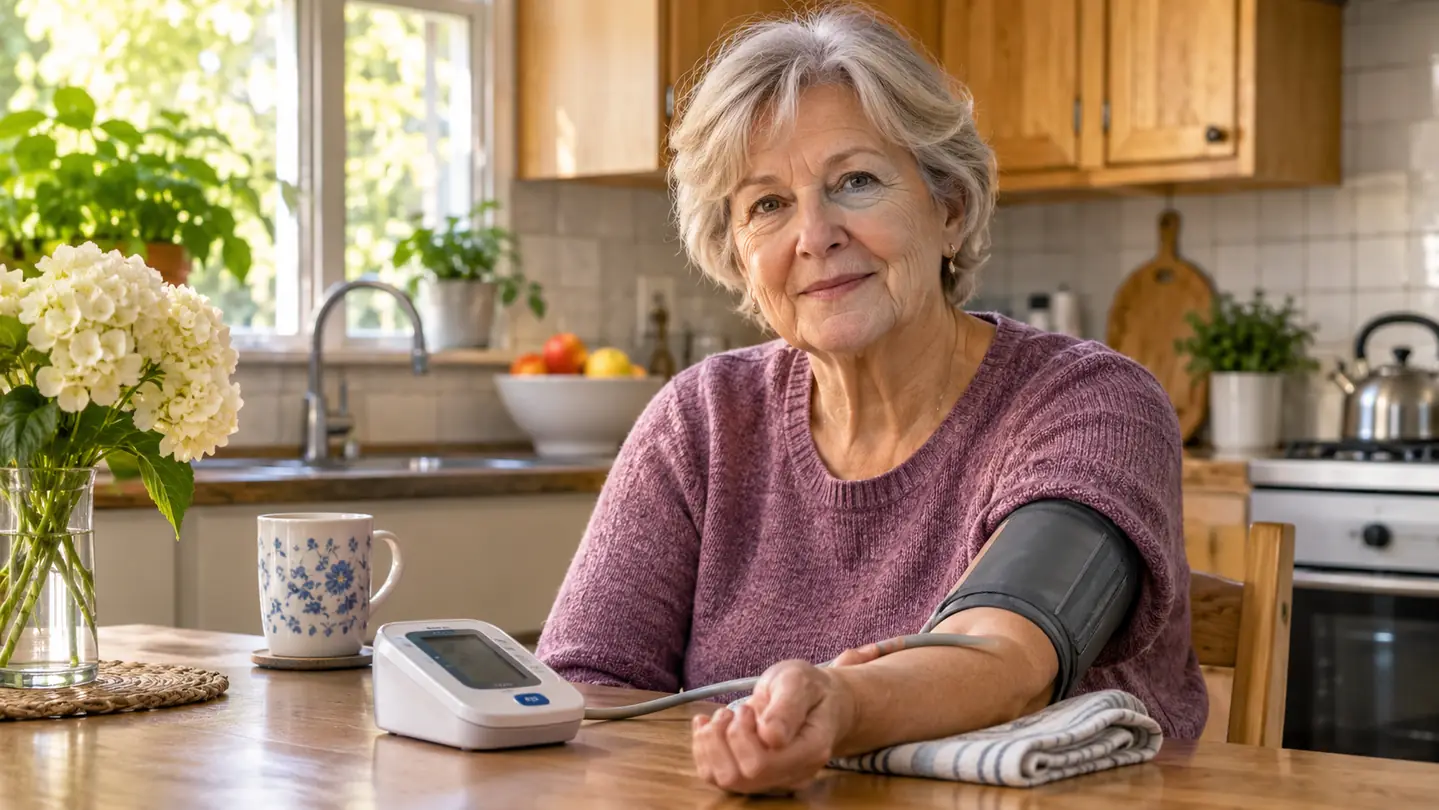
My first home cuff was a hand-me-down with a bulb and a gauge, and I never did trust the numbers it gave me. My readings at the doctor's office had been running higher than they used to, so my doctor asked me to check at home twice a day for a few weeks and bring the log in with me. That is how the Omron Gold Wireless Wrist monitor ended up in the kitchen drawer next to the potholders. It has been there for months now, through spring and a cold snap and one week at our daughter's house, and I have used it more mornings than I have missed.
I am 67, retired after thirty-one years as a bank teller in Lawton, Oklahoma, and I am not a nurse. My husband Gene is 70 and retired as well, and he takes his own readings with the same machine, which is the main reason we chose this model over a plainer one. What follows is not medical advice and it is not a promise about anybody's health. It is one household's plain account of what this little monitor is like to live with, what it does well, and the two or three things that made me set it down and take a breath before trying again.
The Quick Verdict
Small, quick, and it keeps two separate histories, so Gene's numbers never land in my log. It is particular about wrist height, and in a cold kitchen my hands need a few minutes of warming before a reading settles.
Amazon Check Today's Price →The monitor that earned its spot in the kitchen drawer
A wrist cuff, two users, 200 stored readings each, and a case that keeps the dust off. Today's price and the full listing are on Amazon.
Amazon Check Today's Price on Amazon →How I've Used It
My routine is the same every day, because the only thing I know for certain about home readings is that they are easier to compare when you do the same thing each time. I sit at the kitchen table before my first cup of coffee, feet flat on the floor, and I rest my left forearm on the table with the cuff at about the height of my heart. Then I sit still and let it do its work. I do it again after supper, before the dishes, and I write both numbers in a small notebook with a blue cover.
The first two weeks were the learning curve. My doctor wanted a log, and I wanted to hand over something that looked like I had actually tried. The monitor made that part easy. It stores 200 readings for each of two users, so I could check in the morning, check again at night, and page back through the history when I sat down to copy numbers into the notebook. I did not have to remember Tuesday's reading on Friday. That sounds like a small thing until you are 67 and the week has blurred together.
Gene started using it about a month after I did, mostly because he got tired of watching me. His routine is different from mine. He checks in the late afternoon, after his walk, and he sits in the same chair but with a cushion under his arm because his wrists are thicker than mine and he likes the cuff a little higher up. The monitor does not mind. It keeps his 200 readings separate from my 200, and we have not once mixed up whose numbers are whose.
Getting the Cuff at Heart Level Is Most of the Job
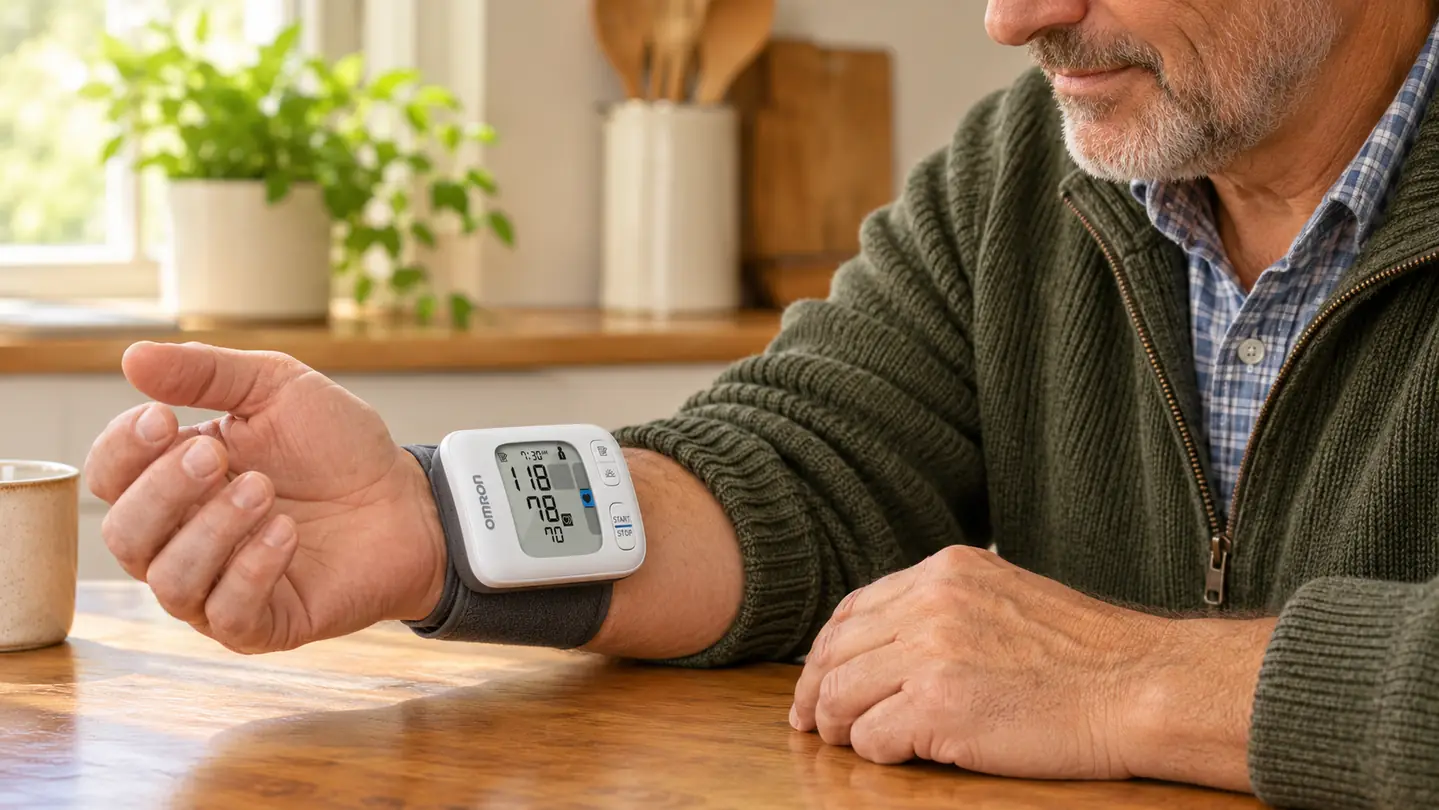
Here is the thing nobody told me about a wrist monitor. Position matters more than it does with the arm cuff they use at the office. If my wrist is hanging down by my side, the reading comes out different than it does when my arm is up at heart height. I learned that the slow way, by taking a reading, looking at it, and realizing my arm had drifted down to my lap halfway through.
Now I set my elbow on the table and rest the cuff against my chest, or I fold a dish towel and prop my forearm on it until the cuff sits level with my heart. It adds maybe fifteen seconds to the routine. It also means I trust the numbers more, which is the entire point of doing this at home instead of guessing.
The other lesson was about cold hands. In January our kitchen is drafty, and a cold wrist gives a fussy reading. I warm my hands on a mug first, or I run them under the tap for a minute, and then I sit down and start over. Gene thinks this is funny. It is not funny, it is just what the machine wants, and a reading I do not trust is a reading I will not write down.
Two Users, One Monitor
Two users sounds like a line off the box until you are the one keeping a log for a doctor's appointment. Gene and I were sharing a paper notebook before this, and twice we wrote a reading in the wrong column, and once we could not agree on which of us had taken the eight o'clock reading on a Tuesday. That has not happened since. Each of us has a separate history on the device, up to 200 readings each, and we can page back through it one reading at a time.
Two hundred readings is more room than I will ever use between appointments. I check twice a day, so that is fourteen readings a week, and my appointments run about every three months. I clear nothing out. I let it fill and copy what I need into the notebook the night before I go in.
I still write the numbers down by hand. The monitor keeps them, but my doctor's office wants a sheet of paper with dates and times, and I would rather hand over something I wrote than try to read a small screen aloud in an exam room. That is a habit, not a complaint. If you are comfortable reading the history off the device, you can skip the notebook entirely.
The Morning Average and the Irregular Heartbeat Indicator
Two features on this monitor are worth explaining in plain words, because the names on the box do not tell you much. The first is the high morning average indicator. The monitor will show you an average of the readings you took in the morning over a stretch of days, rather than one reading on its own. My doctor was the one who brought up morning readings in the first place. She said morning is when she likes to see the pattern, and having an average already worked out meant I was not doing arithmetic at the kitchen table with a pencil.
The second is the irregular heartbeat indicator. If the monitor notices something irregular in the rhythm during a routine measurement, it lets you know. It is not a diagnosis and it does not tell you what is wrong. The first time it showed up on my screen I sat there for a minute, then I called the nurse line and read her the number and the note. She told me to bring the monitor's history to my next appointment, which I did. That is the right use of a feature like this. It points you toward a conversation with your doctor. It does not replace one.
I want to be careful here. Neither of those features is a reason to buy a monitor and then relax. They are reasons to keep a better log and to show up to your appointments with something in your hand.

What I Bring to the Doctor Now
Before this monitor, I brought a number I had scribbled on the back of an envelope and a vague memory of how I had been feeling. Now I bring the notebook, dated and timed, with the morning readings in one column and the evening readings in another. I bring the monitor's own history too, in case she wants to see the days I forgot to copy over. It takes me about ten minutes the night before, and the appointment goes differently when I do it. I get asked fewer questions I cannot answer.
The one thing I would tell anyone starting this is to keep the routine dull. Same chair, same arm, same time, same notebook. The monitor is only as useful as the habit around it, and the habit is the part you have to supply.
What It Is Like to Live With, Months In
The unit itself is small. It weighs a little over three ounces and measures roughly 3.6 by 0.5 by 2.5 inches, so it fits in the drawer without taking over, and the case that comes with it keeps the cuff from picking up whatever else is on the shelf. It runs on two AAA batteries, which came in the box. I have not had to think about batteries yet, and when I do it will be a trip to the junk drawer, not a service call.
The cuff is listed at 8.5 inches, and that is the number that matters if your wrists run on the larger side. Gene's wrists are bigger than mine and the cuff still wraps on him with room to spare. If your wrists are much bigger than that, an arm cuff is probably the better choice, and I would say so to your face at the kitchen table.
My real complaints are small and I want to be honest about them. The screen is small, and I have to hold the monitor out and put my reading glasses on to see the history clearly. Reading back through past readings is one at a time, which is fine for a week and tedious for a quarter. And because it is a wrist monitor, the numbers are not identical to the arm cuff at the office. My doctor explained that different cuffs and different positions give somewhat different numbers, and what matters is the pattern over time, not matching one machine to the other to the decimal.
None of that made me stop using it. Those are the trade for a monitor that fits in a drawer and takes a reading in under a minute.
What I Liked
- Two separate histories, 200 readings each, so a couple can share one monitor without mixing logs
- Small and light enough to live in a kitchen drawer, with a case included
- The morning average saves you from doing arithmetic before coffee
- The irregular heartbeat indicator gives you something specific to raise with your doctor
- Setup was two AAA batteries and a few minutes with the little booklet
Where It Falls Short
- The wrist has to sit at heart height or the reading is not worth writing down
- Cold hands make it fussy in winter
- The screen is small for older eyes, especially when paging back through history
- History is one reading at a time, so you will still want a paper log for appointments
- The listed 8.5 inch cuff size will not suit every wrist
It stores 200 readings for me and 200 for Gene, so neither of us has to remember a number from Tuesday. That alone is worth more to me than anything else on the box.
Who This Is For
This monitor suits a household like ours. Two people, one kitchen table, a doctor who asked for a log, and no interest in a device that needs a phone or a printer to be useful. It suits someone who will actually sit still for a minute with their arm propped at heart height. If you are willing to do that, the readings are steady and the history is genuinely useful when you sit down in an exam room.
It also suits someone who travels a little. The case and the batteries make it easy to put in a bag for a week at a daughter's house, which I have done twice now without thinking about it.
Who Should Skip It
If your wrists are large, or if your doctor has told you to use an arm cuff, skip this one and get an upper arm monitor. That is not a knock on the Omron. It is the right tool for a different job, and the arm cuff is the one most offices compare against.
Skip it too if you want a device that prints, or one that talks you through each step, or one that files everything for you. This is a small machine that takes a reading, keeps a history, and gets out of the way. If you will not sit still for sixty seconds with your arm propped up, no monitor will give you a number you can trust, and this one will just make you cross.
And if you are looking for something to tell you that you are fine, this is not that. It is a way to bring better information to the person who actually treats you.
If your doctor asked for a log, start with a monitor you will actually use
The Omron Gold Wireless Wrist holds two users and 200 readings each, and it lives in a drawer without complaint. Take the numbers to your doctor. Today's price is on Amazon.
Amazon Check Today's Price on Amazon →