
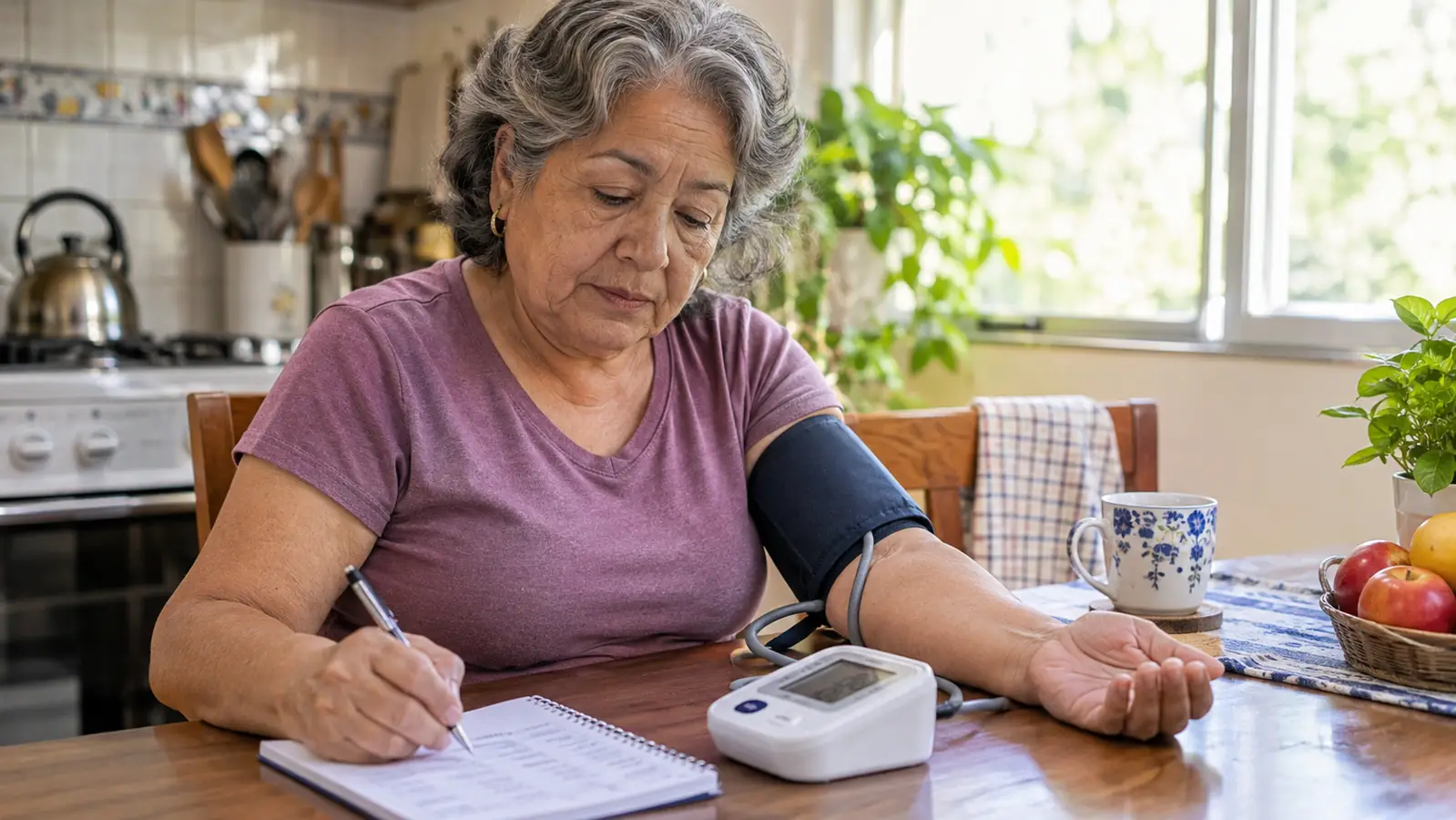
If you are trying to choose between the Omron Gold Wireless Wrist Blood Pressure Monitor and a standard upper arm monitor, here is the short answer. The wrist unit is the one that fits a small house, a shared kitchen table, and a travel bag. The upper arm unit is the one that feels closer to what happens at a doctor's office. I am Beverly, 67, a retired bank teller in Lawton, Oklahoma. My husband Gene and I check our blood pressure at home because my doctor asked me to keep a log and bring it in. We have used both styles, and the monitor that stayed in our kitchen drawer is the Omron Gold Wrist.
The reason is not complicated. The Omron Gold Wrist stores up to 200 readings each for two users, so Gene and I do not mix up our numbers. It also has a high morning average indicator and an irregular heartbeat indicator. A standard upper arm monitor gives you the bicep cuff placement that many people recognize from the clinic. Neither monitor replaces your doctor. The right pick is the one you will actually use twice a day and take to your next appointment.
| Omron Gold Wrist | Standard upper arm monitor | |
|---|---|---|
| Cuff placement | Cuff wraps at the wrist, so it is easy to put on at the kitchen table | Cuff wraps the upper arm, the placement many clinicians use in the office |
| Cuff fit | Band listed at 8.5 inches, so measure your wrist before you buy | Upper arm cuffs often come in more than one size, but you have to check the listing |
| Memory | Stores up to 200 readings each for two users | Varies by model, and some store only one user's readings |
| Morning average | High morning average indicator is built in | Not every upper arm model includes this, so check the listing |
| Irregular heartbeat note | Irregular heartbeat indicator is listed | Common on many upper arm models, but check your specific model |
| Portability | 3.2 ounces, small enough to keep in a kitchen drawer or take in a bag | Bulkier because of the arm cuff and tubing |
| Setup | Battery powered, put it on, and take a reading | Cuff and tube take a little more arranging before you take a reading |
| Shared use | Two users can keep separate readings in one monitor | Varies, and some models are set up for one user |
| Familiar placement | Wrist readings take some getting used to | Feels closer to what happens at a doctor's office |
| Best for | Travel, small spaces, and quick checks in a familiar chair | Someone who wants the upper arm routine and has room to set it up |
Where the Omron Gold Wrist Wins
The first win is sharing. Gene and I are past the stage of keeping two paper logs and hoping we grab the right one. The Omron Gold Wrist stores up to 200 readings each for two users, so his morning readings and mine stay in separate memory. That sounds like a small feature until you are flipping through a notebook trying to remember which column belongs to whom. I still keep a paper log because my doctor likes dates and times, but the monitor's memory gives us a clean record to compare against.
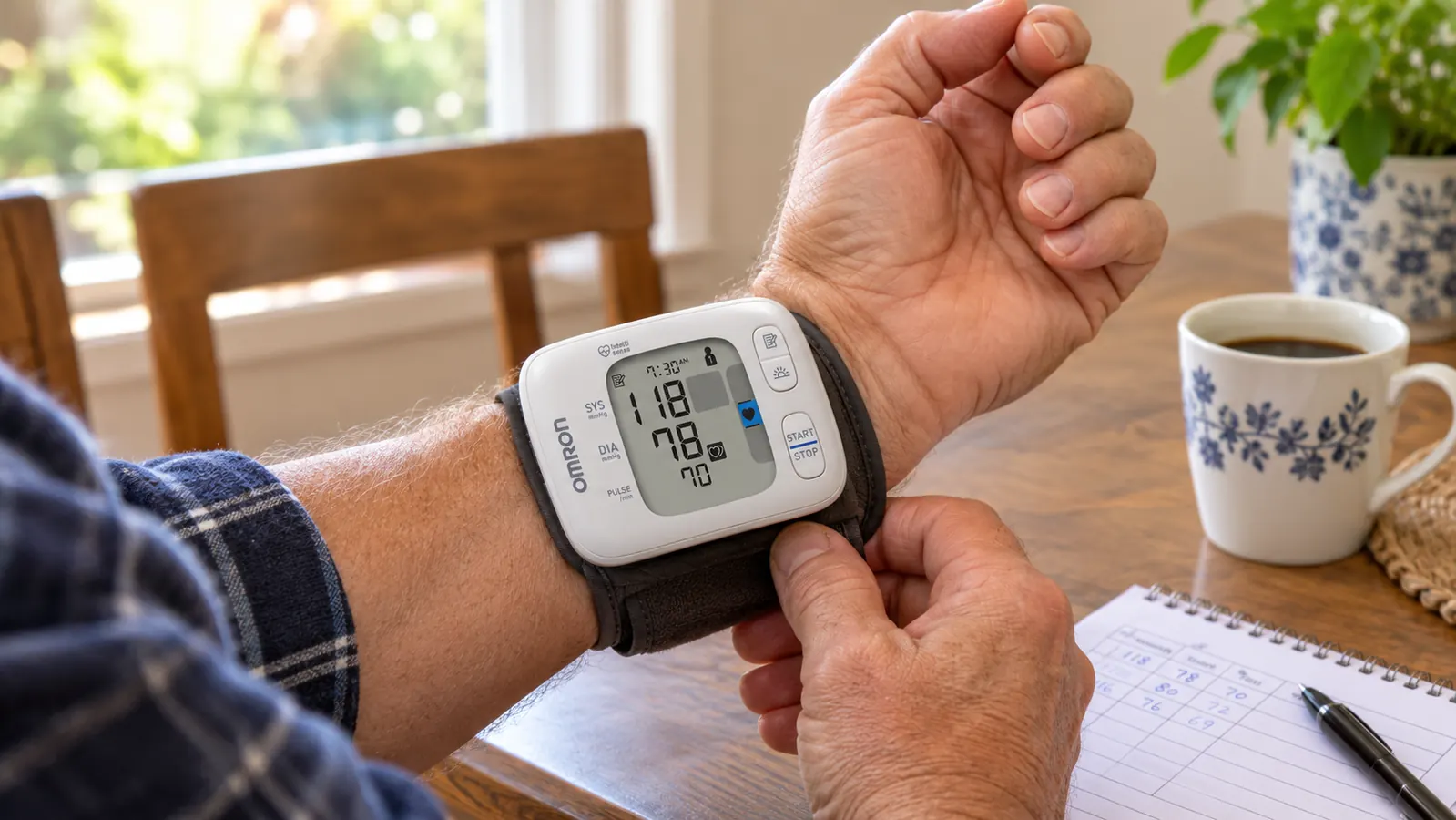
The second win is the morning average. The high morning average indicator is the feature I did not know I wanted. My routine is simple. I sit at the kitchen table before coffee, feet flat, arm resting on the table, and I take a reading. The monitor keeps track of the morning readings so I can show my doctor a pattern instead of one number I happened to write down. The irregular heartbeat indicator is there too. I do not try to interpret it. I write it in the log and mention it at my appointment. The monitor records, the doctor interprets.
The third win is size. The Omron Gold Wrist is 3.2 ounces and listed at 3.58 by 0.52 by 2.49 inches. It comes with a case, and it runs on two AAA batteries that are included. It lives in the kitchen drawer next to the pens, and it goes in my purse when we visit our granddaughter. The band is listed at 8.5 inches, so measure your wrist before you order. A monitor that does not fit is not convenient, no matter how small it is.
Where the Upper Arm Monitor Wins
The upper arm monitor wins on familiarity. If your doctor's office uses an upper arm cuff, that is the placement you have seen and the one you may trust first. There is nothing wrong with wanting the routine that feels familiar. When I first started checking at home, I was not sure I was doing the wrist cuff right, and I second-guessed every reading. An upper arm cuff felt more like the office. For some people, that comfort is the difference between a monitor that gets used and one that stays in the box.
The upper arm monitor also wins on cuff fit options. Upper arm cuffs commonly come in more than one size, so you can measure your arm and look for a cuff that matches. Wrist monitors are more limited. The Omron Gold Wrist lists an 8.5 inch band, and that is the size you get. If your wrist is much smaller or larger, check the fit before you buy. The upper arm style is also less portable because of the cuff and tubing. It is better for a person who checks in the same chair every day and does not need to carry it.
If the small shared monitor sounds like your kitchen table, start here
The Omron Gold Wrist stores two users' readings, tracks morning averages, and fits in a drawer.
Amazon Check Today's Price on Amazon →What Two Weeks of Switching Taught Me
We did not run a science experiment. We did something simpler. On a Monday in early spring we put the wrist monitor on the kitchen table and borrowed an upper arm monitor from a neighbor for two weeks. We kept our usual routine: morning before coffee, evening before the news. We wrote the time, which cuff we used, and anything odd, like a cold hand or a sleeve that was too tight. Then we set the two logs side by side on the table and read them out loud to each other.
The wrist monitor was faster to put on. I could do it sitting down with one hand, and I did not have to roll up a sleeve past my elbow. The upper arm monitor took more arranging. The cuff had to go on the bare arm, and the tubing had to be routed so it was not pulling. Gene has a bad shoulder, and he liked the wrist unit better for that reason alone. He tried the arm cuff twice that first week and then asked me to stop handing it to him.
The upper arm monitor was easier to trust at first. That is the honest truth. I kept thinking, this is how they do it at the office. But after two weeks, my wrist readings were consistent enough that I stopped second-guessing the position. I still bring the log to my doctor, and I do not change anything on my own. The monitor is a tool for recording, not a replacement for a visit. If a reading ever looks strange to me, I take it again after five quiet minutes and write both numbers down.
The monitor that fits your routine is the one you will actually use. For us, that is the Omron Gold Wrist in the kitchen drawer, not a bigger cuff in a closet.
The Features I Actually Use
I use the memory more than any other feature. Two users, up to 200 readings each, means I can hand the monitor to Gene and not worry that his numbers will overwrite mine. When my doctor asks how the mornings have been, I can page through the stored readings instead of squinting at my handwriting. The paper log is still there, but the monitor does the heavy lifting.
I use the high morning average indicator as a conversation starter. It does not tell me what to do. It gives me something specific to show my doctor. That is the part people miss when they compare monitors. A feature is only useful if it helps you and your doctor see a pattern. A number without a date and time is just a number. A morning average with a log behind it is something we can talk about.
I use the case more than I expected. The monitor lives in the kitchen drawer, but when we travel, the case keeps the band from getting twisted around a phone charger. The two AAA batteries are included, so there is no scavenger hunt on the first day. The digital display is easy to read in the morning light. I do not need a color screen. I need a reading I can write down.

What I Would Check Before You Buy
First, measure your wrist. The band is listed at 8.5 inches, and a wrist monitor is not a one size fits all item. Use a cloth tape or a piece of string and a ruler. I did this at the kitchen table with the string from a package I had just opened, and I marked it with a pen before I measured it. If the fit is close to the limit, look at an upper arm monitor with a cuff size that matches your arm. Do not guess. A loose cuff or a tight cuff is a waste of money and patience.
Second, decide where the monitor will live. Ours lives in a kitchen drawer because the kitchen table is where we sit. If you plan to check in a recliner in the den, an upper arm monitor with a table beside it may be easier. If you plan to travel or you have a small bathroom counter, the wrist unit makes more sense. Third, ask yourself who will use it. If two people share one monitor, the dual user memory on the Omron Gold Wrist is a real advantage. If only one person will use it, that feature matters less.
A Word About Fit and Position
Wrist monitors are sensitive to position. My doctor told me to rest my wrist at heart level, and I use the kitchen table to make that easy. I put a folded dish towel under my forearm so my wrist is not floating. I do not talk, I do not cross my legs, and I do not take a reading right after carrying groceries. The first month I did it wrong more than once. I would take a reading standing at the counter with my arm hanging down, and the number would look off, and I would worry for an hour over nothing. Now the towel and the chair come first. Those are not shortcuts. They are the basics of getting a useful log.
Upper arm monitors have their own routine. The cuff goes on the bare upper arm, and the arm needs to be supported. That can be easier for some people and harder for others. If you have trouble rolling up a sleeve or reaching across your body, the wrist unit may be the more practical choice. If you have plenty of room and you want the familiar feel of the office cuff, the upper arm unit is a reasonable choice. Either way, measure your cuff size and read the manual. The manual is dull, but it is where the position instructions live, and position is most of the job.
Who Should Buy Which
Buy the Omron Gold Wrist if you share a monitor with a partner, if you check at a kitchen table or in a small space, if you travel, or if you want the memory and morning average in one small unit. It is also the one I would pick for someone who has trouble with sleeves or shoulder movement. Measure your wrist first, because the band is listed at 8.5 inches. If it fits, the rest of the routine is simple. Gene and I have kept ours in the same drawer for over a year now, and it has not moved.
Buy a standard upper arm monitor if you want the placement you have seen at the doctor's office, if your clinician has asked you to use an upper arm cuff, or if you have room to leave it set up in one spot. It is not the one I would pack for a trip. And whoever you are, bring the readings to your doctor. I do not change anything on my own based on a home reading. I bring the log and let my doctor tell me what it means.
Put the readings in your bag and take them to your doctor
The Omron Gold Wrist is the one we keep in the kitchen drawer, with two users' readings and a morning average ready to show.
Amazon See the Omron Gold Wrist on Amazon →