
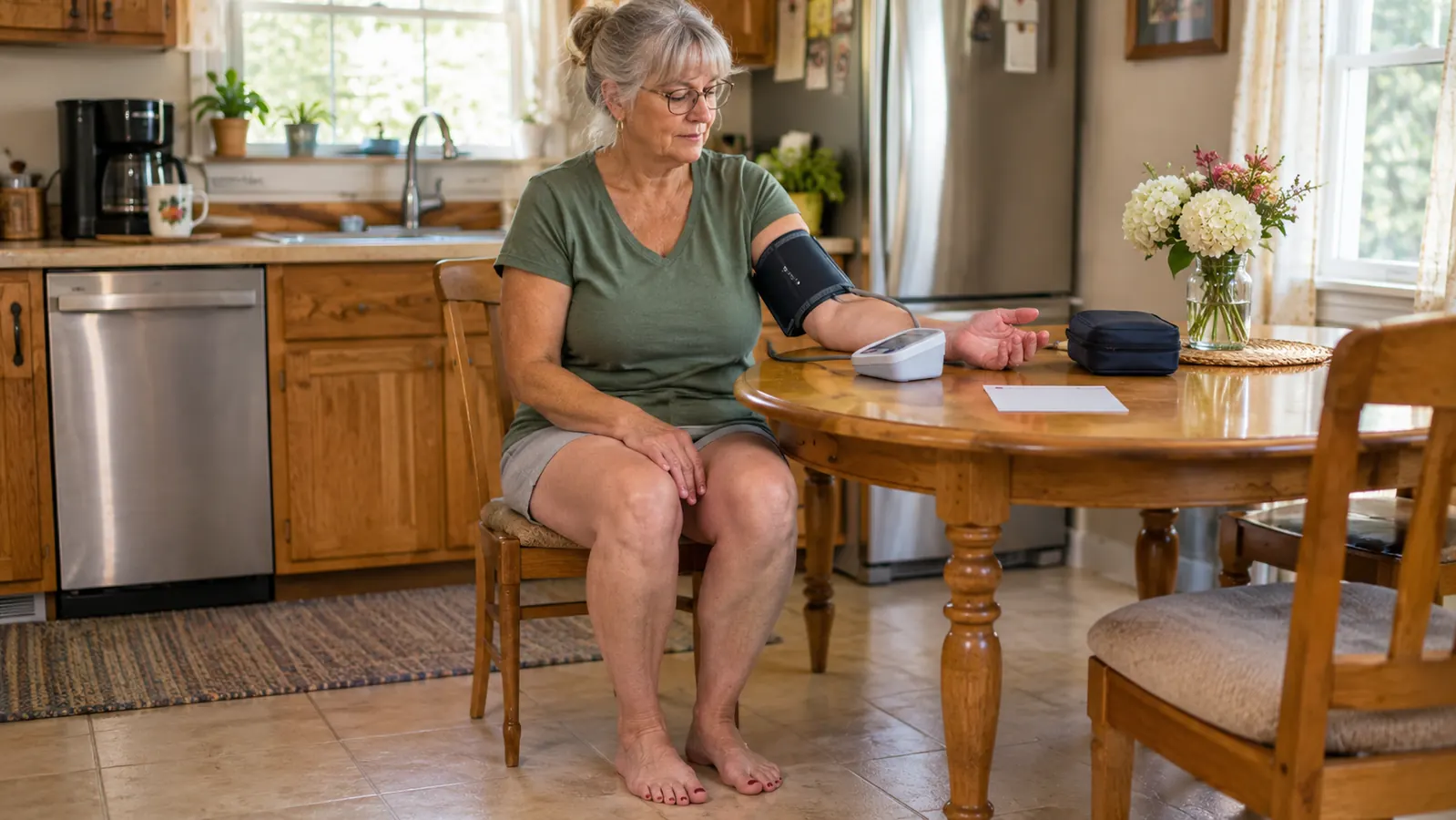
I did not want to like this thing. I bought the Greater Goods upper arm blood pressure monitor last spring because my doctor asked me to start checking at home twice a day and bringing her the numbers, and I am too stubborn to buy the first machine I see. So I read every review I could find, most of which said it was easy to use, gave it five stars, and told me nothing I could actually use. Two months later it lives in the kitchen drawer by the potholders and I use it morning and evening. But there are a handful of things about it I wish somebody had said to me straight before I opened the box, and that is the whole point of this piece.
Here is my situation, so you can judge whether it matches yours. I am 67, retired from a bank in Lawton, Oklahoma, and my husband Gene is 70. Our readings are different enough that we wanted one machine with two memories rather than two machines arguing for drawer space. We check at the kitchen table with our feet flat and our arm resting on the table, before coffee in the morning and again in the evening. That is the entire routine. One monitor, two people, twice a day. If your situation looks like ours, this will be useful. If it does not, I will tell you plainly who should walk away.
The Quick Verdict
A small, unglamorous, one-button monitor that does the basic job well. Measures systolic, diastolic and pulse, holds 60 readings per user, runs on four AAA batteries. Know the 16.5 inch cuff ceiling and the profile button before you order and you will be happy with it.
Amazon Check Today's Price →If your upper arm measures inside 8.75 to 16.5 inches, this is the one I would start with
That is the whole decision for most people. Measure your arm with a cloth tape, check that range against your number, and the rest of this monitor is simple.
Amazon Check Today's Price on Amazon →What Nobody Tells You Before the Box Arrives
The first thing nobody tells you is that an upper arm monitor is only as good as its cuff, and the cuff is the one part you cannot change after you buy. This one is listed at 8.75 to 16.5 inches around the arm, which is 22 to 42 centimeters. That is a wide range. It is not an infinite one. Go measure your upper arm with a soft tape before you order, around the middle of the arm between shoulder and elbow, not up near the top. If you come in over 16.5 inches, this is not your machine no matter how many good reviews it has, and no amount of careful sitting will fix that.
The second thing is the profile button. This monitor holds two users, 60 readings each, 120 total. You turn it on, you choose User 1 or User 2, then you press Start and the cuff inflates and deflates by itself. Once the profile is picked, it genuinely is one button. What nobody warns you about is that the profile is a step you have to remember, and at six in the morning in a kitchen, remembering things is the hard part. Gene and I spent our first two weeks filing readings under each other's names, which made the log my doctor asked for look like a science experiment.
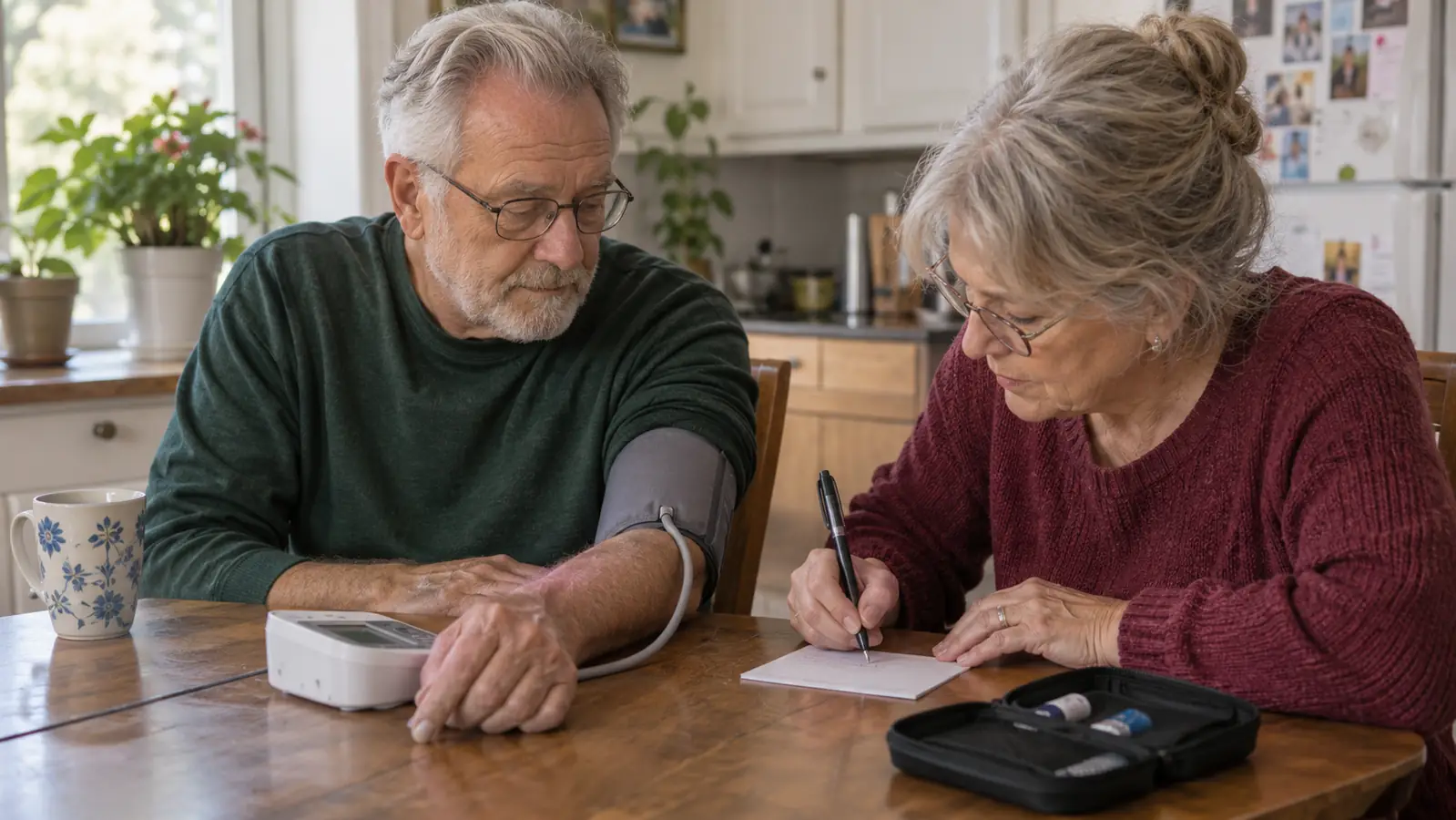
The third thing is arithmetic. 60 readings per user sounds generous right up until you divide it. Twice a day means the memory holds about a month of checking. My doctor wanted six weeks. So the machine's memory and my paper card have to agree with each other, and they will not if I am leaning on the machine alone. I write mine on an index card every morning without fail. The monitor is the measurement. The card is the record. Once I treated those as two separate jobs, the whole routine got easier.
How I Actually Use It, Morning and Evening
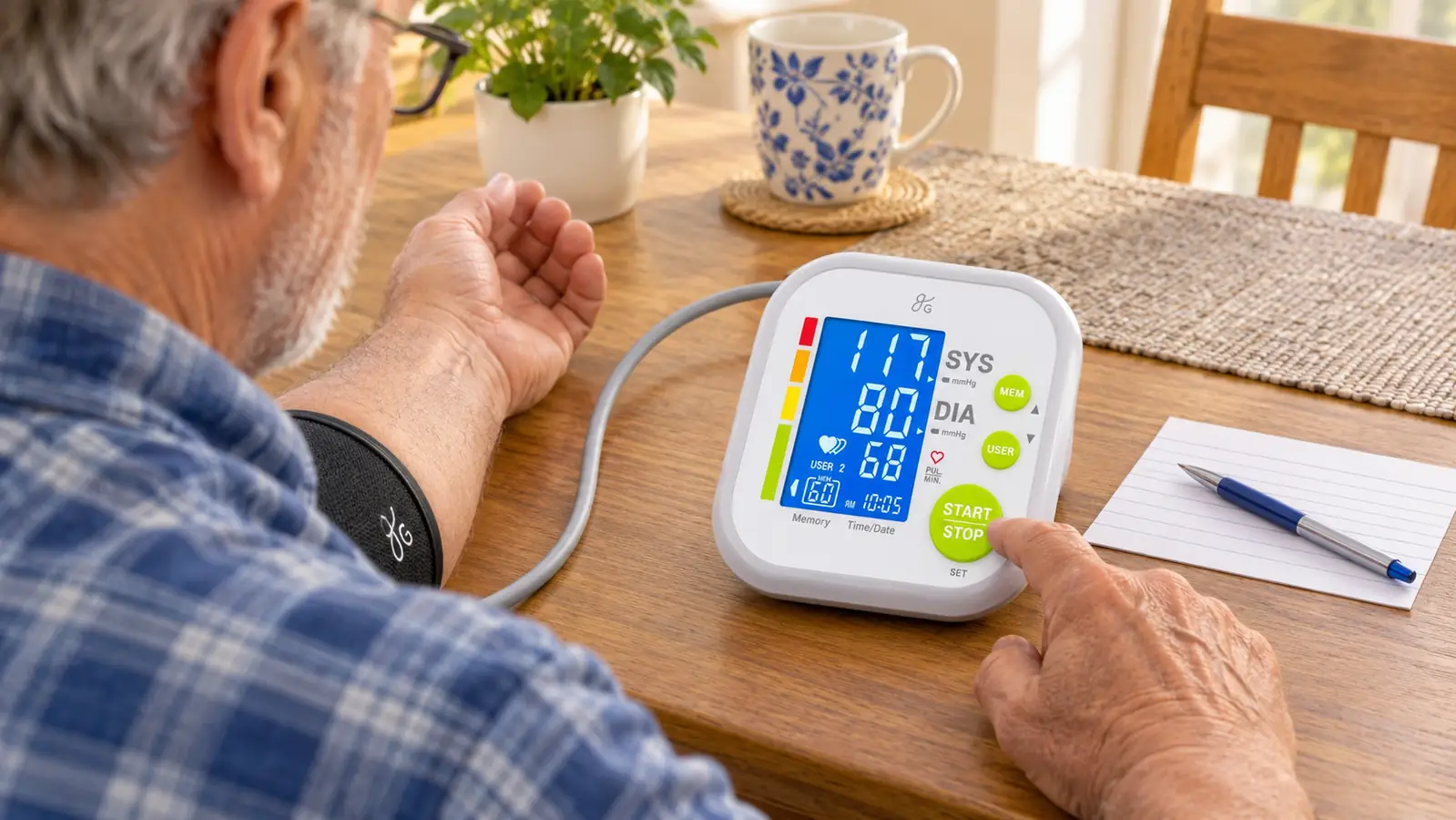
The routine takes about a minute and a half, and that includes sitting still for a moment before I start. I put my feet flat on the floor, rest my left arm on the table with the palm up, and wrap the cuff around the middle of my upper arm. It fastens with a hook and loop strip and pulls snug. The instructions in the box walk you through exactly where the cuff should sit. The first week I did it from memory and the second week I actually read the sheet, and my readings got steadier once I did. Then I press Start and watch the cuff fill and empty.
The display shows systolic and diastolic pressure plus pulse rate on an LCD screen, and the numbers hold long enough that I can read them without hunting for my glasses and then write them down. Gene reads his out loud from across the table so we both hear them. That habit has nothing to do with the machine and I recommend it anyway. The cuff itself takes some getting used to. It is not painful, but it is firm, and the first few times I braced against it, which of course moved the numbers around on me.
What I appreciate most is how unremarkable the whole thing is. It measures 7.25 by 5.25 by 3.25 inches and weighs 6.4 ounces, so it drops into the case it comes with and disappears into the drawer until the next morning. There is no menu to get lost in and no setup I have to re-learn every few weeks. That matters more at my age than I expected it to. I have owned enough small electronics that needed a younger person to explain them. This one I sorted out from the box on my own.
The monitor is the measurement. The index card is the record. Treat them as two separate jobs and the whole routine gets easier.
The Cuff Fit Decides Everything
If you take one thing from this review, take this one. Arm size is the whole ballgame, and it is the thing listings bury and reviews skip. A cuff that is too small for a bigger arm can push a reading up higher than it should be, and a cuff that is too loose can come out low or simply fail to get a reading at all. Neither one is the machine lying to you. It is the cuff being the wrong size for the arm inside it. The 8.75 to 16.5 inch range on the Greater Goods covers a lot of adults, including both of us, but it does not cover everybody, and no monitor covers everybody.
So measure. Take a soft tape around the middle of your upper arm while you are standing relaxed with the arm at your side, and write the number down before you go shopping. If you land near the top of the range, be honest with yourself instead of rounding down because you like the look of the machine. And if you are unsure or sitting right on the edge, ask the pharmacist at your drugstore to check the fit. I did that years ago with my first monitor and I would do it again in a heartbeat. It costs you a few minutes and saves you a return.
The other fit question is the arm position, not the size. This is an upper arm monitor, so the cuff goes on the arm rather than the wrist, and that means you need a table at a workable height and a chair you can sit squarely in. Ours is the kitchen table, same chair, same corner, twice a day. If your only comfortable seat is a recliner in the living room, think ahead about whether you can set up a steady flat surface nearby. A wobbly setup shows up in the numbers, and then you will blame the monitor for something the furniture did.
Two Users, Sixty Readings Each, and One Small Catch
The two-user memory is the reason we chose this model over something plainer, and I would choose it again for that alone. 120 readings total, 60 for each of us. Gene writes his down when he remembers and I write mine down every single time, and neither of us has to scroll past the other's numbers or keep a separate notebook with somebody else's initials scribbled on the cover. For a couple sharing one drawer, it is the right amount of memory and the right number of profiles.
The catch is the one I mentioned earlier, and it is not really a defect. It is a habit problem wearing a defect's coat. When the screen comes on and asks which user you are, you have to actually look at it. In our house the monitor sits in the drawer overnight, so whoever reaches it first in the morning is choosing the profile for the day. We solved it by deciding that I always go first. If you are not a person who likes house rules, put a sticky note on the case. Do not laugh. It worked for us for a solid month.
One more honest note on the memory. The 60-reading limit is plenty for a couple of weeks of careful logging and thin for a couple of months. It is not a record-keeping system and it does not claim to be. If your doctor wants a written summary, you will be copying from your own notes onto a card or a sheet. That is not a knock on the monitor. It is a knock on expecting a small battery-powered device to do the job of a filing cabinet.
What I Liked
- The 8.75 to 16.5 inch cuff range covers most adult arms, so one monitor can serve a couple
- One press of Start once a profile is chosen; the cuff inflates and deflates on its own
- Two separate memories at 60 readings each, so Gene and I never mix up our logs
- Small and light at 7.25 by 5.25 by 3.25 inches and 6.4 ounces, and the included case keeps it tidy
- Runs on four AAA batteries that come in the box, so no cord across the kitchen table
- Flags an irregular heartbeat, which I write down and hand to my doctor rather than reading myself
Where It Falls Short
- Over 16.5 inches around the upper arm and this cuff will not fit, so measure before ordering
- You have to remember to pick your profile every time or the reading lands under the other person
- 60 readings per user fills up in about a month at twice a day, so a paper log is still required
- Battery powered per the listing, with four AAA in the box and no cord option described
- The screen shows numbers, not explanations, so the meaning stays a conversation for your doctor
The Plain Facts That Held Up
A lot of what Greater Goods claims on the listing turned out to be accurate, which sounds like a low bar until you have bought a few things online and been disappointed. It measures systolic and diastolic pressure and pulse rate. It detects irregular heartbeats. It has two user profiles and a one-button start. The box contained the monitor, four AAA batteries, a case and the cuff, which is exactly the list the description gives. It weighs 6.4 ounces. Nothing was oversold and nothing was missing, and I have not been able to say that about every purchase I have made.
The irregular heartbeat detection deserves a plain sentence, because it can sound scarier on a listing than it is in a kitchen. It flagged one reading of mine over two months. I did not panic and I did not try to interpret it myself. I wrote it down with the date and the time and I brought the card to my doctor at my next visit, and she told me what she thought it meant. That is what the feature is for. It notes that something looked different on this reading. It is not a diagnosis, and anything that tells you otherwise is telling you more than a home monitor can know.
The batteries are the quiet hero of the arrangement. Four AAA, included, and the machine runs on them. There is no cord trailing across my kitchen table and no outlet to hunt for behind the chairs, which means I check where I actually sit instead of standing at a counter. When the batteries run down, we swap in four more from the junk drawer. Keep a spare pack on hand. A monitor that goes quiet halfway through a reading is a small annoyance you can prevent entirely for the price of a pack of batteries at the grocery store.
Who This Is For
This is for the person whose doctor said check at home and write it down. That is the entire audience as far as I am concerned, and it is why I bought it. If you want a straightforward upper arm cuff, a clear display, one button, and a memory that keeps two people's readings apart, this does the job without asking you to learn anything complicated. It is also for the couple sharing one monitor, which is our situation exactly, and for anyone who wants the thing to vanish into a drawer between uses rather than sit out on a counter looking medical.
It suits somebody willing to keep a paper log alongside it. That is the honest requirement and I will not dress it up. The monitor gives you the number, and you have to be the one who puts that number somewhere your doctor can read it. Do that, and check that your arm measures inside the cuff range, and this is a sensible, unglamorous, reliable little machine that will quietly do its job for years.
Who Should Skip It
Skip it if your upper arm measures over 16.5 inches around. I have said that three times in this review and I will say it once more, because it is the one thing that will make you dislike a perfectly good monitor. Skip it if you want the readings to travel to your phone or straight to your doctor's office on their own. This one is battery powered and self-contained. The numbers live in its memory and on the card you write them on, and that is the end of the trip.
And skip it if you are looking for a device that tells you what your numbers mean. No home monitor should be doing that, and this one does not pretend to. Bring the readings to your doctor. That is not a shortcoming of the Greater Goods monitor. That is how home checking is supposed to work, and any product that promises otherwise deserves a long hard look before you hand over your card.
Measure your arm first, then look at the cuff range on the listing
8.75 to 16.5 inches around the upper arm. 60 readings per user. Four AAA batteries in the box. That is the whole machine, and now you know the one number that decides it.
Amazon Check Today's Price on Amazon →