

The question I get from friends here in Lawton is never which blood pressure monitor is the best one on the shelf. It is which one I will still be using three weeks from now. That is the honest test, and it is the test most shoppers skip. My doctor asked me to check at home twice a day for a few weeks and bring the log in, and after doing exactly that at my kitchen table, I have opinions about what makes a monitor easy to keep using. The short answer: the Greater Goods upper arm monitor is the one I would hand to a couple sharing a single machine. The Omron Bronze is the one I would hand to one person who wants a plain, familiar name and nothing extra on the screen.
Both are upper arm monitors. Both give you systolic, diastolic, and pulse. Neither one is a doctor, and neither one tells you what your numbers mean, which is why the log matters more than the label on the box. Pick the one that fits how you actually live, then use it the same way every time: sitting down, feet flat, arm resting at heart height, cuff on bare skin, and the readings written down to take with you. That routine is the part that produces something useful for your doctor. The machine is just the part you hold.
| Greater Goods | Omron Bronze | |
|---|---|---|
| Sharing with a spouse | Two user profiles and up to 60 saved readings for each of you, 120 in total. | Aimed at one person's readings, so a second person usually keeps a paper log or buys a second machine. |
| Track record in blood pressure | A younger brand in health devices, with a following built largely on kitchen and home goods. | Decades of blood pressure equipment behind it, and the name many of us first saw in a doctor's office. |
| Everyday operation | Choose User 1 or User 2, press Start, the cuff fills and releases, the reading appears on the LCD. | A plain start-and-read flow of its own, with a shorter feature list to learn. |
| Cuff fit | Listed for arms from 8.75 to 16.5 inches, 22 to 42 centimeters. | A standard adult cuff, with the range printed on each Bronze listing. Measure your arm and confirm before ordering. |
| What comes in the box | Monitor, cuff, case, and four AAA batteries included. | Check the box contents on the exact listing you are buying from. |
| Best for | Two people sharing one machine and one twice-daily routine. | One person who wants a familiar name and nothing extra. |
Where Greater Goods Wins
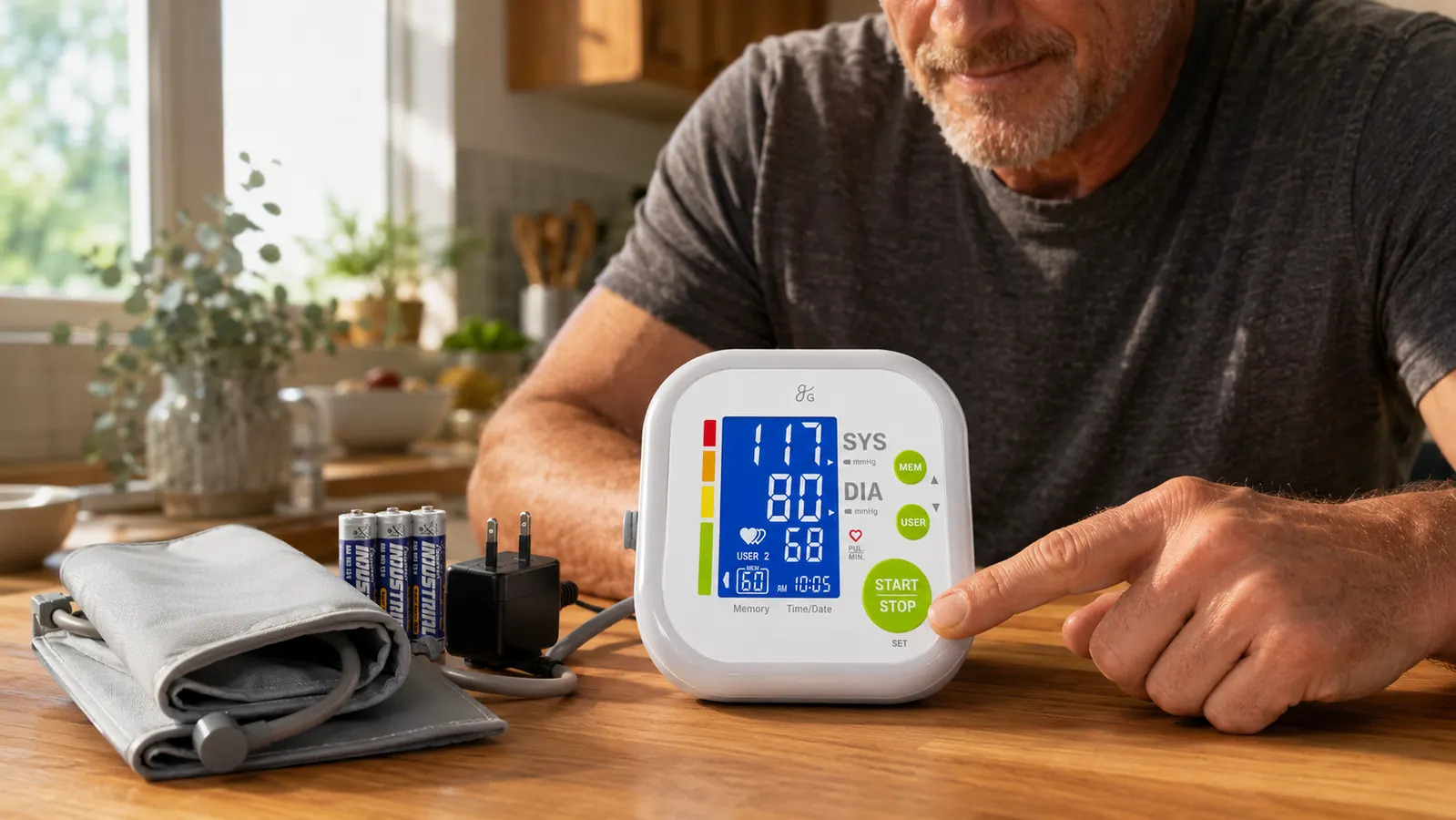
The two-user memory is the reason this one lives in my kitchen drawer instead of Gene having a machine of his own. You pick User 1 or User 2 before you start, and the monitor keeps up to 60 readings for each of you, 120 in all. That sounds like a small thing until you are the one copying numbers onto the back of an envelope. When I take my log in, I am reading off a device that already separated my readings from his. Gene does not have to remember to tell me which reading was his, and I do not have to squint at two different handwriting styles at the counter while a nurse waits. The first Monday we used it, I took my reading, switched the profile, handed the cuff across the table, and Gene had his in under two minutes. Before that we were writing on the back of a bank envelope, and I had already mixed up which line was his once. Nobody at the front desk ever said a word about it, but I knew.
The other thing I notice every single morning is how little there is to learn. You select your profile, you press Start, the cuff fills and lets go, and the reading appears on the LCD. That is the whole sequence, no submenu, no guessing. The cuff is listed at 8.75 to 16.5 inches, or 22 to 42 centimeters, which is the number to check against your own arm with a tape measure before you order from anybody. It ships with the cuff, a case, and four AAA batteries, so there is no second trip to the store on the day it arrives. The listing also says it detects irregular heartbeats, which is one more thing to mention to your doctor rather than something to work out on your own. It carries 4.4 stars across more than 28,000 reviews, and reading through them, the complaints are the ordinary kind: a cuff that felt tight, a reading that seemed off, a manual somebody wished were plainer.
Where Omron Bronze Wins
I am not going to pretend Omron wandered in yesterday. Omron has been making blood pressure equipment for decades, and it is the name a lot of us first saw sitting on a counter at a doctor's office or on a shelf in the exam room. That history is worth something real. It means a long record behind the measurement itself and a deep catalog of replacement cuffs if yours wears out or the size needs to change. Greater Goods came to health devices from kitchen and home goods, and while that does not make a reading any less useful, the brand has not been in this particular business as long. If a long track record in blood pressure specifically is what lets you relax and actually use the thing, that matters more than any feature on my little list.
There is also a case for buying less machine than I bought. If you are one person checking once a day, the second user profile and the stored readings are features you will never touch. The Bronze is built around a simpler job, and simple is easier to trust when something looks wrong. Fewer settings means fewer things to get wrong at seven in the morning before coffee, and fewer things to explain to a friend who house-sits while you are away. If you have used Omron for years and you like the way it feels on your arm, staying with what you know is a reasonable decision. I would not talk a friend out of it, and I would not claim my drawer is the only drawer that works. A neighbor of mine has used the same Omron for years and is not curious about mine at all. She knows where the cuff goes, she knows the sound it makes, and she has a folder of logs going back to before I retired. There is real value in that kind of settled habit, and a second user profile would not improve it one bit.
Two People, One Log, No Envelopes
The Greater Goods monitor keeps up to 60 readings for you and 60 for your husband or wife, sorted by profile, so the morning check is one button and the log is already done before you sit down with your doctor. Cuff, case, and batteries come in the box.
Amazon Check Today's Price on Amazon →Cuff Fit Trips Up More People Than Any Feature
Most of the frustration I hear about home monitors is not about the electronics. It is about the cuff. A cuff that pinches, or slides, or leaves a deep mark ends a routine faster than any confusing button ever will. Measure your upper arm around the middle, halfway between the shoulder and the elbow, and write that number down before you shop. The Greater Goods cuff is listed as fitting arms from 8.75 to 16.5 inches, 22 to 42 centimeters, which covers a lot of people, but yours is the only arm that gets to decide. Gene's arm is thicker than mine and we have both used the same cuff without a fuss, and I still put the tape measure on it before I bought.
The Omron Bronze ships with a standard adult cuff, and the range for that model is printed on the listing, so do the same tape measure check before you order one of those. If your arm falls outside the listed range, look at the model in that line with the larger cuff instead of squeezing yourself into the wrong one. This is not a small detail. A reading taken through a cuff that does not fit right is not a reading you should hand a doctor, and no amount of extra features rescues it. Both companies tell you what their cuff fits. Measure first, compare second, buy third. I learned that the hard way with an old wrist cuff I bought years ago without measuring anything. It never sat right, the numbers bounced around from one minute to the next, and I quit using it inside a month. That was not the cuff's fault. It was mine, for shopping by the picture instead of by the number.
What the Routine Actually Looks Like at My Table
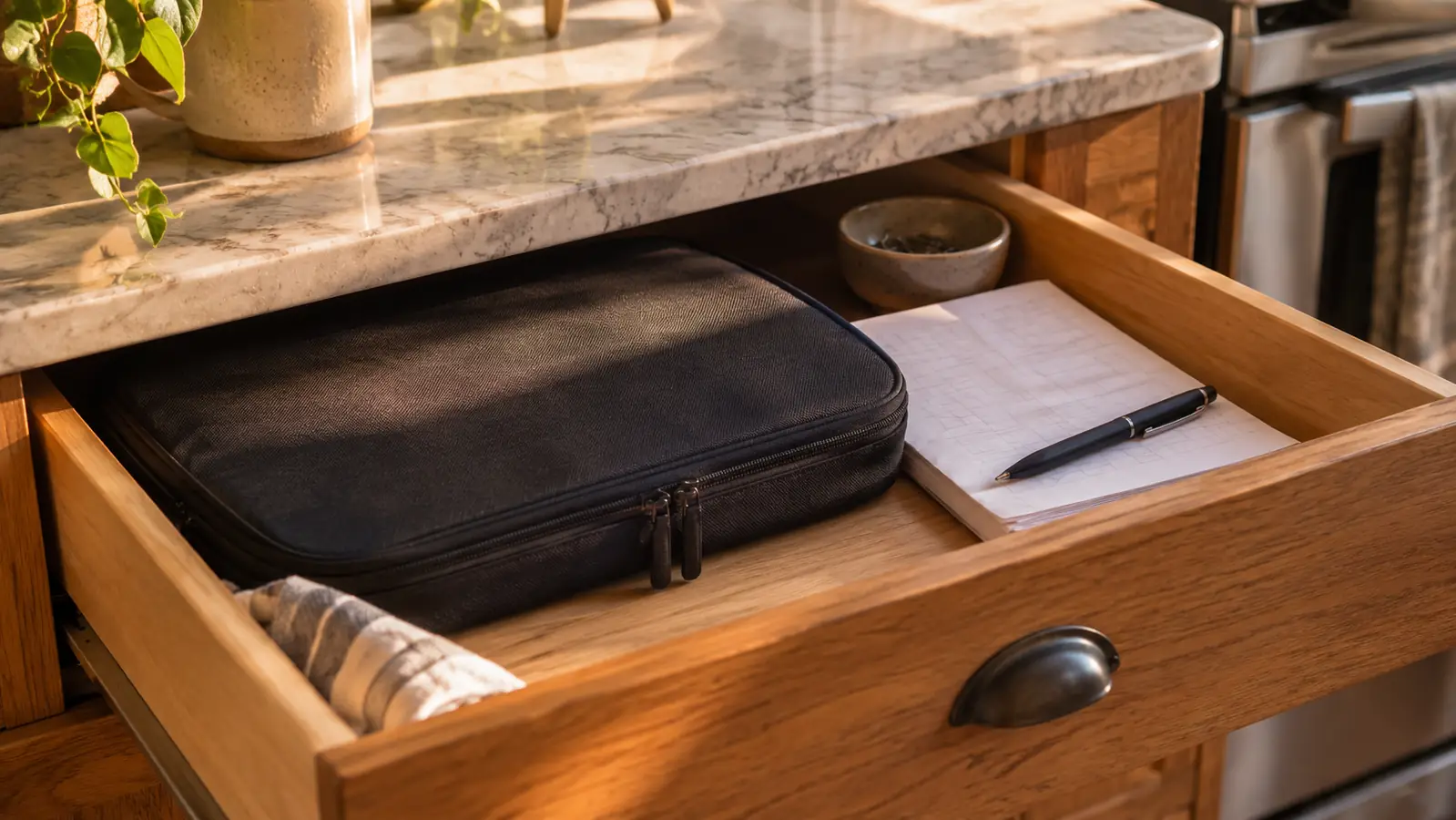
Here is how it goes in our house, because the routine is the part nobody explains. I sit at the kitchen table, left arm resting flat on the tabletop, feet flat on the floor, back against the chair, cuff on bare skin about an inch above the elbow. I press Start and I keep quiet, because talking moves the number, and so does a full bladder, so I take care of that first. Gene does the same thing ten minutes later with his own profile. Then the monitor goes back in its case in the drawer, because a monitor left out on the counter becomes clutter, and clutter becomes something you quietly stop doing. Morning before coffee, evening before the news, seven days a week for the stretch my doctor asked for. What surprised me was how fast the whole thing took the same shape as making coffee. The first week I had the instructions spread out on the table. By the second week I did not need them. By the third week I noticed when I had skipped, because the drawer felt wrong when I opened it for a spoon.
The reason I care about the memory is that my memory is not what it was at thirty. I do not have to trust myself to remember what Tuesday morning said. It is in the machine, filed under my profile, waiting for the next appointment. If you would rather keep a paper log anyway, keep the paper log. Nobody ever regretted having the numbers in two places. What I would not do is assume you will remember them.
Sixty readings for me and sixty for Gene, filed under separate profiles, so the log is already finished before I sit down in the exam room.
What Neither Monitor Does
Neither of these machines will tell you whether a reading is good for you or bad for you, and that line is worth writing on the side of the box. One high morning does not mean much by itself. Ten high mornings in a row is a conversation to have. I have watched friends get frightened by a single number, and I have watched friends quietly ignore a whole month of them, and both reactions cause trouble. The monitor's job is to record what happened, at the same time of day, under the same conditions, so that the person who knows your history can look at a pattern instead of a guess.
That is also why I keep saying bring the log to your doctor instead of asking the internet what a number means. Your doctor knows your medications, your history, and what your arm looked like in the office. I know how to sit still and press a button. Those are different jobs, and it is a relief to keep them separate. If a reading scares you, write it down, check again after a few quiet minutes, and make the call. Do not change anything on your own, and do not skip a medication because one Tuesday looked nice.
Who Should Buy Which
If you and your husband or wife are sharing one machine, one drawer, and one routine, take the Greater Goods. Two profiles, 60 readings each, one button to start, a case and batteries in the box, and a published cuff range you can measure yourself against before you spend anything. That is the setup that matched what my doctor asked me to do, and it is the reason the thing is still sitting in my kitchen drawer instead of the back of a closet.
If you are one person, checking once a day, and you want a plain device from a name you already know, the Omron Bronze is a fair choice, and I will not argue with you about it. Measure your arm, check the cuff range printed on the listing, and buy the model that fits the arm you actually have. Neither monitor is the wrong answer. The wrong answer is the one that stays in the drawer because it was too much bother at six in the morning.
Measure Your Arm, Then Make the Call
The Greater Goods upper arm monitor fits a listed range of 8.75 to 16.5 inches, remembers two users at 60 readings each, and arrives with the cuff, case, and batteries. If that matches your table and your arm, it is a sensible place to start.
Amazon Check Today's Price on Amazon →