

My readings at the doctor's office have always run high. I walk in from the parking lot, sit in a cold room, and by the time the nurse wraps the cuff around my arm I am already rehearsing what I want to say. The number comes back high every time. My doctor did not argue with it. She asked me to check at home twice a day for a few weeks and bring the log in. That was the whole assignment.
What she told me next is the part I had to learn the slow way. She said a home reading only means something if I take it the same way, at about the same time, every day. A number at seven in the morning and a number at nine at night are not the same measurement, and stacking them in one column like they are is how a person scares herself for no reason. I went home with an Omron Bronze upper arm monitor, a spiral notebook, and a much clearer idea of the job than I had ten minutes earlier. The Omron lives in my kitchen drawer now, next to the good scissors.
One cuff, four batteries, and a drawer. That is the whole setup.
The Omron Bronze is an upper arm monitor with a 9 to 17 inch cuff, an LCD display, and four AA batteries. Nothing to pair, nothing to charge, no phone to hunt for at seven in the morning. It is the plainest part of my day, and that is exactly why it works.
Amazon Check Today's Price on Amazon →Why the Clock Matters as Much as the Cuff
Blood pressure moves all day long. It is lower while you sleep, it climbs when you get out of bed, and it goes up with coffee, with a rushed morning, with a phone call you did not want. None of that is a problem. It is how a body works. The problem is what happens when you take one reading at six in the morning and the next at four in the afternoon and then compare them as if the only thing that changed was you. Half of what you are looking at is the clock.
Two times a day is enough. Mine are before coffee in the morning and again in the evening before supper. Gene, my husband, uses the same two windows so we can compare notes across the table. Morning and evening are not magic hours. They are simply two windows far enough apart to show a pattern, and early enough and late enough that a normal week can actually hold them. Pick two you can hit on a Tuesday and on a Saturday, and then hit them.
Step 1: Choose two times you can actually keep
Choose the times before you worry about anything else. Look at a real week, not a good week. If Sunday morning means church, your morning window has to be early enough to fit, or you accept that Sunday is the one you miss. If Tuesday is grocery day, do not build a routine that needs you at the kitchen table at ten.
Write both times on an index card and tape it inside the cabinet where you keep the coffee. I am serious about the card. In my first month I kept losing track of whether I had taken the evening reading yet, and two blank lines per day fixed that faster than any reminder on my phone. A card does not buzz, does not need charging, and does not get buried under a hundred notifications.
Then ask your doctor what schedule they want from you. A morning reading and an evening reading is a common place to start, but your doctor may want something different in your case, and their answer is the one that counts. Write their answer on the same card. You will not remember it at seven the next morning, and neither would I.
One more thing about the morning: take it before your coffee, and if you take a blood pressure pill, ask whether they want the reading before it or after it. That single answer changes what your log means. It is worth asking once instead of guessing every morning for a month.
Step 2: Build the same five quiet minutes around it
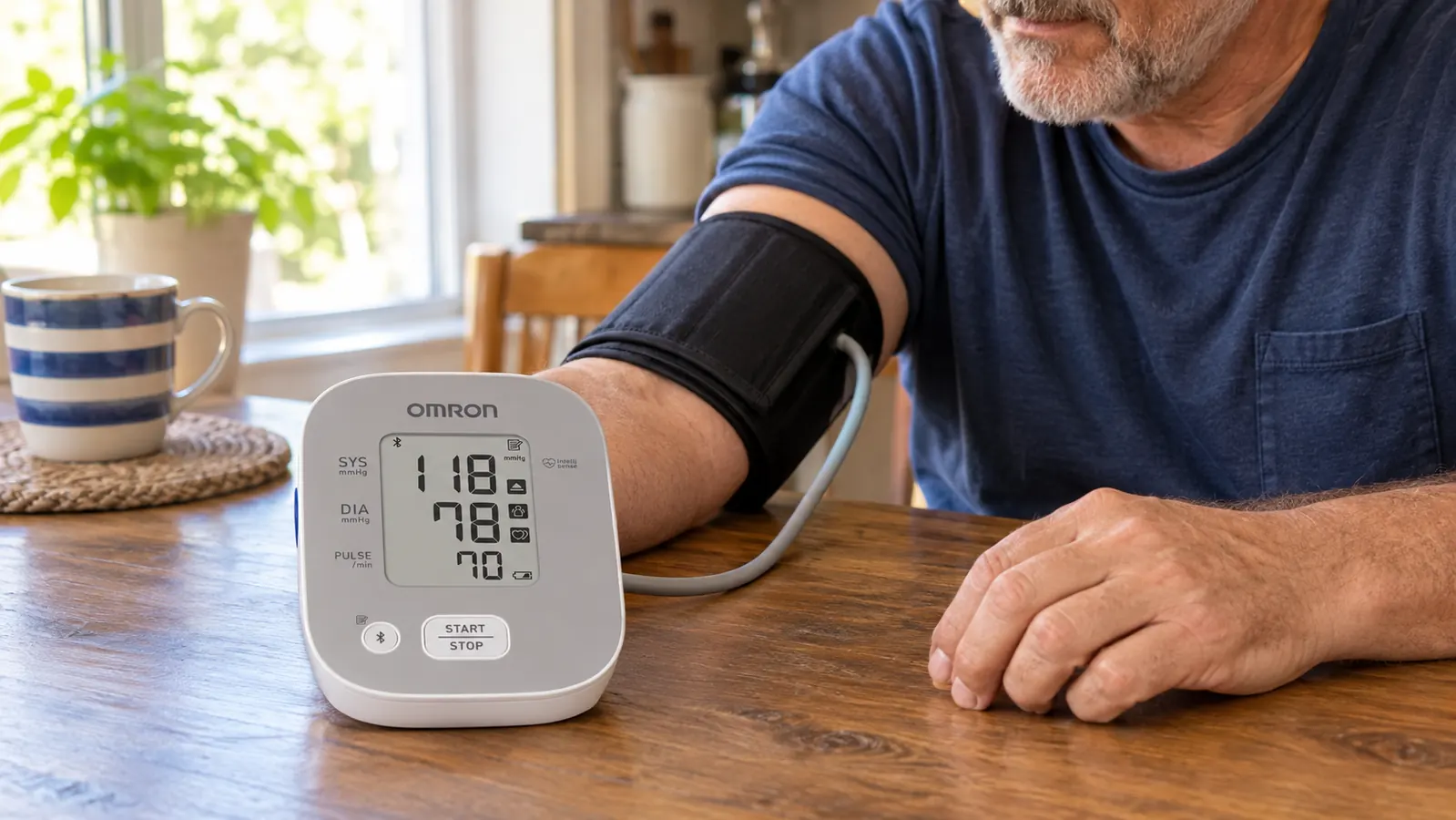
The reading starts before the cuff goes on. I sit at the kitchen table with my back against the chair, both feet flat on the floor, and my left arm resting on the table. I do not cross my legs. I do not talk. I do not look at my phone. Then I sit there for five minutes and do nothing at all.
Doing nothing is harder than it sounds. The first week I fidgeted through the whole five minutes and told myself it did not matter. It matters. My arm moves, the cuff shifts, and the number comes back looking like a different day. Leaving my phone in the other room was the fix. A kitchen timer works too if you want to know when the five minutes are up without picking something up.
Same chair, same table, same arm, every time. If you take the morning reading on your left arm, take the evening one on your left arm too. If your arm floats in the air because the table is the wrong height, fold a dish towel and put it underneath. The cuff wants a still arm, and a towel costs nothing.
The evening reading is the harder one at our house. Supper is on, the phone rings, somebody stops by. What works is taking it before I start cooking rather than after, when the kitchen is hot and I have been on my feet for an hour. If I wait until the dishes are done, I am tired and I rush it, and a rushed reading is a wasted reading.
A reading is worth something next to yesterday's reading, taken the same way, at the same hour, in the same chair.
Step 3: Put the cuff on the same way every single time
The Omron Bronze comes with one cuff sized for arms from 9 to 17 inches around. Measure your upper arm once with a cloth tape before you trust the routine. Gene's arm is thicker than mine, so we checked both of us before we settled in. A cuff that is too small or too big gives you a number that is about the cuff, not about you. If your arm measures outside that range, call and ask about a different cuff before you start a log you cannot use.
Bare skin, not over a sleeve. The cuff goes on the upper arm with the tube running down toward the inside of your arm, and the bottom edge sitting an inch or so above the bend of your elbow. It should be snug enough that one finger slides under the edge and not two. If it pinches, it is too tight. If it slides down when you shift, it is too loose.
Same arm, same height on the arm, same snugness, every time. This is the step people skip, and it is the one that quietly changes the reading. Two inches higher on Tuesday than it was on Monday is enough to make the two days look different when nothing about you has changed.
Do not take the cuff off and slap it straight back on for a second reading. Sit for a minute with the cuff still where it is, then run it again. Write down both numbers. Two readings a minute apart tell your doctor more than one reading repeated three times in a row.
Step 4: Sit still and let it finish
Start the reading and then do not move until the cuff is finished. The monitor fills the cuff with air on its own, and while that is happening it is listening for the pulse in your arm. Talk, cough, shift in the chair, or reach for your coffee and you can move the number without meaning to. Sit the way you would sit while someone finishes a sentence.
The display shows your numbers when it is done, and the Omron also flags an irregular heartbeat if it picks one up during the reading. It shows a hypertension indicator when a reading lands in the elevated range. Neither of those is a diagnosis, and neither one is a reason to panic at your kitchen table. Write down what you saw, note that the symbol appeared, and put it in front of your doctor. That is what the feature is there for.
Step 5: Write it down before you stand up
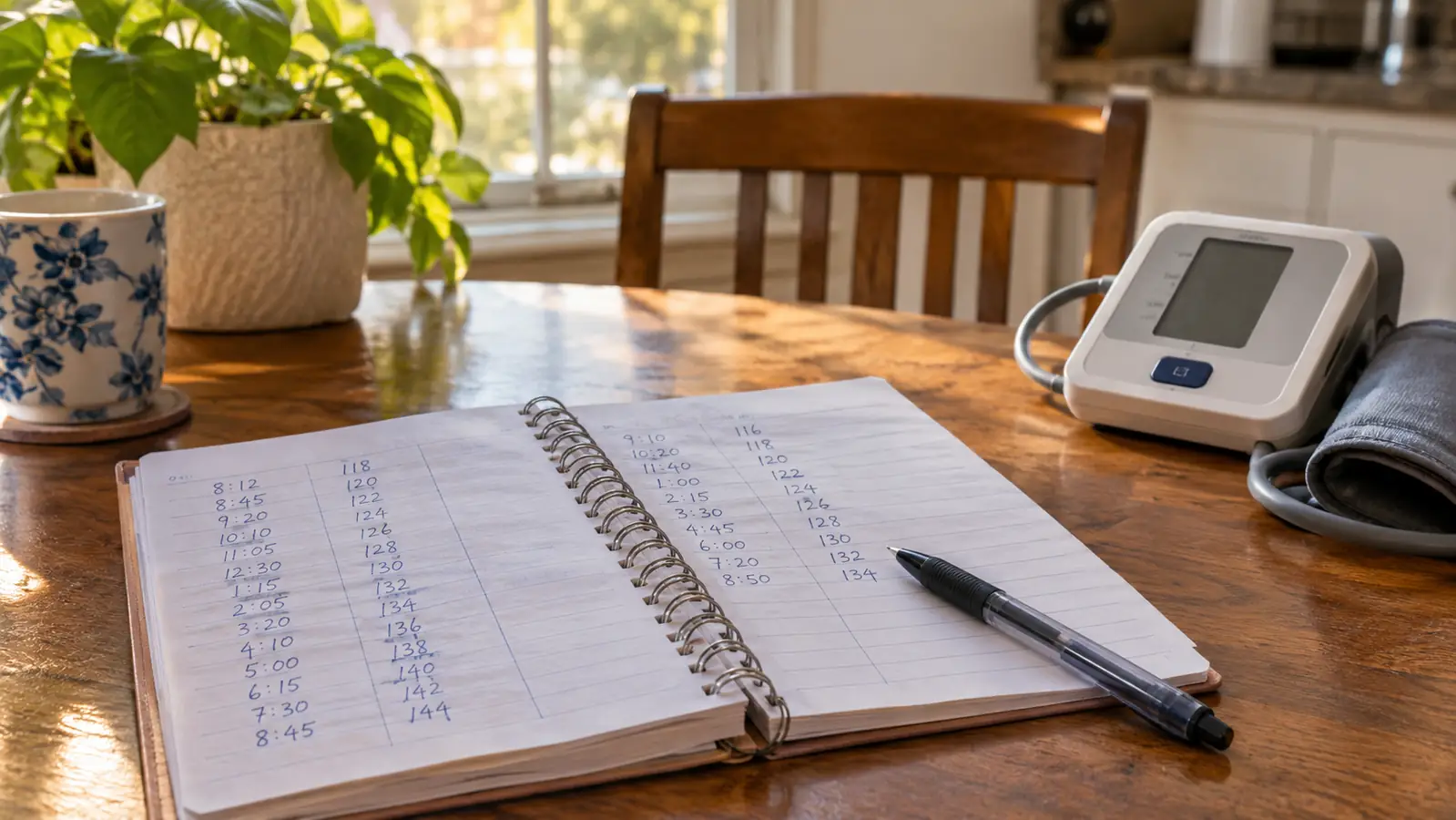
The number on the screen is not the record. The notebook is the record. Date, time, the top number, the bottom number, and one word about anything unusual that morning: slept badly, before coffee, after a walk, felt fine. Fill it in before you get out of the chair, while the last five minutes are still fresh. By lunch you will not remember whether that was the reading where you coughed.
The Omron keeps readings in memory, which is handy on the day you forget the notebook, but I still write mine by hand the same minute. A paper log is the thing I can hand across the desk at the doctor's office. Nobody has ever asked to scroll through my monitor on my behalf, and I would not know how to show them anyway.
That log is the entire point of the exercise. My doctor asked for a few weeks of readings so she could see a pattern instead of one number taken on a stressful morning. A column of readings, all taken the same way at the same two times, tells her something. A handful of scattered numbers tells her almost nothing, and it took me a full month to understand why.
What Else Helps
Check the cuff fit again every few months, especially if your weight has changed or the cuff has been folded up in a drawer since spring. A cuff that fit well last winter can stop fitting well by summer. It is a cheap thing to recheck and an annoying thing to discover in the middle of a two week log you have to start over.
The monitor runs on four AA batteries. When the display starts looking faint or the readings turn strange, change all four at once rather than mixing one new battery with three tired ones. I keep a spare four in the drawer right next to the monitor, because on the morning I needed them I was not going to go out and buy them.
Keep the monitor where you will actually see it, and not where it will get knocked around. Mine sits in the kitchen drawer with the cuff loosely coiled rather than folded sharp, and the tube not kinked. A kitchen drawer is not a medical cabinet, but it is where I am at seven in the morning, and a monitor in a closet is a monitor you stop using.
Bring the monitor to your doctor's office once and ask them to check it against theirs. Take a reading on your own machine while you are sitting there, then let the nurse take one. If the two are close, you can trust the home log. If they are not, you need to know that before you build a month of decisions on top of it.
And do not chase a single reading. One high number is not a verdict, and one good number is not a cure. What your doctor wants is the shape of two or three weeks. That is also why the same time each day matters so much. It is the only way the shape is real instead of a picture of your schedule.
Two times, one chair, one notebook. Start tomorrow morning.
The Omron Bronze is the upper arm monitor I use at my kitchen table, with a 9 to 17 inch cuff and a plain LCD display. Pick your two times tonight, tape the card inside the cabinet, and take the first reading before coffee. Then bring the log to your doctor and let them read it.
Amazon Check Today's Price on Amazon →