
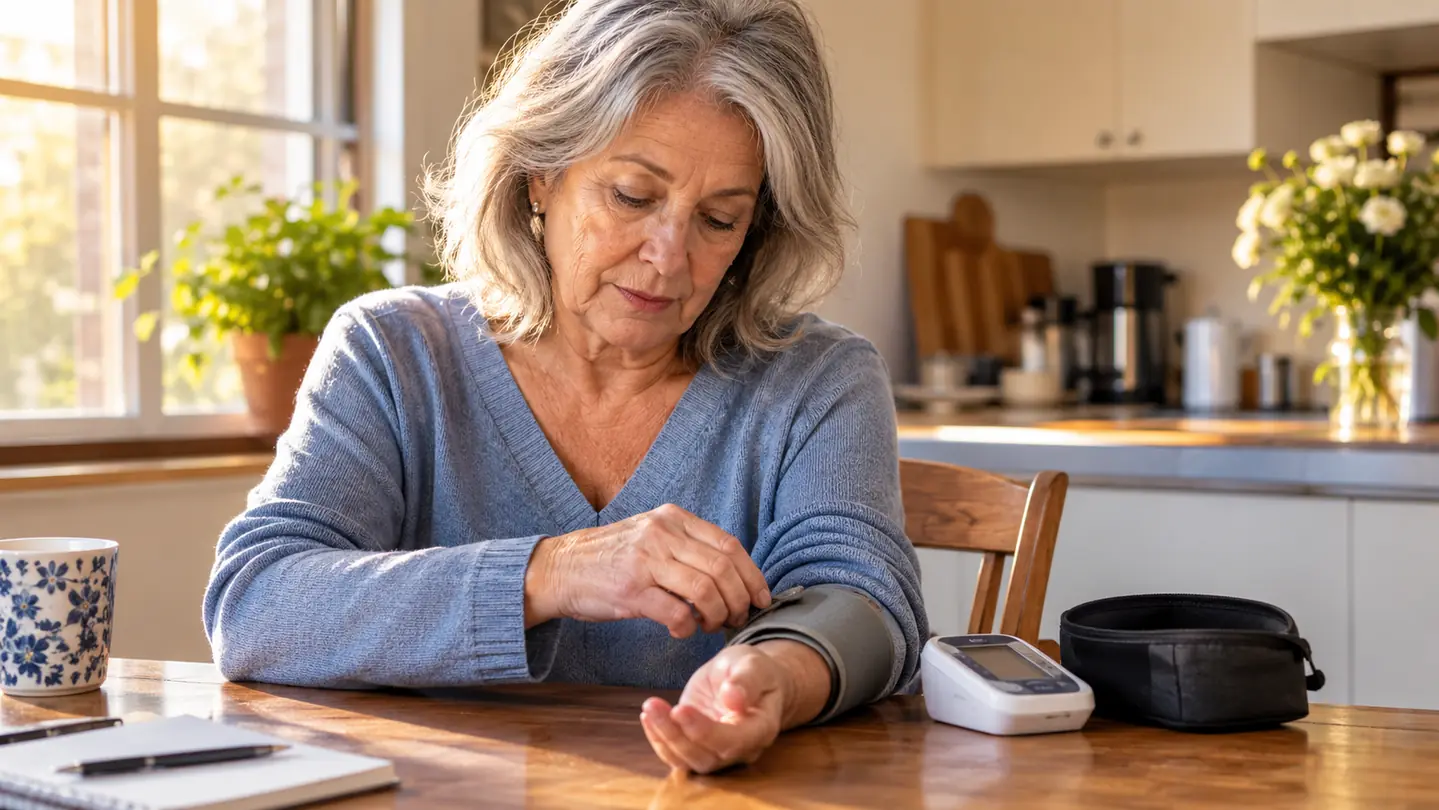
My first month with a wrist monitor, my numbers jumped around like a bad stock ticker. 138 over 84 at seven in the morning. 121 over 79 twenty minutes later, same chair, same coffee cup. Then 145 over 88 that evening after I had done nothing more strenuous than watch the news. I did what most people do. I decided the machine was wrong, or my arm was too small, or the whole business was a waste of batteries.
Then my doctor asked me to check twice a day for three weeks and bring the log in. Gene, my husband, was getting the same wobble on his readings, so I called the pharmacist. She told me the Omron Gold Wireless Wrist Blood Pressure Monitor we had bought would read fine as long as the cuff sat at heart level and I held still. Two inches high or two inches low and the number moves. That was it. Not the machine. The arm.
A steady number starts with where your wrist is sitting
The Omron Gold Wrist reads from the band on your bare wrist, so placement is doing most of the work. Measure your wrist first, then check the fit before you buy.
Amazon Check Today's Price on Amazon →Why a Wrist Cuff Is Pickier Than an Arm Cuff
An upper arm cuff sits on the bicep, close to the heart no matter how you are sitting. A wrist cuff sits lower and farther out, which makes it more sensitive to the height of your arm and the angle of your hand. That is not a flaw in the design. It is geometry.
The tradeoff is worth it for us. A wrist monitor is small enough to live in the kitchen drawer and quick enough that neither Gene nor I has an excuse to skip a reading. The fix is not to baby the machine. The fix is to treat position as part of the measurement, the same way you would treat a scale that needs to sit on a hard floor instead of carpet.
I am not going to tell you a wrist monitor is the better choice for everybody, because for some people it is not. What I will tell you is that a wrist monitor used correctly twice a day beats an arm cuff that stays in the closet because it takes two hands, a table, and ten minutes you do not have.
Step 1: Sit Still for Five Minutes Before You Touch the Monitor
This is the step nearly everyone skips, and I skipped it for the first three weeks. Blood pressure is not a fixed number sitting in your arm waiting to be read. It moves when you walk to the mailbox, when the phone rings, when you are still arguing with somebody in your head at four in the morning. Five minutes with your back against the chair and both feet flat on the floor gets you closer to your real resting number.
Pick your two times and keep them. Mine are right after I get up, before the coffee, and right before supper. The doctor asked for twice a day and did not care which two, only that they were the same two, so the numbers could be compared to each other instead of to nothing. Sit at a table, not on the couch, because you need your forearm supported at chest height and a couch will not do that no matter how many pillows you stack under it.
Empty your bladder before you start. Do not smoke, drink coffee, or exercise for half an hour beforehand. Roll your sleeve up or take the shirt off, because a sleeve bunched around the cuff will squeeze your arm and change the number. I keep one short-sleeved shirt folded by the table so I am not fighting fabric at six thirty in the morning.
Step 2: Put the Cuff on Bare Skin and Check the Fit
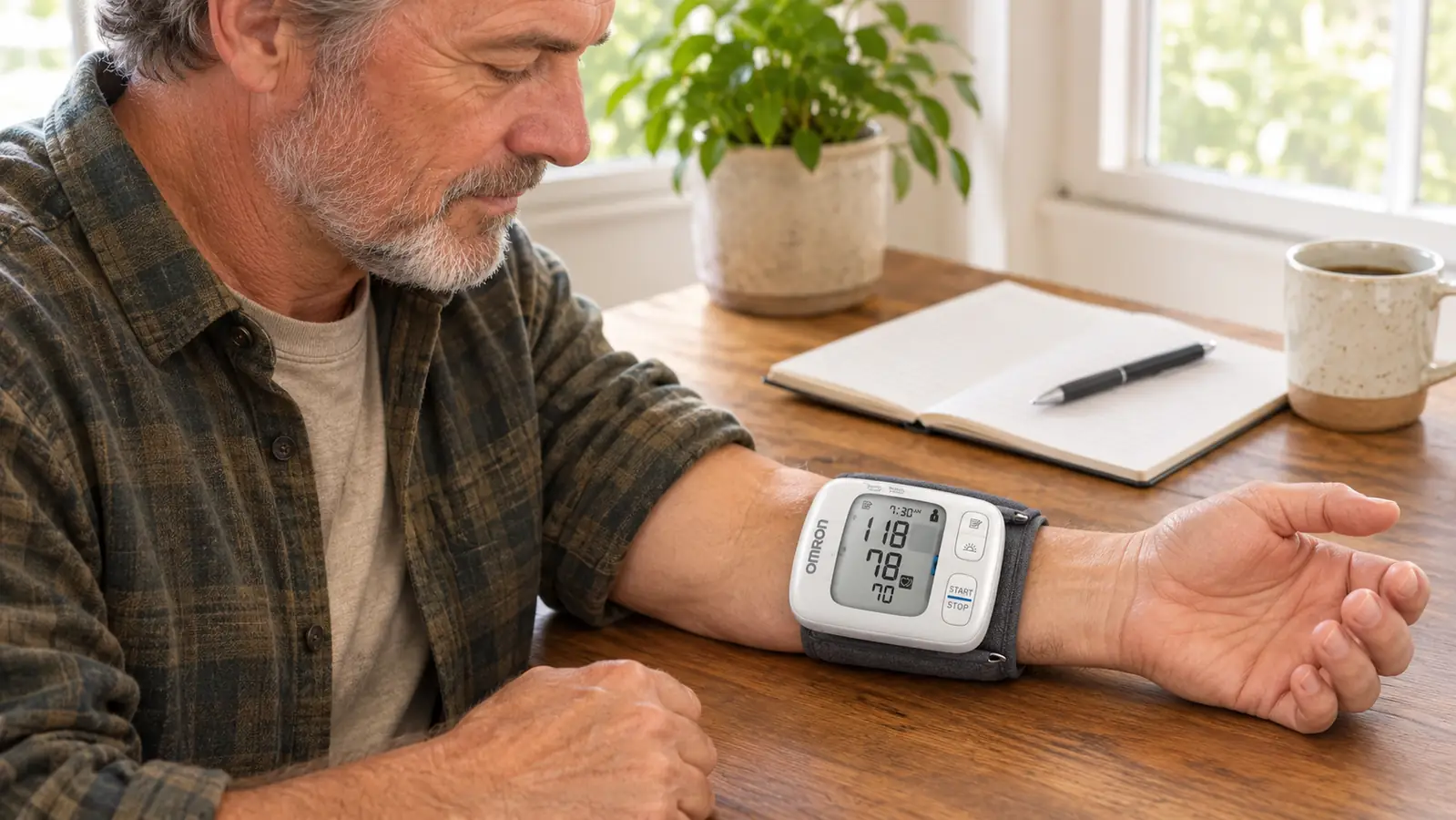
The cuff goes on bare skin. No watch, no bracelet, no sleeve, no compression band. Close it snug, which means you can still slide one fingertip under the edge, not two. If it leaves a red mark or your fingers go numb, it is too tight, and a too tight cuff will read high.
Fit matters more with a wrist cuff than with an arm cuff, because there is less room to work with. The Omron band on this model is listed at 8.5 inches. I measured my wrist with a cloth tape before I ordered, and I measured Gene's too. If your wrist comes up larger than the band allows, that is a sizing problem, not a personal failure. Use an upper arm monitor instead.
Once the band is closed, leave it alone. Fiddling with it after the reading starts is one of the easiest ways to get a number that is off by ten points or more, and you will never know it happened. If you are not sure about placement, take the monitor to the pharmacy and ask. I did that with the first cuff I owned, and the pharmacist watched me put it on and told me I had it too low. Ninety seconds, and it saved me a month of nonsense.
Step 3: Rest Your Forearm at Heart Level
This is the step that fixed my readings. Heart level means the cuff sits at about the same height as your heart. Not your shoulder. Not your lap. Rest your forearm on the table with your palm turned up and your hand loose. If the table is too low, put a folded towel under your forearm until the cuff lines up with the middle of your chest. Gene is taller than I am and his chair sits higher, so his forearm angled down toward the table without either of us noticing, and that folded towel fixed it.
A wrist cuff sitting below heart level reads high. Above heart level reads low. I tested it on myself, because I am that kind of person. Same chair, same five minutes of quiet, cuff resting on my knee instead of the table, and the top number came out fourteen points higher. Back on the table, it settled.
Keep your hand relaxed. Do not make a fist. Do not grip the edge of the table. Do not type or scroll while the cuff is working. A tense hand tightens the forearm, and the cuff reads that tension as pressure.
Same chair, same five minutes of quiet, cuff on my knee instead of the table, and the top number came out fourteen points higher.
Step 4: Press Start and Then Do Nothing
Once the reading starts, your only job is to stay still and breathe normally. Do not talk. Do not shift your feet. Do not lean over to watch the display while it is working, because watching it makes you tense and tension shows up in the number. Gene learned that one the hard way when he decided to give me a play by play in the middle of it.
We set mine to user 1 and Gene's to user 2 so our readings do not get mixed together. The Omron stores up to 200 readings for each user, which is more than either of us will ever need for a two week log, and it means I can hand the machine to him without wiping anything.
If the irregular heartbeat indicator comes on, do not panic and do not decide what it means. It flags a heartbeat that looked uneven during that one reading. Write down the date and the time, and take it in with the rest of your log. That is what I did, and my doctor was the one who decided whether it mattered.
Step 5: Write It Down and Take a Second Reading
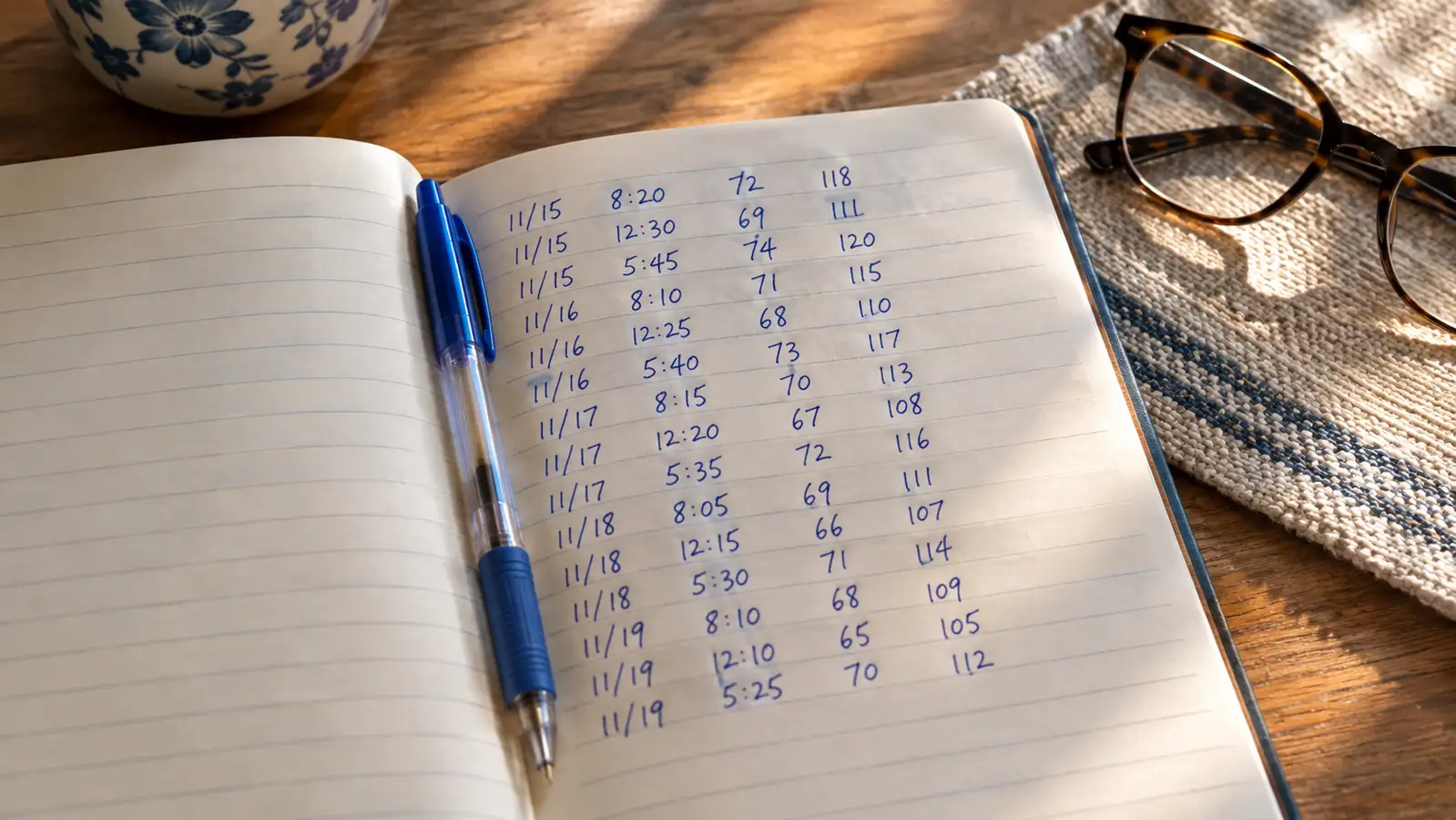
One reading is a snapshot. Two readings a minute apart, averaged, get you closer to the truth. I take mine in the morning before coffee and again in the evening before supper, in the same chair, after the same five minutes of quiet. Date, time, top number, bottom number, in a small notebook that lives beside the pen. Do not take five in a row and keep the lowest, which is what I did at first. That is not a reading. That is shopping.
The monitor has a high morning average indicator, which points out morning readings that run higher than the rest of the day. Morning is a stretch a lot of doctors pay attention to. I still write everything down by hand, because the indicator tells you a pattern exists and the notebook shows the doctor what the pattern looks like.
Take the log to your appointment. Not the one number you remember from Tuesday, the whole log. And do not change any medication on your own based on what you see there. That conversation belongs to you and your doctor, and it goes faster when you walk in with two weeks of dates and times instead of a shrug. The case that comes with the monitor holds the unit and the band, and it is the reason the thing survives going from the kitchen to the car and back.
What Else Helps
Keep the monitor where you will actually use it. Ours lives in the kitchen drawer next to the pens, because the kitchen table is where we sit. A monitor in a bathroom cabinet is a monitor that stays in the bathroom cabinet.
Keep spare AAA batteries in that same drawer. The Omron runs on two AAA batteries, which come included, so you are not hunting for them on day one. I would rather have a spare pair on hand than find out at six in the morning that I am out.
Sit in the same chair at the same table every time. Comparisons only mean something when the setup stays put. If Monday is the kitchen table and Tuesday is the couch with your arm in your lap, you are comparing two different tests and calling it progress.
Keep the arm still and the feet flat, and leave the phone in the other room. I answered one text in the middle of a reading and the number looked like a different person had taken it.
If more than one person uses the monitor, set up the two users before the first reading, not after. Gene and I spent a confusing week with our readings landing in the same memory before we sorted that out, and I could not tell you now which numbers were his.
Do not chase a single reading. One number on one morning is not a trend, and a trend is what your doctor can use. Two weeks of dates and times is a trend. Ten minutes of staring at one high number is just a bad morning.
One more thing about the log. Write the time, not just the number. A reading at six in the morning and a reading at eight at night are not the same measurement, and your doctor will read them differently. My notebook has four columns and I fill in every one of them.
If your readings swing wildly no matter how careful you are, or your wrist measures larger than the band, an upper arm cuff is the more reliable choice. That is not a knock on this one. It is a fit question, and fit is most of the battle.
And take all of it to your doctor. I am a retired bank teller, not a nurse. What I know is how to sit still in a chair for five minutes and write down what a machine tells me. What the numbers mean is somebody else's job, and I am glad it is.
The most useful reading is the one you can hand to your doctor
Same chair. Same five minutes of quiet. Bare wrist at heart level, twice a day for two weeks, written down in four columns. The numbers are information, not a verdict.
Amazon Check Today's Price on Amazon →