

The thing nobody tells you about a wrist blood pressure monitor is that the reading depends on where your hand is. Not on the brand. Not on how new the batteries are. On where your hand is. I am 67, retired after thirty-one years behind a teller window in Lawton, Oklahoma, and my doctor asked me to check my pressure at home twice a day for a few weeks and bring the log in with me. That is how an Omron Gold Wireless Wrist Blood Pressure Monitor ended up in my kitchen drawer next to the potholders. Gene, my husband, uses it too, which turned out to matter more than I expected.
This is not the review where I tell you it changed my life. It is the review I wish I had read in the pharmacy aisle, the one that says plainly: here is what this little cuff does well, here is where it will trip you up, and here is who should walk right past it. More than thirteen thousand ratings average out to four point two stars, which is not a perfect score, and after a few months of twice-a-day use I understand exactly where the missing stars come from. Some of them are the device. Most of them, I think, are the person using it. It is a good tool with a narrow lane, and knowing where the lane runs is worth ten minutes before you order one.
The Quick Verdict
An honest little wrist cuff that remembers two people. It reads only as well as you sit still for it, and it does not forgive a lazy reading.
Amazon Check Today's Price →Small enough that you will actually use it twice a day
Battery powered, batteries in the box, up to 200 readings each for two users, and a case so it does not rattle around a drawer. Check the listed band size against your own wrist first.
Amazon Check Today's Price on Amazon →How I've Used It
Two readings a day, morning before coffee and evening after supper, both at the kitchen table with my feet flat on the floor and my forearm resting on the tabletop. That was the routine the doctor asked for, and the routine is what makes or breaks a wrist monitor. I would like to tell you I was disciplined from day one. I was not. The first week I took half the readings standing at the counter because the phone rang, or because I was in a hurry to get to the store before the heat came up, and those numbers wandered enough that I could not tell whether a reading was telling me about my morning or about my posture. Nothing about the device has changed since then. My chair changed, and so did my attitude about sitting down.
Once I sat down every single time, same chair, same arm, five quiet minutes first, the readings settled into something I could hand a nurse without apologizing for it. That is not a selling point on the box. It is the plain truth about wrist cuffs. They are more sensitive to posture than the upper arm cuff at the clinic, and the Omron is no exception to that. What it does do is make a good reading easy to take once you have decided to sit down properly, and that is most of the battle with any home monitor I have ever tried.
It is also small. Three and a quarter ounces, roughly three and a half inches long, and it lives in its case in the drawer with the dish towels. Nothing to plug in, nothing to charge, nothing to think about between readings, which is the highest compliment I can pay a piece of home equipment at my age. If a thing is annoying to get out of the drawer, you stop getting it out. This one is not annoying, and that has kept my log going longer than good intentions ever did.
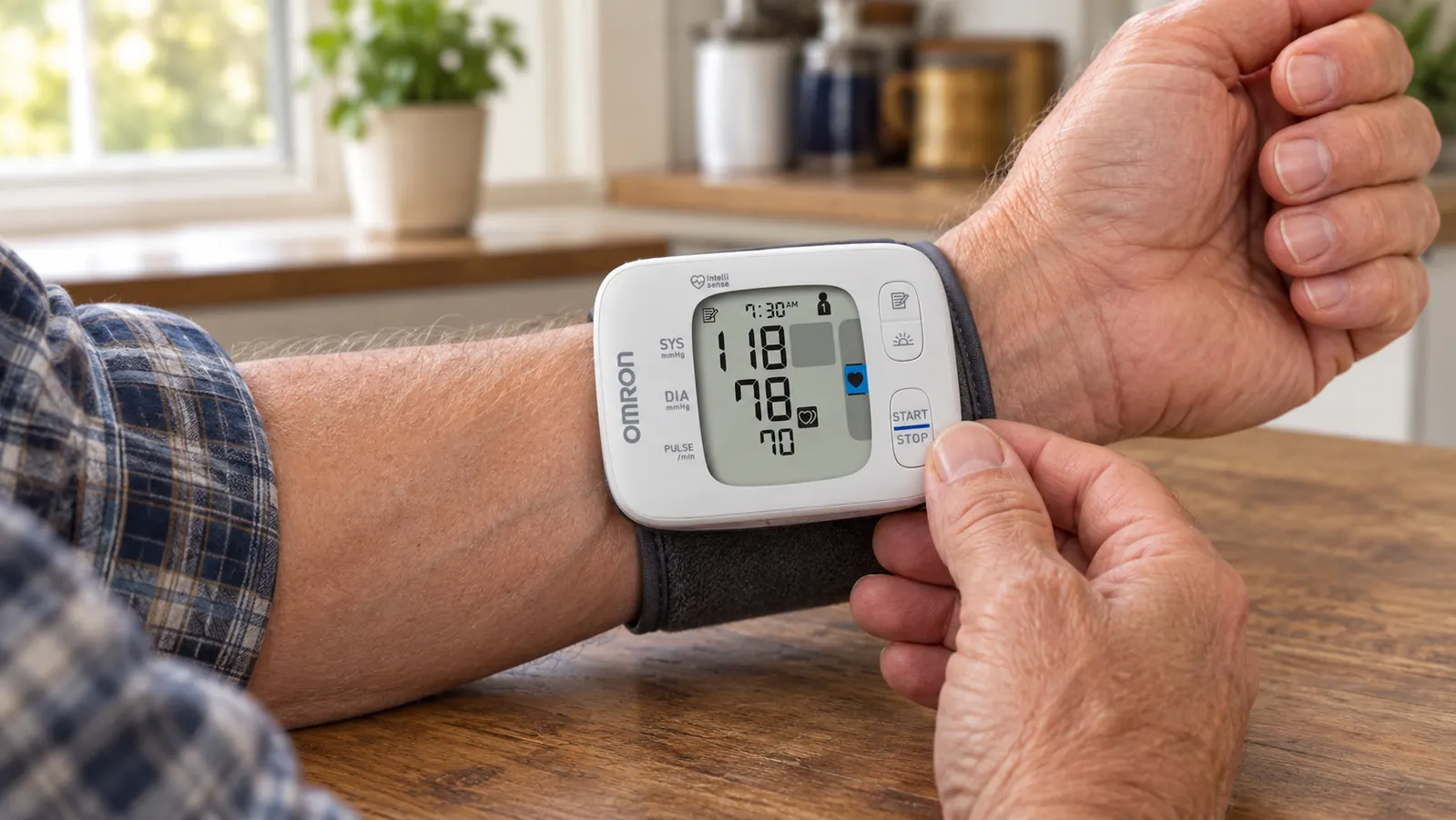
The Part Nobody Tells You: Position Beats Everything
Here is the sentence I want you to carry out of this review. A wrist cuff has to sit at heart level. Not near your heart. At it. For the first month I let my forearm drift down toward my lap while the reading ran, and I could not figure out why the morning numbers and the evening numbers told two different stories. When I finally propped my elbow on the table so the monitor sat level with my chest, the readings stopped arguing with each other. Nothing about the device changed. My elbow changed.
That, I suspect, is the story behind a good share of the low reviews. People strap it on like a watch, let the arm hang, get a reading that does not match the one from the clinic, and blame the monitor. Some of those folks may have a real accuracy complaint and I am not going to tell them they are wrong. Most of them, I would bet, were sitting like I was sitting in week one, with one arm in the air and the other one already reaching for the coffee.
A wrist cuff does not measure your blood pressure. It measures your blood pressure in the exact position you were in when you started it.
The second thing I learned is that the band wants to be snug, not tight, and it wants bare skin rather than a sleeve. I push my sleeve up past the elbow now, every time. It takes four seconds and it removed most of the noise from my log. Gene wears a watch and forgets to take it off maybe half the time, and I can always tell which readings those were without even looking at the time stamp. He knows it too. He just does not care as much as I do about a tidy notebook.
What the Memory Actually Does for Two People
This is where the Omron earns its place in a two-person house. It stores up to 200 readings each for two users, so Gene and I keep separate histories without writing everything down twice. I still keep the paper log, because the doctor asked for paper and I am not going to argue with a woman who has my chart in front of her. But the stored readings mean I can sit at the table and look back through two weeks without squinting at my own handwriting, and at 67 that is a real difference rather than a convenience.
Splitting the memory between two people is the feature I would miss most if it went away. When Gene takes his reading it lands in his own set and does not appear in the middle of mine. That sounds like a small thing until you have spent a month with two people writing numbers on the same envelope in the kitchen and arguing about whose handwriting is whose. We did that before the monitor arrived. I do not miss it, and I would not go back to it.
The irregular heartbeat indicator is the other feature I watch. It flags a reading when it notices something uneven in the rhythm during that measurement. It is not a diagnosis, and I want to be clear about that, because a little symbol on a screen can spook a person who is already worried. What it does is tell me that this particular reading is one to mention at the next appointment instead of one to average into the pile and forget. It has flagged twice in a few months. Both times I wrote the date in the margin and took the log in with me.
That is the whole value of it, as far as I am concerned. Not that the machine knows anything, but that it marks the reading I might otherwise have rounded off in my memory. I have done that. Everybody has done that. You get a number you do not care for, you take it again, you keep the better one. A device that flags the odd reading makes that small bit of self-deception harder to get away with, and I say that as someone who has tried.
The Morning Average, in Plain English
Most of us take a reading, look at the number, and forget it by lunch. The high morning average indicator rolls the morning readings together and shows you the trend rather than the single hit. Morning pressure runs differently than evening pressure for a lot of people, and one morning number can look better or worse than the pattern sitting underneath it. Watching the average over a couple of weeks is much closer to what my doctor actually wanted to see when she asked me to bring the log in, and it saves me from reading too much into any one Tuesday.
It is not a substitute for writing things down, and it does not explain anything to you. But it gave me a way to answer the question of how my mornings have been without flipping through pages hunting for a number. Gene, who is 70 and does not enjoy paperwork, uses it. Gene does not use things he does not enjoy. That alone tells me it was worth the space in the drawer.
Where It Falls Short
The band is the first limit. The listing puts it at 8.5 inches. Gene's wrist fits with room to spare. Mine is smaller, and on my wrist the strap runs out of adjustment before it runs out of strap, so there is a tail of extra band sticking out where I would rather there was not one. It stays put, so I am not complaining about function. I am saying measure your wrist with a tape before you order, and compare the number to 8.5 inches honestly rather than optimistically.
The second limit is the wrist placement itself. Some people get wrist readings that do not track well with what they get from an upper arm cuff. My doctor's office uses an upper arm cuff, and mine matched closely enough that she was satisfied with the log I brought in. That is my arm and my situation and nobody else's. If your doctor wants upper arm readings at home, buy an upper arm monitor. Do not buy this one and hope it will do, because hoping is not a measurement.
The third is the batteries. Two AAA, included in the box, and no cord to lose or outlet to hunt for, which I like more than I expected to on a snowy morning. What I do not like is that I have not been able to predict when they will go. By the time the display looks faint I have already taken one reading wondering why it seemed slow to get going. So I keep a spare pair in the drawer beside the case. A dead monitor on a morning you were supposed to check is a small thing that feels like a large one when you are trying to build a habit.
The Small Stuff I Notice Every Week
The case does what a case should do, which is keep the cuff from getting folded wrong in a drawer full of spatulas. The display is plain digital, and the characters are big enough that I can read them without my glasses when I hold it at the distance I am holding it anyway. In December I turn the kitchen light on before the morning reading, and that is the whole of my complaint about the screen.
One more thing. The stored readings do not sort themselves into anything meaningful. You have to look. The device holds them, which is a convenience, but the work of noticing a pattern is still yours. I say that because I half expected the machine to tell me something, and it does not. It hands you numbers and waits for you to be an adult about them.
What I Liked
- Stores up to 200 readings each for two users, so Gene and I never overwrite each other
- Small and light enough to live in a kitchen drawer without being a nuisance
- Irregular heartbeat indicator marks the odd reading so I know which one to bring up at an appointment
- High morning average turns a pile of morning numbers into one trend to look at
- Battery powered, with the two AAA batteries included, so there is no cord and no outlet
Where It Falls Short
- Readings fall apart if you let your wrist drop below heart level, and that is on the sitter, not the cuff
- Band is listed at 8.5 inches, which leaves a long tail of strap on a smaller wrist
- Wrist readings do not always track with an upper arm cuff, so ask your doctor which kind to use
- I cannot predict when the batteries will go, so I keep spares in the drawer
What I Would Tell a Friend
If you were sitting at my kitchen table and asked me whether to buy it, I would ask you two questions first. What did your doctor ask you to use, and how big is your wrist. If the answer to the first is an upper arm cuff, stop reading and go buy that instead, because no wrist monitor is going to satisfy a doctor who wants an arm reading. If the answer to the second is a wrist on the small side, either bring a tape measure to the store or look hard at the band size before you order. The listing says 8.5 inches and that is a number, not a suggestion.
If both answers come out in your favor, then yes, this is a sensible thing to own. Take it home, put it in a drawer you actually open, and take the reading sitting down with your arm resting on the table. Bring the log, paper or printed, to your next appointment and let your doctor tell you what it means. I am not going to interpret a single number for you and neither is the monitor. That is not what it is for. It is a notebook with a cuff attached, and a good notebook is worth having.
Who This Is For
This is for the person who has been asked to check twice a day and wants something small enough that they will actually do it. It is for a couple sharing one device who want separate histories, which is the feature I would miss most. It is for someone who will sit down properly, feet flat, arm on the table, and take the reading the same way every time. If you can do that, the Omron does its job quietly and asks very little of you. It travels well too, case and all, and it does not need an outlet in a hotel room.
Who Should Skip It
Skip it if your doctor wants upper arm readings. Skip it if you know from experience that wrist cuffs read differently on your body. Skip it if your wrist is small enough that the band will hang loose, or large enough that it will not close comfortably, because the listed band is 8.5 inches and there is no second size in the box. Skip it if you want the machine to do the thinking, because it will not. And skip it if you are going to take readings standing at the counter with your arm hanging down. A wrist cuff used that way will give you numbers you cannot trust, and a log full of numbers you cannot trust is worse than no log at all.
Bring your doctor a log, not a guess
Two users, up to 200 readings each, and a morning average that shows the trend instead of one number. Take the reading sitting down.
Amazon Check Today's Price on Amazon →