

I did not buy the Withings BPM Connect because I wanted a gadget in the kitchen drawer. I bought it because my doctor's office readings came back high three visits running, and he asked me to check at home twice a day for a few weeks and bring him the log. That is a different job than shopping for a gadget. It means the thing has to be simple enough that I can do it before coffee without reading the instructions again, and steady enough that the numbers I hand over are worth his time. I have used this monitor long enough now to have opinions, and a few of them are not flattering. So here is the version I would want to read if I were on your side of the page instead of mine.
My husband Gene is 70 and retired, and he checks his blood pressure too, so the monitor gets used by two people with two different arms and two very different habits. He is a tap, wait, done man. I am a sit still and write it down woman. Living with both of those in one device is where a lot of what follows comes from, including the parts that annoy me.
The Quick Verdict
A calm, well-built upper arm monitor that makes a proper log easy and makes the cuff fit the hard part. Right for anyone who will actually hand readings to a doctor, less right for anyone who wants to set it and forget it.
Amazon Check Today's Price →If your doctor asked for a home log, start by measuring your arm
The cuff covers arms from 22 to 42 cm, readings sync over Wi-Fi or Bluetooth to the Health Mate app, and the display gives color-coded feedback before you ever open your phone. Check today's price on Amazon and confirm your measurement first.
Amazon Check Today's Price on Amazon →How I've Used It, and What That Does to a Review
I check in the morning before coffee and again in the evening, sitting at the kitchen table in our small one-story house with my feet flat on the floor and my left arm resting on the table. That is the routine my doctor gave me, and the monitor fits into it without drama, which is exactly the standard I hold it to. It lives in the kitchen drawer when it is not in use, and that matters more than it sounds like it should. A monitor that needs a dedicated shelf does not get used twice a day for weeks.
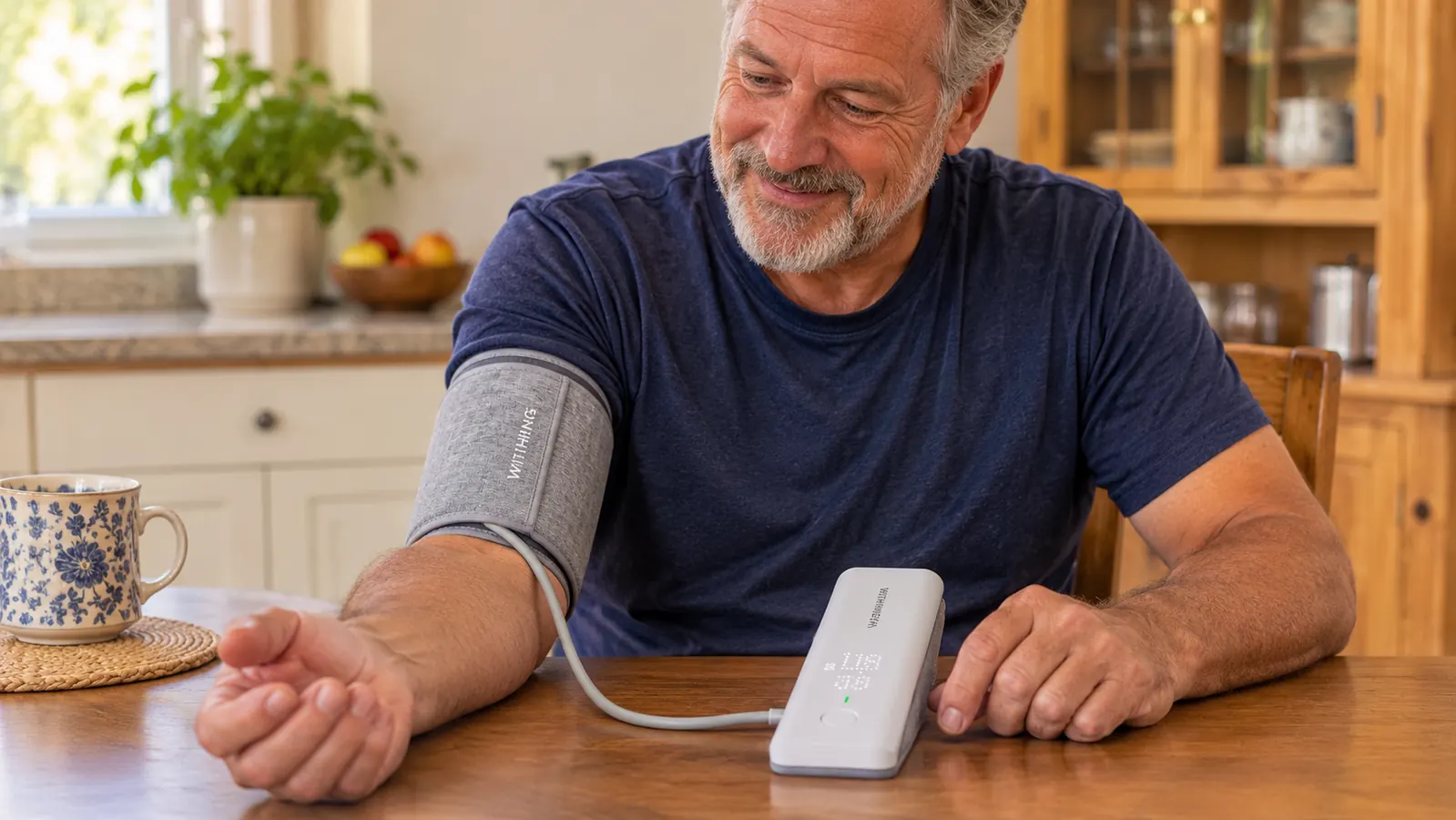
The cuff wraps and fastens with one hand, which is not true of every monitor I have tried. Gene's arm is bigger than mine and the band covers him too, 22 to 42 cm, and neither of us has had to fight with it. When it finishes a reading, the display shows the numbers in large digits and the case gives color-coded feedback, so you know roughly where you landed without squinting or reaching for your glasses. Then, when it syncs, the same reading shows up in the app and stays there.
Where my opinion shifts is in the middle of the routine. When it works, it is about forty seconds of my morning. When it does not sync, it is forty seconds plus ten minutes of me standing in the kitchen holding a phone at arm's length, which I have done more than once. The readings themselves have been consistent enough that I trust the log. The path those readings take to get into the app is the part I would warn a friend about.
I will say one thing about the shape of the routine, because it is the least glamorous sentence in this review. Sitting still before a reading is the part that makes the numbers worth anything, and it is the part I hate. The monitor does not hurry you and it does not scold you. It sits there while you wait, and then it gives you a number. If you are not going to sit still, you will not get a good log out of any device, and I would rather tell you that now than have you blame a machine.
What Nobody Tells You About the Cuff
The biggest thing left out of most reviews of any upper arm monitor is the size of your arm. The Withings BPM Connect ships with a band that covers 22 to 42 cm. Before I ordered it I measured around the middle of my upper arm with a cloth tape and wrote the number on a sticky note. Gene did the same. That ten minutes is the difference between a monitor you can use and a monitor you have to send back, and no app on earth makes up for a cuff that does not fit.
The other thing nobody mentions is that the unit weighs about 12.8 ounces and measures roughly 6.1 inches long by 2.36 wide by 2.16 thick. That is small enough to sit in a kitchen drawer next to the pens, and it is the reason I use it. A monitor that has to be docked and set up on a stand does not survive contact with a real morning. This one comes out, gets wrapped, gets used, and goes back.
What I would tell you plainly is that the cuff does the work and the electronics only report it. If you wrap it loose, or over a shirt sleeve, or with your arm hanging down, you will get a number that looks like bad news and is not. I did that twice early on and then read the small guide properly. Since then, arm on the table, feet flat, no talking, and the readings have been steady enough that my doctor stopped raising his eyebrows at them.
Two people, one band that runs 22 to 42 cm, twice a day for weeks. The cuff fit was the make or break in this house, not the app.
The App Is the Real Product, and That Cuts Both Ways
The BPM Connect is Wi-Fi and Bluetooth and it syncs to the Health Mate app. When the sync lands, this is a genuinely useful arrangement. I open the app at the end of a week and there is the whole log in order, with dates and times, and I can hand my phone to the nurse instead of a page of my own handwriting she has to squint at. For the specific job my doctor gave me, that is the feature that earns its place on the kitchen table.
When the sync does not land, the arrangement gets thin. The Withings monitor does not change, but my patience does. I have had mornings where the reading is on the display, clear as day, and the app does not show it until later, or until I open the app and let it catch up over Bluetooth. Nothing is actually lost. But there is a real difference between a monitor that records your readings and a monitor that records them after you go and fetch them.
There is a second thing the app does that I did not expect to care about. Because Gene and I both use the monitor, the readings land in the same place in date order, and I can see at a glance which ones were morning and which were evening. That is more useful than it sounds, because the morning numbers and the evening numbers in this house do not look alike, and seeing them side by side is the whole reason my doctor wanted them.
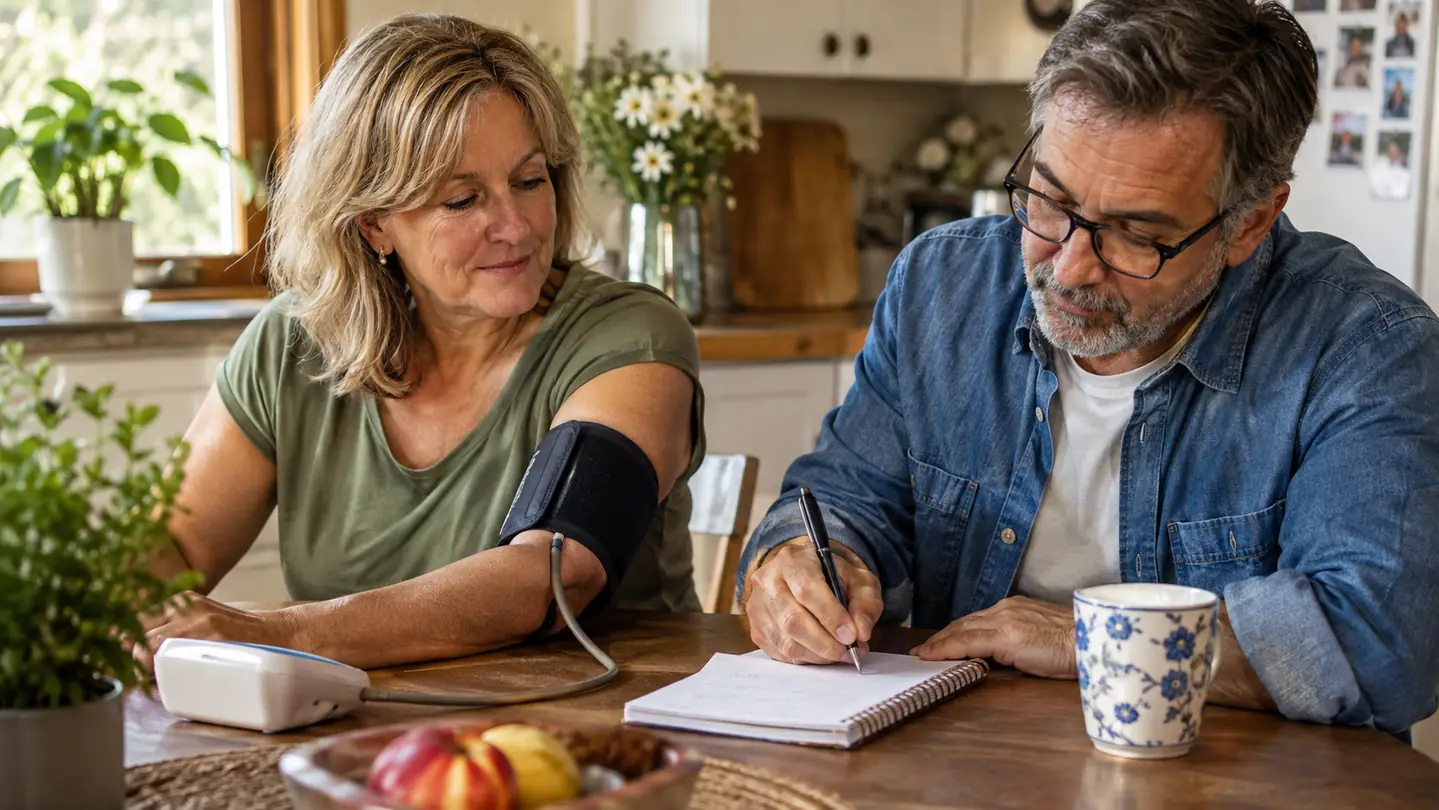
My advice here is simple and it is not a knock on the machine. Keep a paper notebook anyway. Write the number and the time on the day you take it. If the app and the notebook ever disagree, the notebook is right, because you were there when it happened. I am not a technical person and I worked that out the hard way.
Sharing It With Someone Who Does Not Read Instructions
The first week, Gene used it wrong twice and I used it wrong once. He wrapped the cuff over his shirt sleeve because he was in a hurry, and he let his arm hang at his side because nobody had told him not to. Both of those produce a number that will worry you for no reason at all. We sorted it out in a week with the little guide and one conversation, and since then it has been a two person device without any trouble. If you are buying this for a household of two, budget a week for everybody to learn it.
The size range does the heavy lifting. A band that runs from 22 to 42 cm is not a marketing number, it is the reason Gene and I can share one machine without buying a second cuff. Before this I had a wrist cuff that I never quite trusted, and I gave up on it inside a month. The upper arm cuff takes longer to put on and gives you something you can actually hand to a nurse.
The Parts That Frustrate Me
It runs on batteries, and a charger is included in the box. Batteries are the right call for something that sits in a drawer, but a low battery does not announce itself in a way that feels urgent until the readings start behaving strangely, and by then you are standing in the kitchen wondering whether the machine is off or you are. I keep spares in the drawer now. Gene thinks I am being dramatic. Gene has not been the one holding a cuff that will not wake up at 6:40 in the morning.
The Withings display is an LCD with large digits, which is the right choice for the people most likely to buy this, and I have no complaint there. My complaint is with the printed materials. The quick guide is thin enough that I missed the part about resting first, and I am a person who reads instructions. If you are buying this for a parent, sit with them for the first three readings. Not because the machine is complicated, but because the first three readings are where the habits get set for good.
There is also a two year manufacturer warranty, and I would tell you to keep the receipt somewhere you can find it. A folder, not a shoebox. I have not had to use it. But the fact that I know it exists, and know where the paper is, is part of why I stay calm about the batteries and the occasional slow sync.
What I Liked
- Cuff covers 22 to 42 cm, so it fits a wide range of arms including Gene's
- Wi-Fi and Bluetooth sync put the whole log in the Health Mate app in date order
- Color-coded feedback on the case tells you roughly where you landed before you open your phone
- Small and light at about 12.8 ounces, so it genuinely lives in the kitchen drawer
- Two year manufacturer warranty
- One-hand wrap and a short routine once you have the habit
Where It Falls Short
- Sync can lag, so the reading is on the display before it is in the app
- Runs on batteries, and a low battery is not as obvious as it should be
- The thin quick guide skips the resting period, which matters more than anything else in the box
- Measuring your arm is on you, and it is the step most likely to go wrong
What These Readings Are, and What They Are Not
I want to be careful here, because I am a retired bank teller, not a nurse. The numbers this monitor gives you are information to take to your doctor. They are not a diagnosis and they are not a decision you make alone at the kitchen table. What changed for me was not the number itself. It was having weeks of numbers on one page instead of one nervous reading in a cold exam room. My doctor could see the shape of my week instead of a single afternoon.
The color-coded feedback on the case is worth explaining to a nervous person before they start. It is a rough guide to where you landed, not a verdict, and I have watched it send Gene into a spiral over a reading he took with his arm hanging at his side. Take the reading properly, write it down, and let your doctor interpret it. That is the arrangement that has worked in this house, and it is the only arrangement I would recommend.
That is the honest case for a home monitor, and it is the case for this one. It produced a log my doctor could read at a glance, taken the way he asked, at the times he asked. Whether your numbers are good or bad is between you and your doctor. Whether the log is legible and complete is the machine's job, and on that job this one mostly delivers.
Who This Is For
This is for the person whose doctor said to check it at home for a few weeks and bring it in. It is for the couple who share one monitor and need a cuff that fits both arms. It is for anyone who wants the readings to end up in one place they can show someone, rather than on the back of an envelope that goes missing. If you are comfortable with an app and willing to keep a paper backup, this monitor will do the job you bought it for.
It is also for the person buying for a parent, with one condition. Measure their arm first, and sit with them for the first three readings. The machine is not difficult, but the setup is where the mistakes happen, and a frustrated 78 year old will put it in a drawer and leave it there. That drawer is the only real failure mode I have seen.
Who Should Skip It
If you want a monitor that never asks anything of you, skip it. It wants fresh batteries, a phone nearby now and then, and a few quiet minutes before you press anything. If your arms fall outside the 22 to 42 cm band, skip it and buy something sized for you. And if you already know in your heart that you will not keep a log, no monitor on the market will fix that, this one included. The device records. It does not sit still for you.
One more, and I mean this kindly. If you are the sort of person who will see a reading you do not like and start checking every twenty minutes, do not buy a home monitor at all without talking to your doctor first. That is not a comment on this machine. It is a comment on what a number sitting in your kitchen can do to a worried person at seven in the morning.
Measure your arm, then buy once and stop shopping
Twenty-two to 42 cm covers most adults, including the bigger arms in the house. Readings sync over Wi-Fi or Bluetooth to the Health Mate app, the case gives color-coded feedback, and the two year warranty is there if you need it. Check today's price on Amazon, but write the measurement down before you order.
Amazon Check Today's Price on Amazon →